Bruno Panucci RMT
Massage for Chronic Pain in Brantford: An Honest Look
Quick answer: Massage for chronic pain in Brantford, with Bruno Panucci RMT, is Registered Massage Therapy that aims to ease pain, tension, and the stress that feeds them, not to fix the underlying condition. When pain has lasted past the normal time for healing, the nervous system often stays switched on, so a good session is paced and client-led rather than forceful. Massage can support comfort and function as one part of a plan your physician leads, and the evidence for it is modest and honest. This page is general information, not medical advice.
Chronic pain is pain that lingers past the normal time for tissue to heal, often defined as pain lasting longer than three months (Hilton and colleagues, 2017). When pain persists that long, it stops being a simple alarm and becomes a pattern the nervous system learns to hold, which is exactly why forceful, dig-it-out massage tends to backfire. Bruno Panucci RMT has spent 25 years as a Registered Massage Therapist in Brantford, working with people whose pain has outlasted the injury that started it, across Brantford and the Brant County towns of Paris, St. George, Mt. Pleasant, and Burford. His approach is plain: massage for chronic pain is symptom support that sits alongside your medical care, built on the client-controlled pressure gradient rather than on how hard someone can push.
Bruno Panucci RMT, 25 years of practice: “I would rather be straight with people than sell them a miracle. Massage does not cure chronic pain, and anyone who tells you it does is guessing or selling. What it can do, on a good stretch of regular visits, is turn the volume down a little, loosen what is bracing, and give the nervous system a reason to stop bracing so hard. Some people get real relief from that. Others get a little, and a few get almost none. My job is to be honest about which one you are, and to keep the session gentle enough that we never make you worse chasing a win.”
In short: massage for chronic pain is Registered Massage Therapy that eases pain, muscle tension, and stress rather than treating the condition causing the pain. The relief tends to be modest, works best with some continuity, and always belongs alongside your physician’s plan, never in place of it.
6 min read
Why chronic pain is different from a fresh injury
Chronic pain is different from a fresh injury because the pain can outlast the thing that caused it. A cut or a strain hurts because tissue is damaged, and the hurt fades as the tissue heals. Chronic pain lingers past that point, and over time the nervous system can turn up its own sensitivity, so that ordinary pressure and ordinary movement start to register as genuine pain, a change researchers describe as central sensitization or wind-up (Savage and colleagues, 2008). Persistent pain also feeds a cycle: it disturbs sleep, raises anxiety and low mood, and tightens muscles, and that fatigue and tension then expand the pain further (Savage and colleagues, 2008). This is why a therapist who works a chronic-pain body the way they would work a weekend athlete’s stiff back often makes things worse. For Bruno Panucci RMT, the practical takeaway across 25 years in Brantford is simple: start gentle, move slowly, and treat the whole picture of tension and stress, not just the spot that hurts.
Can massage help chronic pain?
Massage can help some people with chronic pain feel better, and the honest framing matters more than the hopeful one. Massage is one of several physical, hands-on approaches that sit inside a broader pain-management plan rather than replacing it (Savage and colleagues, 2008). A common pattern in the non-drug research is telling: in a meta-analysis of mindfulness meditation for chronic pain, the benefit for pain itself was small, while the gains for mood and quality of life were clearer (Hilton and colleagues, 2017). That fits what Bruno sees in his Brantford in-home practice. Some clients find that regular Registered Massage Therapy eases their pain and loosens the muscles that have been guarding for months. Almost everyone finds it calms the stress and tension that chronic pain piles on, and since stress and pain amplify each other, easing one genuinely helps the other. Massage does not cure chronic pain, it does not remove toxins, and it does not speed healing. It supports symptoms, and it is worth pacing so the relief holds. A gentler, more relaxation-focused visit is often the better tool here, which is why finding a sustainable rhythm matters more than any single intense session.
What a chronic-pain massage session looks like
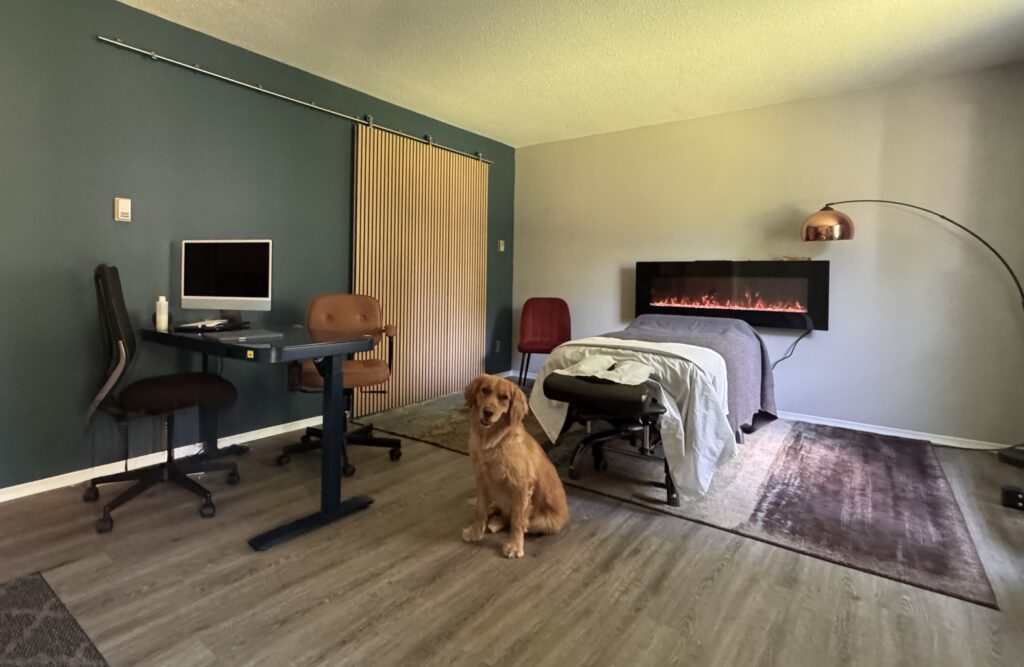
A chronic-pain massage session is built around one promise: you set the pressure, and you can adjust it, or stop, at any time. Because a sensitized nervous system can flare from too much too soon, Bruno starts lighter than most people expect, from the soft end of the soft-through-medium-to-deep scale, and adds pressure only if you ask for it. Deep work is on request and is rarely the right first tool for pain that has lasted months. Expect frequent check-ins rather than a silent hour, and know that a shorter session is a genuine option, not a lesser one. Treatment happens in the private treatment room at his Brantford in-home practice, draped to College of Massage Therapists of Ontario standards, with positioning supported by pillows and bolsters and side-lying available if lying flat is uncomfortable. Two friendly, calm dogs share the treatment room, and they can be kept out on request if you have allergies or simply prefer a quieter room. If it has been more than a few months since your last massage, take a little less pressure the first time, so you leave with pleasant tenderness rather than next-day soreness. The table below shows how common concerns change the way a session runs.
| Your concern | How the session adapts |
|---|---|
| Pain that flares easily, an overactive alarm | Pressure starts lighter than you think you want, and builds only if and when you ask. |
| Not sure how much you can take | Frequent check-ins and clear permission to slow down or stop at any point. |
| Low energy, limited stamina | A shorter session, around 30 to 45 minutes, is a valid choice, not a compromise. |
| Sore the day after past massages | We err gentle, note how you responded, and adjust the next visit to suit. |
| Positions that hurt | Supported positioning with pillows and bolsters, and side-lying if lying flat is uncomfortable. |
| Sensitive to a busy room | A quiet, low-lit room, and the two dogs kept out of the treatment room on request. |
How massage fits with your medical care
Massage for chronic pain works best as one part of a plan your physician leads, not as a plan of its own. Chronic pain is complex, and successful treatment is frequently a multidimensional process in which a combination of approaches, rather than any single one, works best (Savage and colleagues, 2008). Diagnosis, medication, and the overall management of your condition belong with your doctor or specialist; Registered Massage Therapy sits alongside that care as symptom support, the way gentle movement, paced activity, and good sleep habits do. There are also times to see your physician first: new, severe, or rapidly worsening pain, numbness or weakness, unexplained weight loss, or pain that follows a significant injury are reasons to get assessed before booking any massage. Bruno Panucci RMT is glad to work in step with what your healthcare team recommends, and he will tell you plainly when something is outside what massage can help. A 60-minute session at his Brantford in-home practice is $115, receipts work with most extended health plans, and because the practice runs from his own home the lower overhead keeps the price fair, so your benefits stretch further across a series of visits. If firmer, focused work does become part of the picture later, it is always offered rather than imposed, and you stay in control of the pressure the whole time.
Frequently asked questions
Does deep pressure work better for chronic pain?
Not usually, and often the opposite. When pain has lasted months, the nervous system is frequently more sensitive, so hard pressure can flare things rather than settle them. Bruno starts light and only goes deeper if you ask and it helps. You set the pressure, and you can change it or stop at any time. The goal is relief that lasts, not the hardest session you can survive.
How often should I get a massage for chronic pain?
There is no single rule, and pacing beats overdoing it. Many people find that regular, gentler sessions help more than occasional intense ones, since the benefits for chronic pain tend to be modest and hold better with some continuity. The right rhythm depends on your pain, your energy, and your budget. Bruno would rather help you find a sustainable pace than sell you a package.
Can massage cure my chronic pain?
No. Massage does not cure chronic pain, and it does not treat the condition causing it. What it can do is ease pain, loosen guarded muscles, and calm the stress and tension that make pain worse, as symptom support alongside your physician’s care. For some people that relief is meaningful, for others it is small. Bruno will be honest with you about which it seems to be.
Is massage safe if I take medication for my pain?
In most cases yes, and Registered Massage Therapy is meant to work alongside your medical care, not replace it. Keep your physician’s plan and your medication as they are, and tell Bruno about your condition and any medications so he can adapt the session. If your pain is new, severe, or changing quickly, see your physician before booking. This page is general information, not medical advice.
Book a chronic-pain massage with Bruno in Brantford
Bruno Panucci RMT offers gentle, client-led Registered Massage Therapy for people living with chronic pain at his in-home practice in Brantford, serving Brant County including Paris, St. George, Mt. Pleasant, and Burford, with occasional mobile visits on request. Sessions are $115 for 60 minutes, and a shorter or lighter session is always a valid choice. Receipts are provided for most extended health plans, with direct billing available for most insurers.
Text Bruno at 519-753-5544 (he prefers texts), call the same number, or book online. If you need a time the calendar does not show, a shorter session, or a 90-minute session, text him directly. He can often rearrange to fit you in, sometimes the same day. And if a bad day means you need to cancel, that is completely understood.
A note on scope: This page is general information, not medical advice. Chronic pain has many causes, and its diagnosis and management belong with your physician; massage is symptom support, not a treatment or a cure. See your physician first for pain that is new, severe, or rapidly worsening, or that comes with numbness, weakness, or unexplained weight loss, and stop and speak with your healthcare provider if massage ever increases your pain. Bruno Panucci is a Registered Massage Therapist (RMT), and works within current RMT scope of practice.
Related reading
- gentle support for widespread pain
- firmer work, offered not imposed
- pacing a sustainable series of visits
- rates and session lengths
Sources
- Hilton L, Hempel S, Ewing BA, Apaydin E, Xenakis L, Newberry S, Colaiaco B, Maher AR, Shanman RM, Sorbero ME, Maglione MA. Mindfulness meditation for chronic pain: systematic review and meta-analysis. Annals of Behavioral Medicine, 2017; 51: 199-213. doi.org/10.1007/s12160-016-9844-2
- Savage SR, Kirsh KL, Passik SD. Challenges in using opioids to treat pain in persons with substance use disorders. Addiction Science and Clinical Practice, 2008; 4: 4-25. doi.org/10.1151/ascp08424
- College of Massage Therapists of Ontario, Standards of Practice.
- Government of Ontario. Massage Therapy Act, 1991, S.O. 1991, c. 27. ontario.ca/laws/statute/91m27