Bruno Panucci RMT
Is Deep Tissue Massage Supposed to Hurt? An RMT Answers
Quick answer: Is deep tissue massage supposed to hurt? No, not the way people fear. Effective firm work feels like a strong, manageable ache you can breathe through, not sharp or electric pain. Bruno Panucci RMT, a Registered Massage Therapist in Brantford, works the pressure you choose, from soft through medium to deep, and deep is on request, never the default. You set it, and can stop at any time. This page is general information, not medical advice.
Deep tissue massage is firm, sustained pressure applied to the deeper layers of muscle and fascia to ease long-held tension and stubborn tight spots. The common worry, that it has to hurt to work, is the myth this page takes apart. Bruno Panucci RMT has spent 25 years treating backs, necks, and shoulders across Brantford and Brant County, including Paris, St. George, Mt. Pleasant, and Burford, and his honest answer is that effective deep work feels intense but manageable, never like an injury. You can read what his deep-tissue sessions actually involve, but the short version is that pressure is a dial you control, not a test you endure. Slow fascial-style work gets its own honest page: myofascial release without the mystique.
Bruno Panucci RMT, 25 years of practice: “The client who worries me most is the one gripping the table and breathing through their teeth to be polite. They think toughing it out is what you are supposed to do. I would so much rather you tell me. In 25 years I have never once thought less of anyone for saying that is too much. When you brace against me, your muscles fight back and I end up working against a wall. Say something, I ease off, and we both get further.”
In short: deep tissue massage should feel like a good ache you can breathe through, not a sharp pain that makes you tense up. A little tenderness the next day is normal. Bruising, sharp or electric pain, and being sore to move all mean the pressure went too far.
6 min read
Is deep tissue massage supposed to hurt?
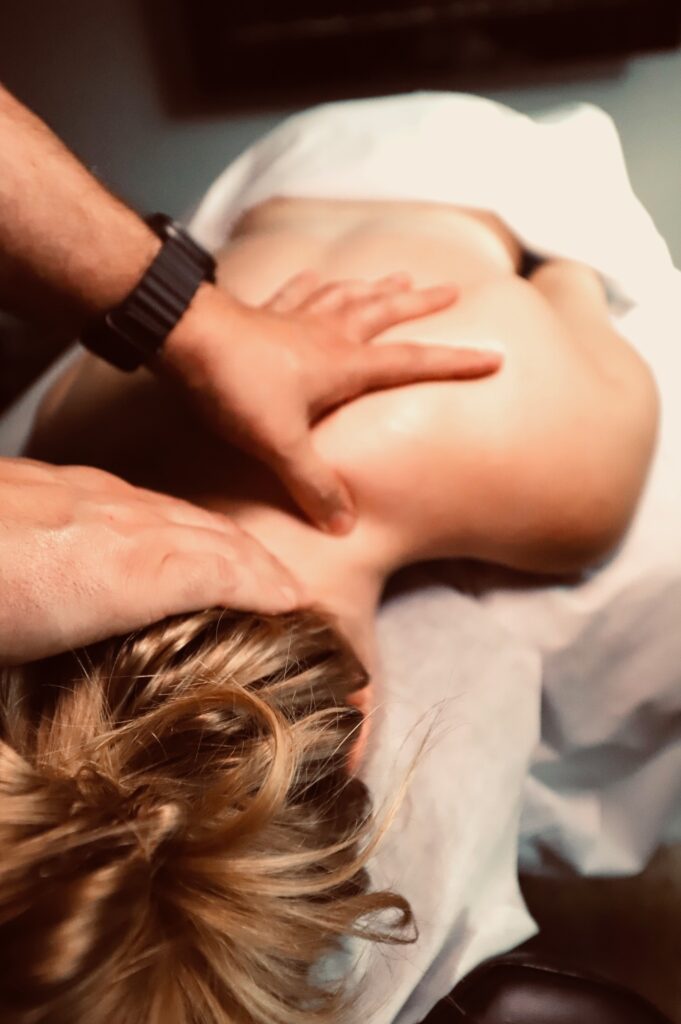
Is deep tissue massage supposed to hurt? The honest answer is no, not in the way people brace for. You set the pressure. You can adjust it, or stop, at any time. Effective deep tissue work lives at the edge of comfortable, a strong sensation you can still breathe steadily through, often called a good ache. That is different from pain that makes you flinch, hold your breath, or pull away. With Bruno Panucci RMT, pressure runs on a gradient, from soft through medium to deep, and the deepest end is offered on request, never imposed. A lifelong weight-training background lets him reach the deep layers with control, so the aim is precision, not force. If a technique only “works” by hurting you, it is not a technique, it is just pressure.
Good ache or bad pain: how can you tell in the moment?
Telling a good ache from bad pain is mostly about what your body does on its own. A good ache lets you keep breathing slowly, the muscle softens and gives, the feeling is dull and spreads out, and it fades the moment the pressure lifts. Bad pain does the opposite: your breath catches, the muscle guards and braces instead of releasing, the sensation is sharp, hot, or electric, and it lingers after the hands move on. The table puts the two side by side, so you know what to notice and what to say.
| What to notice | Good ache (keep going) | Bad pain (ease off) |
|---|---|---|
| Your breathing | Stays slow and easy | Catches, and you hold it |
| The muscle | Softens and gives | Guards, braces, and tightens |
| The sensation | Dull, warm, spreads out | Sharp, hot, or electric, stuck in one point |
| The next day | Pleasantly worked, like after a workout | Bruised, or sore to move |
| What to say | “That’s a good spot, stay there” | “That’s too much, please ease off” |
None of this is a test you can fail. If you are not sure which one you are feeling, say so, and Bruno will back the pressure off until it is clearly a good ache again.
Is “no pain, no gain” true for massage?
No pain, no gain is a gym slogan, not a rule of massage therapy, and the research does not support applying it to the treatment table. In the related area of therapeutic exercise, a 2017 systematic review and meta-analysis in the British Journal of Sports Medicine found that, beyond the short term, working into pain gave no clear advantage over pain-free approaches for pain, function, or disability. Massage has its own evidence that the benefit is not about how much it hurts. A 2015 randomized trial found that massage over a tender spot raised its pain-pressure threshold, meaning it took more pressure before the spot felt sore, and the effect showed up even when the therapist worked the opposite limb. That points to the nervous system, not brute force, as part of how massage settles an irritable muscle. So bruising is not a badge of honour, and a therapist grinding you into the table is not proof of better work.
How do you speak up during a deep tissue massage?
Speaking up during a deep tissue massage is expected, not rude, and it is the surest way to get a session that helps. You do not need any massage vocabulary. Plain words work: “that’s too much, ease off,” “a little lighter here,” “that spot is great, stay there,” “that one’s sharp, skip it,” or simply “stop for a second.” Bruno checks in as he moves between areas and changes pressure, and consent is ongoing, not a form you sign once at the door. If you are new to this, the intake and consent walkthrough explains how that works from the first minute. Draping follows College of Massage Therapists of Ontario standards, so only the area being worked is uncovered, and you stay in charge of the pace.
Why are you sore the day after, and when does it mean too much?
Some tenderness the day after a massage is normal, especially after deeper work, and it is not the same as being hurt. Think of it as the pleasant heaviness that follows a good workout: the muscle was worked and is settling. What you do not want is to wake up bruised, stiff, or sore to move, which is the sign the pressure went past useful. Here is the advice Bruno gives most often: if it has been more than a few months since your last massage, take a little less pressure the first time. Like getting back on a bike after a winter off, you feel great during the ride and sore afterward. Going lighter to start turns that into pleasant tenderness instead of real soreness, and you can build up next visit. If you were sore to move after your last session, treat that as your cue to dial the pressure back a notch, not a reason to skip massage. There is a full guide to what post-massage soreness should and should not feel like, including the signs that mean more.
Frequently asked questions
Should a deep tissue massage leave bruises?
No. Bruising is a sign the pressure was too high, not proof the work was effective. A good deep tissue massage in Brantford with Bruno Panucci RMT should leave you feeling worked, maybe a little tender the next day, but not black and blue. If you bruise easily or take blood thinners, tell Bruno so he can adjust.
Does deeper pressure always work better?
Not necessarily. Research does not show that more pain means more benefit, and comfortable, well-placed pressure can change a tight muscle just as well. Deep work is available on request when your body genuinely wants it, but it is a choice, never a requirement.
It has been months since my last massage. Should I ask for less pressure?
Yes, that is a smart move. Like riding a bike after a winter off, you can feel great during the session and sore afterward. Taking a little less pressure your first time back turns next-day soreness into pleasant tenderness, and you can always build up on your next visit.
How do I tell my therapist the pressure is too much?
Just say so, plainly. “That’s too much, ease off,” or “a little lighter here” is all it takes, and no good Registered Massage Therapist will be offended. Bruno would far rather you speak up than grip the table and tough it out, because a braced muscle only fights the work.
Book a deep tissue massage with Bruno in Brantford
Bruno Panucci RMT offers deep tissue and therapeutic massage at his in-home practice in Brantford, serving Brant County including Paris, St. George, Mt. Pleasant, and Burford, with occasional mobile visits on request. Sessions are $115 for 60 minutes, the pressure is always yours to set, and receipts are provided for most extended health plans.
Text Bruno at 519-753-5544 (he prefers texts), call the same number, or book online. Need a time the calendar does not show, or a 90 minute or two hour session? Text him directly. He can often rearrange to fit you in, sometimes the same day.
A note on scope: This page is general information, not medical advice. Registered Massage Therapy can support comfort and function, but it does not diagnose or treat any condition, and it should never involve pain you cannot easily breathe through. If you have a health concern or new or severe pain, speak with your physician first. Bruno Panucci is a Registered Massage Therapist and works within current RMT scope of practice.
Related reading
- recovery work for training bodies
- the truth about muscle knots
- low back sessions, pressure included
- session rates
Sources
- Smith BE, Hendrick P, Smith TO, Bateman M, Moffatt F, Rathleff MS, Selfe J, Logan P. Should exercises be painful in the management of chronic musculoskeletal pain? A systematic review and meta-analysis. British Journal of Sports Medicine, 2017; 51(23): 1679-1687. doi.org/10.1136/bjsports-2016-097383
- Aboodarda SJ, Spence AJ, Button DC. Pain pressure threshold of a muscle tender spot increases following local and non-local rolling massage. BMC Musculoskeletal Disorders, 2015; 16: 265. doi.org/10.1186/s12891-015-0729-5
- College of Massage Therapists of Ontario, Standards of Practice.