Bruno Panucci RMT
Muscle Knots: What They Are and How Massage Helps
Quick answer: A muscle knot is a tender, taut spot in a muscle, often called a myofascial trigger point. It is not literally knotted muscle. Bruno Panucci RMT treats these tight spots at his Brantford in-home practice for $115 per 60 minute session, using the pressure you choose, from soft through medium to deep. Massage often eases a knot in the short term, though the exact biology is still debated. This page is general information, not medical advice.
A muscle knot is the plain-language name for a tender, taut spot in a muscle, the kind you press on and think “there it is.” In research it is usually discussed as a myofascial trigger point. Bruno Panucci RMT, a Registered Massage Therapist in Brantford, has spent 25 years finding these spots on desk workers, trades, and athletes across Brantford and Brant County, from Paris and St. George to Mt. Pleasant and Burford. What is clearer than the biology is that knots cluster in predictable places, especially in the desk-tension pattern where knots breed, and that hands-on pressure often eases them.
Bruno Panucci RMT, 25 years of practice: “After 25 years I could almost guess your job from where your knots are. Right-handed mouse users get one in the right upper trap, just inside the shoulder blade, nearly every time. Hairdressers and dentists get them in the neck and forearm, drivers in the glutes. The body keeps an honest record of how you spend your days, and I have read it on a lot of backs.” Typing forearms get their own deep-dive on the carpal tunnel and wrist page.
In short: a muscle knot, or myofascial trigger point, is a small tender, taut band within a muscle that can feel sore locally and sometimes refer sensation nearby. Research supports short-term relief from massage and sustained pressure, while the exact biological cause of trigger points remains debated.
6 min read
What is a muscle knot, really?
A muscle knot is a small patch of muscle that feels firm, tender, and tight compared with the tissue around it. Press an overworked upper shoulder and you may feel a ropey band with a sore point in it. That sore point is what clinicians call a myofascial trigger point, and pressing it can ache locally or refer a dull sensation nearby. Here is the honest part: researchers still debate what a trigger point physically is. The usual explanations involve muscle fibres that will not fully relax and local changes in chemistry and nerves, but none is settled. So a knot is real and tender, you can feel it, yet its exact biology stays an open question, and Bruno Panucci RMT would rather say so than pretend otherwise. If you have wondered about cupping and what it actually does, there is an honest page on it. The targeted approach, trigger point therapy, is explained on its own page. The underlying question, how massage actually works, is explained without the mysticism. The bigger question, why muscles feel tight all the time, has its own honest unpacking.
Where do muscle knots usually form?
Muscle knots tend to form in the muscles that hold a posture or repeat a motion all day, so they cluster in a few predictable spots: the upper trapezius and levator scapulae at the neck and shoulder, the forearms, the glutes and hips, and the muscles beside the spine. The pattern usually matches how you spend your days more than any injury, so the fix is part hands-on work, part habit change.
| Where the knot sits | The daily habit behind it | What tends to help |
|---|---|---|
| Upper trapezius (shoulder top) | Hunching at a keyboard, cradling a phone, a one-sided bag | Shoulder rolls, a headset, focused trap and neck massage |
| Levator scapulae (neck to shoulder blade) | Turning to a side monitor, looking down at a phone | Centre the screen, gentle neck stretches, hands-on work |
| Forearms and hands | Mouse and keyboard, hairdressing, gripping tools | Micro-breaks, wrist stretches, forearm massage |
| Glutes and hips | Long driving, hours of sitting | Walk hourly, hip stretches, deeper glute work |
| Erector spinae (beside the spine) | Prolonged sitting, repetitive bending or lifting | Change position often, core movement, back massage |
Why do muscle knots form?
Muscle knots usually form from sustained, low-grade load rather than a single dramatic injury. When a muscle holds a light contraction for hours, the same fibres stay switched on without rest, and tender, taut spots grow out of that steady demand. Three everyday drivers repeat: posture that parks a muscle in one position, repetition that fires the same fibres over and over, and stress, which quietly raises muscle tone in the neck, shoulders, and jaw. That is why knots love desk work, assembly work, and hard weeks, and why Bruno Panucci RMT treats the tender spot and asks what in your day keeps rebuilding it.
What does massage actually do for a knot?
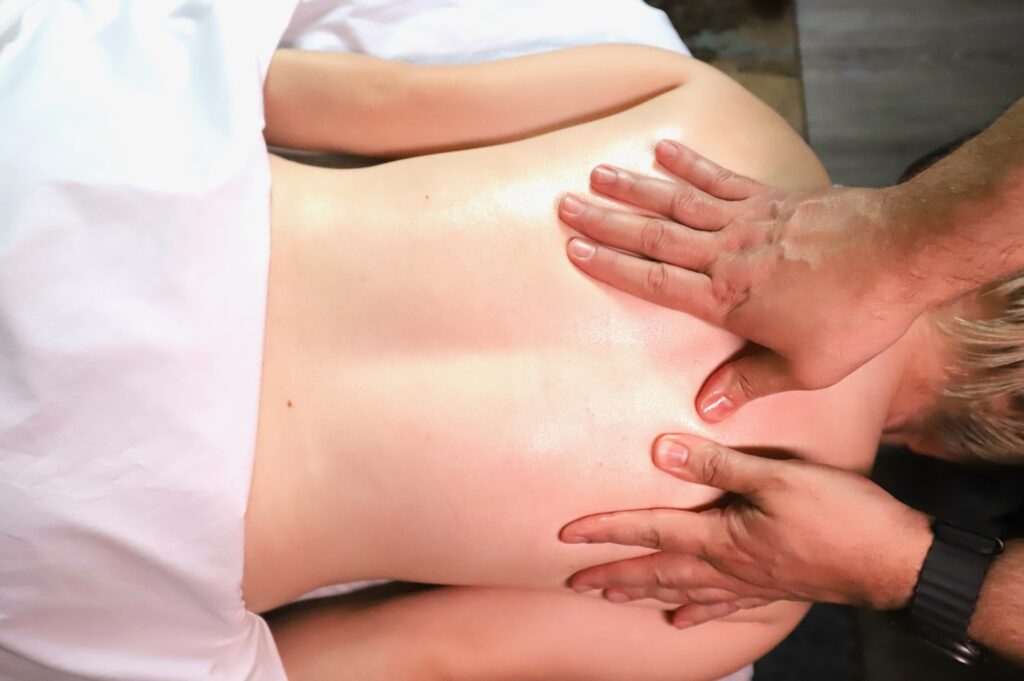
Massage for a muscle knot means applying sustained, focused pressure to the tender spot and easing the muscle around it. You set the pressure. You can adjust it, or stop, at any time. Bruno Panucci RMT works along the gradient you choose, from soft through medium to deep, with the deepest pressure available on request and never the default. The honest evidence: short-term relief from massage is reasonably well supported and matches what clients report, while the mechanism is still being researched. A narrative review by Vigotsky and Bruhns (2015) concluded that the pain-relieving effects of manual therapy are not fully understood and seem to work largely through the nervous system’s own pain-dampening pathways, not by physically untangling anything. A broader review (Clar and colleagues, 2014) rated the evidence for musculoskeletal complaints as modest but real. So massage can settle a knot for a while, but no honest therapist claims one session dissolves it for good. This is sustained, controlled pressure work, matched to what your muscle will accept that day. The slow, sustained style itself is unpacked in myofascial release, explained. If you own a roller, a foam roller versus massage is worth a read.
What can you do about a muscle knot between sessions?
Between sessions, self-care for muscle knots is simple and low-risk: move, warm, and break up the load. Gentle movement keeps the tight area from settling into a held position, and heat, a warm shower or a heat pack, helps a guarded muscle relax enough to move. Most useful of all are breaks: standing and shifting position every half hour interrupts the sustained load that built the knot. None of this is a cure, and grinding hard into a knot with a ball or tool can leave it more irritated, not less. If a spot keeps returning to the same place, the habit behind it, not the spot, is what to change.
When is a muscle knot something to see a doctor about?
Most muscle knots are harmless and safe to treat, but a few things that feel like a knot are not. See your physician rather than booking a massage if any of these are true:
- A lump that persists for weeks, grows, or feels hard, fixed, or steadily larger.
- Numbness, tingling, or weakness in an arm or leg alongside the sore spot.
- Pain that is severe, unexplained, or steadily worsening rather than tied to activity.
- A lump paired with fever, night sweats, or unexplained weight loss.
- A new lump after an injury with significant swelling or bruising.
None of these mean massage is ruled out forever, only that “knot” is the wrong assumption until a physician checks for something that needs different care. For the ordinary tender spots most people carry from work and stress, massage is a reasonable, low-risk place to start.
Frequently asked questions
Are muscle knots real, or is that just a figure of speech?
The tender, taut spot is real and you can feel it. What is debated is the biology behind it. Researchers call it a myofascial trigger point and still argue over what physically causes it, but the sore spot is not imaginary.
Can a massage get rid of a muscle knot permanently?
Usually not in one session, and any therapist who promises that is overselling. Massage often eases a knot for days to weeks. Lasting change comes from also shifting the posture, repetition, or stress that keeps rebuilding it.
Does getting rid of a knot have to hurt?
No. You set the pressure, from soft through medium to deep, and research does not show that more pain means better results. Effective knot work should feel like a manageable, good ache you can breathe through, not sharp pain. Bruno keeps the deepest pressure on request only.
How much is a session with Bruno for muscle knots in Brantford?
A 60 minute session at Bruno Panucci RMT’s Brantford in-home practice is $115, kept steady by low overhead. Because he is a Registered Massage Therapist, your receipt is accepted by most extended health plans, so you usually pay only your plan’s portion.
Book a muscle-knot massage with Bruno in Brantford
Bruno Panucci RMT treats muscle knots and everyday tension at his in-home practice in Brantford, serving Brant County including Paris, St. George, Mt. Pleasant, and Burford, with occasional mobile visits on request. Sessions are $115 for 60 minutes, with receipts for most extended health plans and direct billing available for most insurers.
Text Bruno at 519-753-5544 (he prefers texts), call the same number, or book online. Need a time the calendar does not show, or a 90 minute or two hour session? Text him directly. He can often rearrange to fit you in, sometimes the same day.
A note on scope: This page is general information, not medical advice. Registered Massage Therapy can ease muscle knots and tension, but it does not diagnose or cure any condition, and results vary. For the warning signs listed above, or any new, severe, or unexplained symptoms, see your physician first. Bruno Panucci is a Registered Massage Therapist and works within current RMT scope of practice.
Related reading
- how hard knot work should feel
- trigger points and headaches
- back-focused sessions
- what a session costs
Sources
- Vigotsky AD, Bruhns RP. The Role of Descending Modulation in Manual Therapy and Its Analgesic Implications: A Narrative Review. Pain Research and Treatment, 2015; 2015: 292805. doi.org/10.1155/2015/292805
- Clar C, Tsertsvadze A, Court R, Lewando Hundt G, Clarke A, Sutcliffe P. Clinical effectiveness of manual therapy for the management of musculoskeletal and non-musculoskeletal conditions: systematic review and update of UK evidence report. Chiropractic & Manual Therapies, 2014; 22: 12. doi.org/10.1186/2045-709X-22-12
- College of Massage Therapists of Ontario, Standards of Practice.