Bruno Panucci RMT
Foam Rolling vs Massage: What Each One Actually Does
Quick answer: Foam rolling and massage therapy do related but different jobs. Foam rolling is a self-care tool you use on yourself, and research suggests it can ease muscle soreness and briefly improve flexibility. Registered Massage Therapy is a regulated, hands-on assessment and treatment delivered by a therapist who can reach what a roller cannot and adjust to your body in real time. Bruno Panucci RMT offers massage therapy in Brantford at $115 for 60 minutes, and he sees the roller as a useful companion to treatment, not a replacement. This page is general information, not medical advice.
People compare foam rolling vs massage because both promise looser, less sore muscles, and one is free after the first purchase while the other is a booked appointment. Foam rolling is a form of self-myofascial release, meaning you press your own body weight against a firm cylinder to work through tight tissue. Registered Massage Therapy is a regulated health profession delivered by a therapist, defined under Ontario’s Massage Therapy Act, 1991 as the assessment and treatment of the body’s soft tissue and joints. Bruno Panucci RMT has practised for 25 years, is registered with the College of Massage Therapists of Ontario (CMTO), and treats clients from his in-home practice in Brantford, serving Brant County towns including Paris, St. George, Mt. Pleasant, and Burford. If you want to know how hands-on work targets the stubborn spots a roller skims over, his page on what massage does for muscle knots goes deeper.
Bruno Panucci RMT, 25 years of practice: “I tell clients to keep their foam roller. It is a good habit between appointments, the same way stretching is. What it cannot do is feel what is happening the way a trained hand does, or reach a deep hip rotator, or hold pressure at exactly the angle a knotted muscle needs. A roller does one blunt thing to whatever you lean on it. I do a hundred small, adjusting things based on what your tissue is actually telling me. Both have a place. I would rather you use both than think one replaces the other.”
In short: foam rolling is self-myofascial release you perform on yourself with a firm cylinder, useful for general soreness and a quick pre-workout warm-up. Massage therapy is a regulated, hands-on assessment and treatment that reaches deeper, adapts to your body, and can address specific problem areas a roller cannot target. They work well together, and neither one cures an injury.
6 min read
What is the difference between foam rolling and massage?
Foam rolling and massage differ in who does the work and how much it can adapt. Foam rolling is self-myofascial release: you control a firm roller with your own body weight, pressing along a muscle group to work through tension. It is a tool, and it does the same broad thing to whatever you place on it. Registered Massage Therapy is delivered by a therapist trained to assess your soft tissue first, then treat it hands-on, changing depth, angle, speed, and technique moment to moment based on what the tissue is doing. Under the Massage Therapy Act, 1991, that assessment-and-treatment role is what defines the regulated profession, and it is the part a roller structurally cannot replicate. Foam rolling is maintenance you do for yourself, and massage therapy is treatment a Registered Massage Therapist does with you. How a massage gun versus hands-on work compare is laid out on its own page.
| Aspect | Foam rolling | Registered Massage Therapy |
|---|---|---|
| Who does it | You, on yourself | A Registered Massage Therapist |
| Adaptability | One broad pressure on whatever you lean on | Depth and technique adjusted moment to moment |
| Reach | Large surface muscles you can position over the roller | Deep and awkward areas, including specific spots you cannot target yourself |
| Assessment | None | Hands-on assessment before and during treatment |
| Best use | Daily maintenance, warm-up, general soreness | Targeted tension, problem areas, focused relief |
| Cost | One-time purchase | $115 for 60 minutes, receipts for most extended health plans |
What is foam rolling actually good for?
Foam rolling is genuinely useful for a few specific things, and the honest research picture is modest rather than miraculous. In a warm-up comparison of trained athletes, Ormeno and Driller (2025) found that foam rolling was associated with lower muscle soreness and a small gain in ankle mobility, though it did not improve, and in some measures slightly reduced, explosive jump performance compared with a dynamic warm-up alone. Gaias and colleagues (2026) reported that self-myofascial release increased posterior-chain flexibility without reducing knee-extensor force, calling the effect real but preliminary given a small sample. In a six-month study of cyclists, Posch and colleagues (2026) found foam rolling did not raise VO2max but did improve some markers of metabolic efficiency, describing it as a valuable supplemental recovery tool rather than a performance transformer. The pattern across studies is consistent: foam rolling helps soreness and short-term flexibility and supports recovery, but it is a maintenance habit, not a fix for a specific problem. If your soreness keeps returning after every hard session, that is usually the signal to book targeted recovery-focused massage rather than roll harder.
What does hands-on massage add that a roller cannot?
Hands-on massage adds three things a foam roller structurally cannot: assessment, reach, and real-time adjustment. A Registered Massage Therapist feels what is happening in the tissue and changes the treatment accordingly, working a deep hip rotator or a spot beside the shoulder blade that you simply cannot position over a cylinder. That adaptability is why massage therapy is regulated under the Massage Therapy Act, 1991 and foam rolling is not. On soreness specifically, the evidence favours skilled touch: Hou and colleagues (2026), in a network meta-analysis of recovery strategies, found massage among the more effective options for easing early delayed-onset muscle soreness after hard exercise. At Bruno Panucci RMT’s in-home practice in Brantford, the pressure is always yours to choose, from soft through medium to deep, and deep pressure is offered on request, never imposed. You set the pressure, and you can adjust it, or stop, at any time. That is the difference between a tool that does one blunt thing and a therapist responding to your body, and it is worth knowing how firm that pressure should feel before you book.
Should you use foam rolling and massage together?
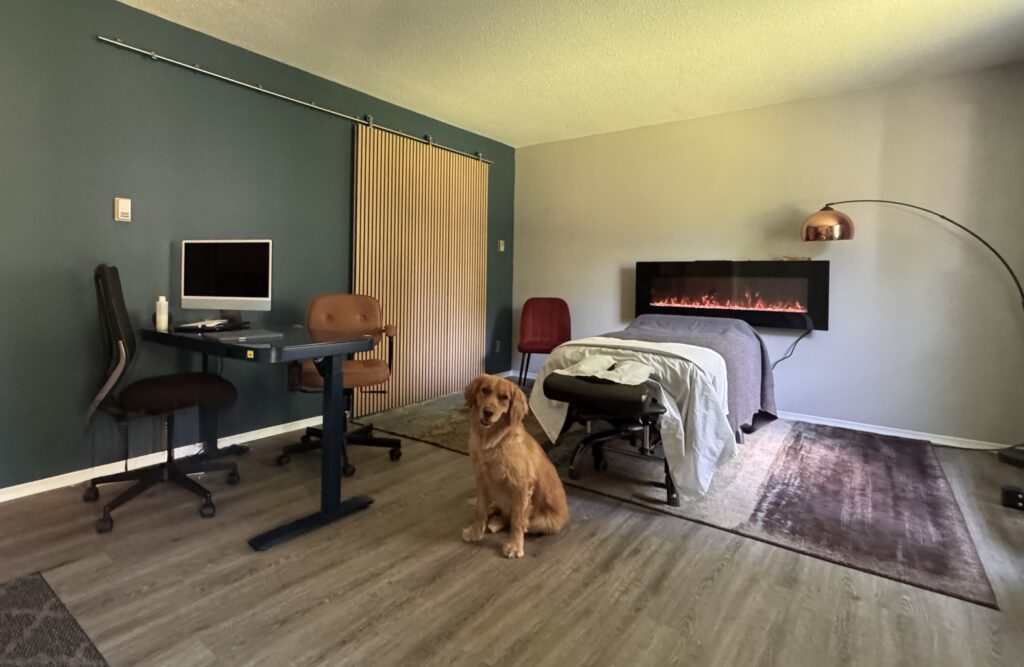
Foam rolling and massage work best as a pair, not as rivals, and using both is what Bruno actually recommends. The simple division of labour is this: foam rolling is the daily and pre-workout maintenance you do on your own, keeping large muscle groups loose and easing routine soreness, while Registered Massage Therapy is the periodic, targeted work that reaches the spots a roller misses and treats a specific problem area. Posch and colleagues (2026) framed foam rolling exactly this way, as a supplemental tool for ongoing recovery and maintenance rather than a standalone solution. Think of the roller as brushing your teeth and massage as the cleaning, both belong, and neither replaces the other. If you roll regularly and still feel a knot that will not release, that is the moment a therapist earns their appointment. Two friendly, calm dogs share Bruno’s treatment room, and clients with allergies or a preference can ask him to keep them out.
Which should you choose for your problem?
Choosing between foam rolling and massage comes down to whether your issue is general or specific. For everyday tightness, mild post-workout soreness, and staying loose before training, a foam roller is a sensible, low-cost first move, and the research supports that modest role. For a persistent knot, a deep area you cannot reach, tension that keeps returning to the same place, or when you want the pressure worked precisely and adjusted as you go, a Registered Massage Therapist is the better tool. Taghidoust Chahardeh and colleagues (2026) found that foam rolling changed only some narrow aspects of muscle function and was not a universal performance enhancer, which is a fair reminder that the roller is not built to fix targeted problems. One honest limit applies to both: neither foam rolling nor massage diagnoses or cures an injury. New, severe, or unexplained pain, numbness, weakness, or pain after real trauma belongs with your physician first. When the fit is hands-on work, Bruno Panucci RMT charges $115 for 60 minutes at his Brantford in-home practice, and you can text him to book the targeted session a roller cannot deliver.
Frequently asked questions
Is foam rolling as good as a massage?
Not quite, and they are built for different jobs. Foam rolling is good self-care for general soreness and a quick warm-up, but it cannot assess your tissue, reach deep or awkward areas, or adjust the way a therapist’s hands do. For a specific problem area, hands-on massage does more. For daily maintenance, a roller is a sensible companion between appointments.
Can foam rolling replace seeing a massage therapist?
No. A foam roller is a maintenance tool you use on yourself, while Registered Massage Therapy is a regulated, hands-on assessment and treatment. Rolling can keep large muscles loose between sessions, but it will not reach or release the specific spots a therapist can. Bruno Panucci RMT recommends using both rather than treating one as a replacement for the other.
Does foam rolling actually do anything, according to research?
Yes, but modestly. Studies suggest foam rolling can ease muscle soreness and briefly improve flexibility, and it supports recovery as a supplemental habit. What the research does not show is foam rolling fixing a specific injury or reliably boosting performance. Treat it as useful maintenance, not a cure, and see your physician for any new or unexplained pain.
How much does a massage cost in Brantford compared to a foam roller?
A foam roller is a one-time purchase, and a session with Bruno Panucci RMT is $115 for 60 minutes at his in-home practice in Brantford, with receipts most extended health plans accept. They serve different purposes, so most people who use a roller at home still book massage therapy for the targeted work a roller cannot do.
Book a massage with Bruno in Brantford
If a persistent knot or a spot you cannot reach needs hands-on work, Bruno Panucci RMT provides Registered Massage Therapy at his in-home practice in Brantford, serving Brant County including Paris, St. George, Mt. Pleasant, and Burford, with occasional mobile visits on request. Sessions are $115 for 60 minutes, receipts work with most extended health plans, and direct billing is available for most insurers.
Text Bruno at 519-753-5544 (he prefers texts), call the same number, or book online. Need a time the calendar does not show, or a 90 minute or two hour session? Text him directly. He can often rearrange to fit you in, sometimes the same day.
A note on scope: This page is general information, not medical advice. Foam rolling and Registered Massage Therapy can support comfort and ease muscle soreness, but neither diagnoses or cures any condition. For new, severe, or unexplained pain, numbness, weakness, or pain after an injury, speak with your physician first. Bruno Panucci is a Registered Massage Therapist (RMT), and works within current RMT scope of practice.
Related reading
- why a knot keeps coming back
- massage for training and recovery
- how much pressure is the right amount
Sources
- Ormeno L, Driller M. Does Massage Gun or Foam Roller Use During a Warm-Up Improve Performance in Trained Athletes? Sports, 2025; 13(9): 282. doi.org/10.3390/sports13090282
- Gaias D, Martínez-Serrano A, Sanz-Matesanz M, Blanco-Luengo D, Martínez-Aranda LM. Comparative Effects of an Acute Bout of Self-Myofascial Release on Quadriceps Function and Flexibility. Healthcare, 2026; 14(6): 757. doi.org/10.3390/healthcare14060757
- Posch D, Antretter M, Burtscher M, Faulhaber M. Chronic Self-Myofascial Release in Road Cyclists: Effects on Cardiorespiratory Capacity, Metabolism, and Mechanical Power. Sports, 2026; 14(2): 82. doi.org/10.3390/sports14020082
- Hou C, Yin W, Qiao F. Acute and Delayed Effects of Post-Exercise Recovery Strategies on Explosive Performance and Markers of Muscle Damage: A Systematic Review and Network Meta-Analysis. Healthcare, 2026; 14(10): 1321. doi.org/10.3390/healthcare14101321
- Taghidoust Chahardeh S, Hosseini SH, Shamsi Majelan A. Acute effects of three warm-up protocols on drop jump biomechanics in elite Taekwondo athletes: An IMU-based analysis. PLOS ONE, 2026; 21(1): e0351884. doi.org/10.1371/journal.pone.0351884
- College of Massage Therapists of Ontario, Standards of Practice.
- Government of Ontario. Massage Therapy Act, 1991, S.O. 1991, c. 27. ontario.ca/laws/statute/91m27