Bruno Panucci RMT
Trigger Point Therapy in Brantford: Working the Knot’s Source
Quick answer: Trigger point therapy is focused, sustained pressure held on a tight, tender spot in a muscle until it eases, and Bruno Panucci RMT uses it within a regular Registered Massage Therapy session in Brantford, not as a separate service or upcharge. Research suggests this kind of sustained compression can ease muscle pain in the short term, though the evidence is modest. It is folded into the standard $115 session, at the pressure you choose. This page is general information, not medical advice.
Trigger point therapy is a hands-on approach that targets a trigger point, the small, tight, tender knot inside a muscle that can ache locally or refer pain somewhere else. Rather than gliding over the area, Bruno Panucci RMT settles onto the spot with steady pressure and waits for it to soften. Across Brantford and Brant County, from Paris to St. George, Mt. Pleasant, and Burford, people book this hoping one magic press will fix everything. The honest picture is quieter than that. It is one tool inside Registered Massage Therapy, and it usually lives alongside the broader therapeutic work of a deep-tissue session rather than standing on its own.
Bruno Panucci RMT, 25 years of practice: “People point at one sore spot and want me to dig it out like a splinter. Sometimes that focused pressure is exactly right and the muscle lets go. Other times the spot is only where you feel it, and the real tension is spread across the whole area. After 25 years I trust what the muscle tells me under my hands more than any map of where a knot is supposed to be. I hold, I wait, and I keep you in charge of how deep it goes.”
In short: a trigger point is a tight, sensitive spot in a muscle that can hurt where it sits or refer pain elsewhere. Trigger point therapy applies steady, focused pressure to that spot and holds until it eases. The effect tends to be short-term relief of tightness and pain, not a permanent cure, and it works best as part of a fuller session.
6 min read
What is a trigger point, and what is trigger point therapy?
A trigger point is a tight, tender knot within a taut band of muscle that can be painful on its own or send, or refer, pain to another area. Trigger point therapy is the hands-on practice of finding that spot and applying steady, focused pressure, often called ischemic compression, until the muscle releases. Myofascial pain syndrome, the broader condition trigger points belong to, is marked by muscle spasm, localized ischemia, and pain, as Zhang and colleagues (2026) describe in their overview of ischemic mechanisms in chronic muscle pain. The idea behind the compression is simple: briefly limiting blood flow to the tight spot and then releasing it may help the guarded muscle settle. In Bruno Panucci RMT’s Brantford in-home practice, this is not a branded add-on. It is ordinary Registered Massage Therapy, applied with patience to the spots that need it, and it sits close to the focused work described in the plain story on muscle knots.
What does trigger point therapy feel like?
Trigger point therapy feels like a firm, focused press that settles on one spot and stays there. You set the pressure. You can adjust it, or stop, at any time. Bruno finds the tight band, sinks in to a depth you are comfortable with, and holds while the muscle softens, often for a slow count of twenty to sixty seconds before the ache starts to fade. Done well it registers as a good hurt, the deep, satisfying kind you can breathe through, and it eases as you stay with it. It should never be sharp, electric, or something you have to brace against. The pressure runs on the same scale as the rest of a session, from soft through medium to deep, with the deeper end offered on request and never forced. If a spot refers pain, you might feel a familiar ache light up somewhere nearby. That is useful information, not a sign anything is wrong, and it is worth telling Bruno so he can work the right area.
Does trigger point therapy actually work?
Here is the honest version. Manual pressure on trigger points can help, but the evidence is modest rather than dramatic. In a network meta-analysis of fourteen randomized trials covering 588 patients, Chen and colleagues (2025) found that manual techniques for myofascial pain, including massage and ischemic compression, had a favourable effect that did not reach statistical significance, and they called for larger, higher-quality studies. Reviewing sixty-seven trials on cervical myofascial pain, Simati and colleagues (2025) reported that release methods such as ischemic compression gave short-term relief and functional gains, and that combining hands-on work with exercise consistently outperformed any single approach on its own. So the reasonable promise is real, short-term easing of tightness and pain, not a permanent fix.
Two other honest notes matter. First, finding the exact spot is not an exact science. Dunning and colleagues (2014) reported that manual examination for pinpointing a trigger point’s precise location is neither valid nor reliable between different examiners, which is one reason Bruno works by feel and your feedback rather than by a rigid map. Second, the tool does not have to be a thumb. Testing an instrument-assisted technique in women with myofascial pain, Cigdem-Karacay and colleagues (2025) found it eased pain and reduced trigger point counts, though it worked about as well as a sham version, a reminder that the pressure and attention often matter more than the gadget.
| Aspect | Trigger point therapy | Broad myofascial work |
|---|---|---|
| Target | One small, tender knot in a taut band | A whole tight region or sheet of tissue |
| Technique | Focused, sustained pressure held on the spot | Slow, broad holds across a larger area |
| Good for | A specific spot that aches or refers pain | Tightness that spreads and stays put |
| Honest promise | Short-term local relief, evidence modest | Short-term easing of broad tension |
Is trigger point therapy the same as dry needling?
Trigger point therapy and dry needling are not the same thing, and only one of them is what Bruno does. Trigger point therapy is hands-on: fingers, thumbs, knuckles, or an elbow applying pressure through the skin. Dry needling inserts a thin filament needle into the tissue and is performed by other regulated professionals, not by a Registered Massage Therapist in his hands-on scope. The two share a target but differ in method and in who is trained for them. The needling literature is candid about its own limits. Dunning and colleagues (2014) noted a paucity of high-quality, long-term evidence for needling directly into muscular trigger points, and questioned some of the strong claims made for it. None of that is a knock on either approach. It is context, so you can see that Bruno’s trigger point work is pressure-based Registered Massage Therapy, delivered at his in-home practice in Brantford within current RMT scope, and closely related to the sustained pressure explained in the honest breakdown of myofascial release.
How does Bruno fit trigger point work into a session?
Trigger point work is one part of a fuller session, not the whole appointment, at Bruno’s Brantford in-home practice. A typical hour blends broad warming strokes, some focused pressure on the spots that are asking for it, and enough general work to leave the surrounding muscle looser than the knot alone. The research points the same way: Simati and colleagues (2025) found that multimodal care, hands-on work paired with movement, beat any single technique. There is no separate charge for the word trigger point. It is folded into the standard $115 for 60 minutes, the same as any appointment, and working from his own home keeps overhead low so that rate stays steady and your extended health benefits stretch further, since receipts are accepted by most plans. If one nagging spot is your main complaint, say so when you book so Bruno can plan the session around it. If it has been more than a few months since your last massage, a lighter first pass often leaves you with pleasant tenderness instead of soreness.
Frequently asked questions
Is trigger point therapy supposed to hurt?
It should feel like a firm, satisfying ache you can breathe through, not sharp or electric pain. You set the pressure and can ease it or stop at any time. A good spot often hurts a little at first, then fades as Bruno holds it. If it stays sharp, that is your cue to speak up.
Does trigger point therapy cure my pain for good?
No. The honest answer is that research suggests short-term easing of tightness and pain, not a permanent cure. Chen and colleagues found the effect of manual therapy for myofascial pain favourable but modest. It often helps more when paired with movement, and it works best as part of a fuller session rather than one heroic press.
Is trigger point therapy the same as dry needling?
No. Trigger point therapy is hands-on pressure through the skin, which is what Bruno Panucci RMT does within Registered Massage Therapy scope. Dry needling inserts a thin needle and is performed by other regulated professionals. They share a target but differ in method and training.
Do I need to book a special appointment for trigger point therapy?
No. It is included in a standard 60 minute Registered Massage Therapy session at $115, not a separate service or upcharge. Just mention the sore spot when you book so Bruno can plan the session around it.
Book a massage with Bruno in Brantford
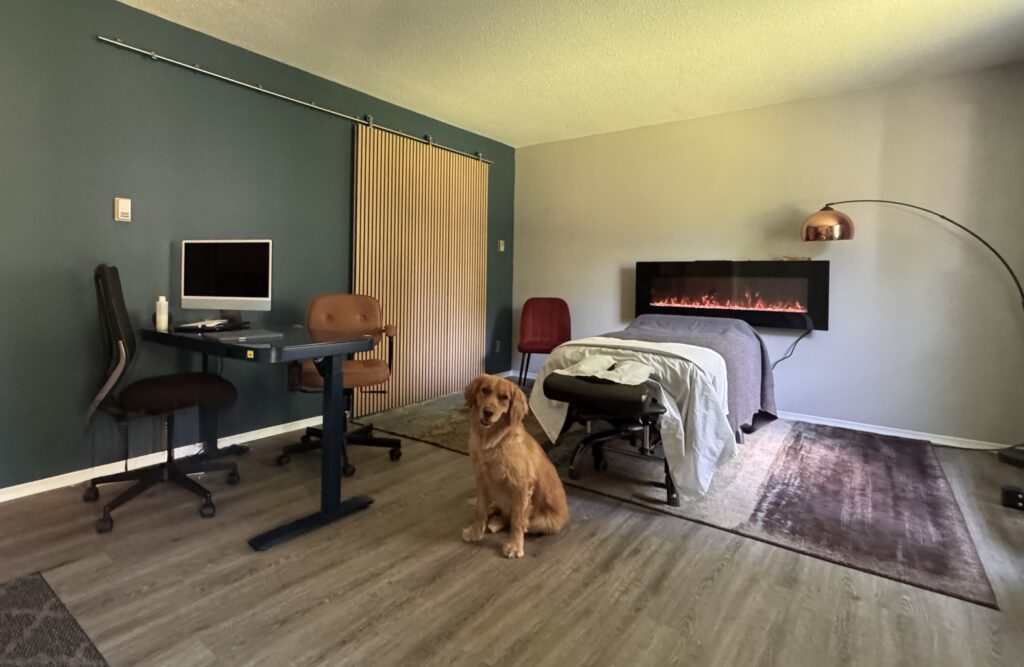
Bruno Panucci RMT uses trigger point therapy and the rest of his Registered Massage Therapy toolkit at his in-home practice in Brantford, serving Brant County including Paris, St. George, Mt. Pleasant, and Burford, with occasional mobile visits on request. Sessions are $115 for 60 minutes, with receipts for most extended health plans and direct billing available for most insurers. Two friendly, calm dogs share the treatment room, and they can be kept out on request if you have allergies or a preference.
Text Bruno at 519-753-5544 (he prefers texts), call the same number, or book online. Need a time the calendar does not show, or a 90 minute or two hour session to work a stubborn spot properly? Text him directly. He can often rearrange to fit you in, sometimes the same day.
A note on scope: This page is general information, not medical advice. Trigger point therapy may ease muscle tightness and support comfort in the short term, but it does not diagnose, treat, or cure any condition, and results vary. For new, severe, or unexplained pain, numbness, or pain that spreads or wakes you at night, see your physician first. Bruno Panucci is a Registered Massage Therapist (RMT), and works within current RMT scope of practice.
Related reading
- what a muscle knot really is
- deep-tissue and therapeutic massage in Brantford
- how sustained fascial work differs
Sources
- Zhang Q, Luo J. An Overview of Ischemic Preconditioning as a Potential Therapeutic Target for Chronic Muscle Pain. Journal of Pain Research, 2026. doi.org/10.2147/jpr.s546782
- Chen J, Yin L, Hu Q, Liu S, Zeng L. Manipulative Treatment of Myofascial Pain Syndrome: A Network Meta-Analysis Based on Randomized Controlled Trials. Journal of Pain Research, 2025. doi.org/10.2147/jpr.s517869
- Simati K, Paraskeva A, Tzigkounakis G. Multimodal Physiotherapy Interventions for Cervical Myofascial Pain (2019-2025): A Structured Narrative Literature Review of Randomized Trials. Cureus, 2025. doi.org/10.7759/cureus.96752
- Cigdem-Karacay B, Sahbaz T, Gumusay D, et al. Short-term results of instrument-assisted soft tissue mobilization in female patients with myofascial pain syndrome: A randomized blinded sham-controlled study. Turkish Journal of Physical Medicine and Rehabilitation, 2025. doi.org/10.5606/tftrd.2025.15466
- Dunning J, Butts R, Mourad F, et al. Dry needling: a literature review with implications for clinical practice guidelines. Physical Therapy Reviews, 2014; 19(4): 252-265. doi.org/10.1179/108331913×13844245102034
- College of Massage Therapists of Ontario, Standards of Practice.
- Government of Ontario. Massage Therapy Act, 1991, S.O. 1991, c. 27. ontario.ca/laws/statute/91m27