Bruno Panucci RMT
How Does Massage Actually Work? Nerves, Blood Flow, Fascia
Quick answer: Massage works mainly through your nervous system, not by flushing toxins. Firm, rhythmic touch calms the nerves that report pain and tension, prompts a relaxation shift you can measure in the brain, and moves local blood and fluid where a therapist’s hands press. Bruno Panucci RMT provides Registered Massage Therapy in Brantford, at $115 for 60 minutes, working the pressure you choose, from soft through medium to deep. Massage can ease symptoms and help you feel and move better, but it does not detox the body or cure disease. This page is general information, not medical advice.
How does massage actually work? Registered Massage Therapy is hands-on treatment of the body’s muscle and soft tissue, and its real effects run through the nervous system, local circulation, and the connective tissue under your skin, not through mysterious toxins leaving the body. Bruno Panucci RMT has practised massage therapy for 25 years, trained at the Alexandrian Institute for Massage Therapy, is registered with the College of Massage Therapists of Ontario (CMTO), and works from an in-home practice in Brantford, serving Brant County towns including Paris, St. George, Mt. Pleasant, and Burford. If you want the deeper-pressure version of this work, how deep-tissue therapy actually reaches muscle covers the mechanics.
Bruno Panucci RMT, 25 years of practice: “People sometimes ask me to press the toxins out of them, and I tell them, gently, that is not what is happening. What I am really doing is talking to your nervous system through my hands. When I work a tight spot at a pressure you can breathe through, your body stops guarding it. The muscle lets go because your brain decides it is safe to, not because I squeezed something out. Twenty-five years in, the honest version of how massage works is more interesting than the myth, and it is the version I want you to have.”
In short: massage works through your nervous system first. Steady, comfortable touch turns down pain signalling and shifts the body toward a calmer, parasympathetic state, which lets guarded muscles release. The pressure moves local blood and fluid where the hands press. It eases symptoms and tension; it does not remove toxins, cure conditions, or speed tissue healing.
6 min read
How does massage work on the nervous system?
Massage works on the nervous system first, and that is the mechanism with the strongest evidence behind it. Firm, rhythmic touch stimulates sensory nerves in the skin and muscle that feed the spinal cord and brain, and the brain responds by turning down how loudly it reports pain and by shifting the body toward a calmer, parasympathetic state. Reviewing brain-imaging studies, Chmiel and Kurpas (2026) found that massage reliably changes brain activity within a single session, commonly increasing alpha rhythms linked to relaxation, with moderate pressure favouring that calming, parasympathetic profile. This is why a good session leaves you feeling settled rather than merely rubbed. A newer framework from Jinich-Diamant and colleagues (2026) describes how force-based work on soft tissue engages both the sensory pathways that carry touch and the emotional pathways that colour how pain feels, which helps explain why massage can ease tension that is partly held by stress. Bruno Panucci RMT works with this directly at his Brantford practice: the calmer your system feels, the more a guarded muscle is willing to let go. The science of why massage feels so good is unpacked without the mysticism.
Does massage really improve blood flow and circulation?
Massage does move blood and fluid locally, but the honest version is smaller than the marketing version. When a therapist’s hands press and glide over an area, they mechanically push blood and lymph through the vessels right under that pressure, and the skin often flushes as local circulation rises for a while. That is real, and it is part of why worked tissue can feel looser and warmer afterward. What massage does not do is meaningfully change your whole-body circulation the way exercise does, or “pump out” waste on a system-wide scale. Some of the calming, circulation-adjacent effects also travel through the nervous system rather than raw mechanics: research on hormones tied to relaxation is genuinely mixed, and a scoping review by Cao and colleagues (2026) found that cortisol and oxytocin responses to manual therapy vary a lot from study to study. So the accurate claim is modest and local: massage encourages blood flow where the hands work, and it can support comfort, without any promise of detoxing your circulation.
What does massage do to muscle and fascia?
Massage affects muscle and fascia through pressure and sensation more than by physically stretching tissue like taffy. Muscle is the contractile tissue that moves you; fascia is the thin, tough connective webbing that wraps and connects muscle. A tight, tender spot, what many people call a knot, is better understood as a small patch of muscle held in a protective, contracted state, and massage works there by giving the nervous system enough safe, sustained input to let that guarding ease. You can read more on what a muscle knot really is and on the connective-tissue side in the plain-language guide to myofascial work. Sustained pressure and slow strokes change how the tissue feels and how the brain maps that area, which is often felt as release. Bruno Panucci RMT, at 6’2″ with a lifelong weight-training background, can deliver deep, controlled pressure when a client asks for it, but the same principle holds at every depth: the tissue softens because the system allows it, not because it was forced.
Does massage flush toxins or speed up healing?
Massage does not flush toxins, and it does not reliably speed up tissue healing, and being straight about that matters on a health page. Your liver and kidneys clear waste from your body; no massage stroke does their job, and the post-massage tiredness people blame on “released toxins” is a myth, and is far better explained by deep relaxation and the nervous-system shift described above. The healing claim deserves the same honesty. In a narrative review of massage for post-exercise muscle repair, Tiidus (2026) reported that massage has not been shown to enhance recovery from exercise-induced muscle damage in humans, even though animal studies suggest a possible effect under specific conditions. So if you train hard and book a massage, it may help you feel less sore and more relaxed, which has real value, but do not expect it to physically repair the muscle faster. Registered Massage Therapy supports comfort and function. It is not a detox, not a cure, and not a shortcut through the body’s own repair timeline. If you have new, severe, or unexplained symptoms, see your physician first. Several common massage myths are unpacked on a page of their own.
Why the pressure you choose changes how it works
Pressure is not just comfort preference; it changes the mechanism itself. You set the pressure, and you can adjust it, or stop, at any time. That control is not a courtesy, it is part of how massage works, because tissue only releases when the nervous system feels safe. Pressure that is too much for you triggers guarding, which is the opposite of what you came for; pressure you can breathe through invites release. This is why Bruno Panucci RMT frames every session as a gradient, from soft through medium to deep, with the deepest work offered on request rather than imposed. The nervous-system angle also shows up in stress and sport: a study by Taskin and colleagues (2025) found that a pre-match massage significantly lowered state anxiety in elite soccer players, a calming effect that has little to do with pressing hard and everything to do with how touch settles the system. Lighter work is as much the craft as deep work, and the right depth is the one your body can accept.
Bruno Panucci RMT, 25 years of practice: “If it has been more than a few months since your last massage, take a little less pressure the first time. It is like getting back on a bike after a long layoff: you feel great during, then sore the next day. Start lighter and you get pleasant tenderness instead of soreness, and the work still lands, because the release is coming from your nervous system, not from how hard I lean.”
Frequently asked questions
How does massage actually work in simple terms?
Massage works mainly through your nervous system. Comfortable, rhythmic touch calms the nerves that report pain and tension and shifts your body toward a relaxed state, which lets guarded muscles release. The pressure also moves blood and fluid locally where the hands press. It eases symptoms rather than curing anything.
Does massage get rid of toxins in the body?
No. Your liver and kidneys clear waste; no massage stroke removes toxins. The tired, loose feeling after a session comes from deep relaxation and a nervous-system shift, not from toxins being flushed out. Bruno Panucci RMT is straightforward about this in Brantford: massage eases tension, it does not detox you.
Does massage speed up muscle healing after exercise?
Not reliably. A 2026 review by Tiidus found that massage has not been shown to speed recovery from exercise-induced muscle damage in humans, though it may help you feel less sore and more relaxed. That comfort has real value, but do not expect massage to physically repair muscle faster.
Does deeper pressure make massage work better?
No. Tissue releases when your nervous system feels safe, so pressure you can breathe through works better than pressure that is too much and makes you guard. Bruno Panucci RMT works a gradient from soft through medium to deep, with the deepest work on request. You set the pressure and can change it at any time.
Book a massage with Bruno in Brantford
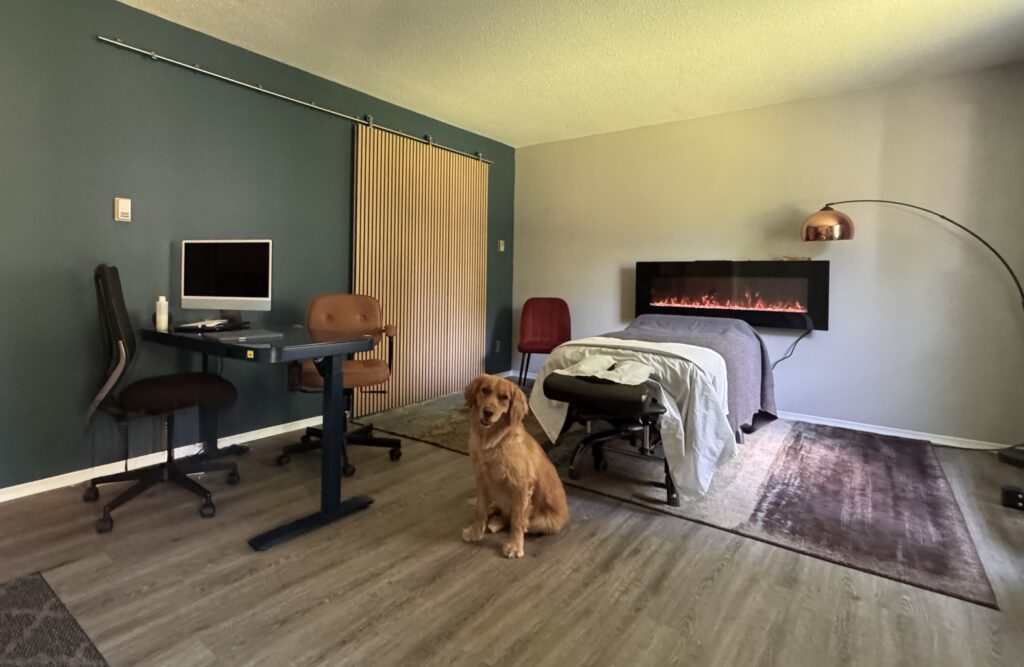
If you want to feel how this works in practice, Bruno Panucci RMT provides Registered Massage Therapy at his in-home practice in Brantford, serving Brant County including Paris, St. George, Mt. Pleasant, and Burford, with occasional mobile visits on request. Sessions are $115 for 60 minutes, receipts work with most extended health plans, and direct billing is available for most insurers.
Text Bruno at 519-753-5544 (he prefers texts), call the same number, or book online. Need a time the calendar does not show, or a 90 minute or two hour session? Text him directly. He can often rearrange to fit you in, sometimes the same day.
A note on scope: This page is general information, not medical advice. It explains how Registered Massage Therapy works and what it can reasonably do; massage can support comfort and function, but it does not detox the body, cure conditions, or speed tissue healing. For new, severe, or unexplained symptoms, numbness, weakness, or pain after an injury, speak with your physician first. Bruno Panucci is a Registered Massage Therapist (RMT), and works within current RMT scope of practice.
Related reading
- how deep-tissue pressure reaches the muscle
- what a muscle knot actually is
- myofascial release, in plain language
Sources
- Chmiel J, Kurpas D. Through Massage to the Brain: Neuronal and Neuroplastic Mechanisms of Massage Based on Various Neuroimaging Techniques (EEG, fMRI, and fNIRS). Journal of Clinical Medicine, 2026. doi.org/10.3390/jcm15020909
- Tiidus PM. Mechanisms and Efficacy of Massage Therapy for Post-Exercise Muscle Repair: A Narrative Review. Muscles, 2026. doi.org/10.3390/muscles5020029
- Cao AT, Alanazi MS, Billings R, Reed WR. Physiological changes of cortisol and oxytocin following manual therapy: a scoping review. Frontiers in Rehabilitation Sciences, 2026. doi.org/10.3389/fresc.2026.1719735
- Taskin M, Korkmaz E, Budak M, Sahin IH, Taskin H. The effect of sports massage on state anxiety in elite soccer players. Frontiers in Psychology, 2025. doi.org/10.3389/fpsyg.2025.1724892
- Jinich-Diamant A, Albinni B, Fishbein JN, et al. MASSAG model: Towards an integrative neuroscience framework linking emotional trauma, pain, and mechanisms of force-based manipulations. Neuroscience and Biobehavioral Reviews, 2026. doi.org/10.1016/j.neubiorev.2025.106517
- College of Massage Therapists of Ontario, Standards of Practice.
- Government of Ontario. Massage Therapy Act, 1991, S.O. 1991, c. 27. ontario.ca/laws/statute/91m27