Bruno Panucci RMT
Massage Myths and Facts: Toxins, Knots, and No Pain No Gain
Quick answer: Most popular massage claims are half true at best. Massage therapy does not flush toxins out of your body, a “knot” is not a lump of trapped waste, and it does not have to hurt to do you good. What massage does well is ease muscle tension, calm the nervous system, and help a sore body feel and move better. Bruno Panucci RMT provides Registered Massage Therapy in Brantford at $115 for 60 minutes, with the pressure you choose, from soft through medium to deep. This page is general information, not medical advice.
Massage myths spread because they sound satisfying: press hard enough on a knot and toxins drain away. The truth is quieter and more useful. Bruno Panucci RMT has practised Registered Massage Therapy for 25 years, is registered with the College of Massage Therapists of Ontario (CMTO), and works from his in-home practice in Brantford, serving Brant County towns like Paris, St. George, Mt. Pleasant, and Burford. He would rather tell you what massage genuinely does than sell you a myth. A trigger point, the thing people call a knot, is described in the research as a hyperirritable spot inside a taut band of muscle fibres (Steen and colleagues, 2025), not a deposit of anything. If you want to know what is actually happening under the hands, that is the honest starting point.
Bruno Panucci RMT, 25 years of practice: “People come in wanting me to break up a knot and release the toxins, and I get why, it is a great story. But in 25 years I have never squeezed a toxin out of anyone. What I can do is take tension out of a tight muscle so it stops pulling on you, and calm a nervous system that has been stuck in high gear. That is real, and it is enough. I would rather give you the honest version than a magic one, because the honest version actually holds up when you get off the table.”
In short: massage therapy does not detox the body, melt fat, or remove waste. A knot is a tight, irritable band of muscle, not trapped toxins. Massage can ease that tension, reduce pain in the short term, and help you relax, and firm pressure is only one way to get there, chosen by you, never forced.
6 min read
Does massage flush toxins out of your body?
Massage does not flush toxins out of your body, and this is the myth worth retiring first. There is no toxin that builds up in a tight muscle and drains away when it is pressed, and your liver and kidneys, not a pair of hands, are what clear waste from your blood. The reason the story took hold is that people often feel a little tender or wrung out the day after deeper work, and “toxins leaving” sounds like an explanation. The likelier reason is simpler: worked muscle tissue and a body that drank too little water. So massage therapy does not detox you, does not cause weight loss, and does not speed healing. What Bruno Panucci RMT can honestly promise is tension eased and comfort improved, not a cleanse. If a Brantford massage provider is selling detox or toxin release, that is your cue to ask harder questions.
What is a muscle knot, really?
A muscle knot is not a knot at all, and it is not a lump of waste product. In the research it is called a myofascial trigger point, described as a hyperirritable spot within a taut band of muscle fibres that can produce both local pain and pain referred somewhere else (Steen and colleagues, 2025). You feel it as a tight, tender band, and pressing it can send a familiar ache down your arm or up into your head. Manual therapy is one of the approaches with some supporting evidence for these points, though the wider science on how they form and how best to treat them is still being worked out (Steen and colleagues, 2025). A related idea, working the fascia and muscle mechanically, is most consistently linked to short-term improvements in pain and range of motion rather than any permanent structural change (Gao and Gao, 2026). In plain terms, Bruno can help that band settle and calm down. He is not dissolving a lump, because there was never a lump to dissolve. If muscle knots are your main concern, the fuller picture on what a knot is and how massage helps goes deeper than one section can.
Does massage have to hurt to work?
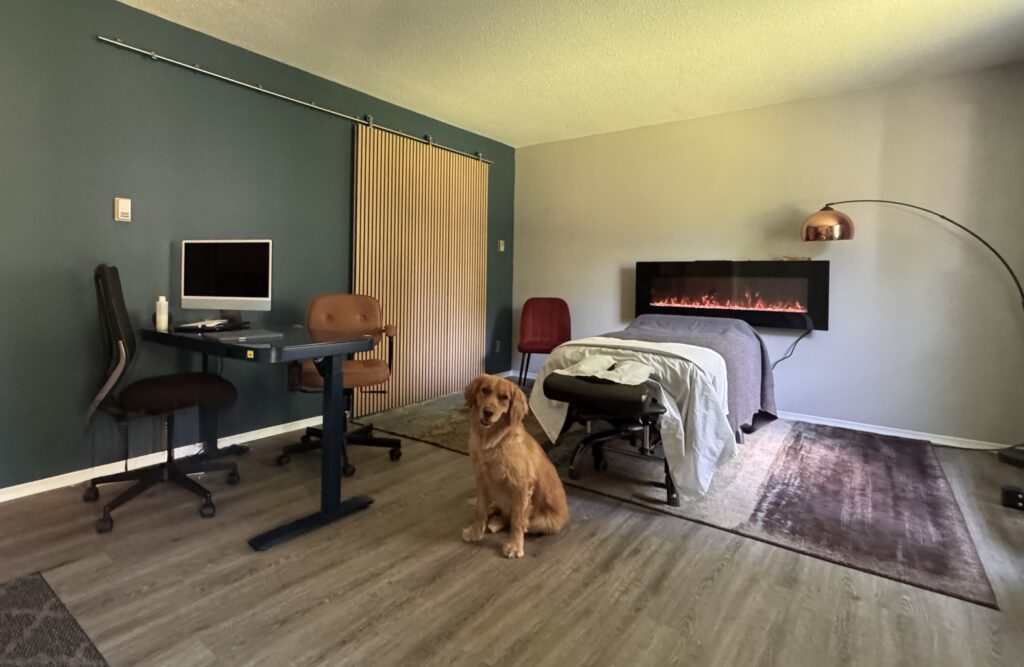
Massage does not have to hurt to work, and “no pain, no gain” is the myth that puts the most people off booking. You set the pressure. You can adjust it, or stop, at any time. Firm, focused pressure has real evidence behind it, ischemic compression on a jaw trigger point, for instance, meaningfully reduced orofacial pain in one comparative trial (Macedo de Sousa and colleagues, 2024), but that same study found firm compression was not the only effective route, and it was not even the strongest one tested. Pain that makes you brace and hold your breath is counterproductive, because a muscle you are guarding will not let go. The useful sensation is a “good hurt,” pressure firm enough to register, not so hard you tense against it. Bruno Panucci RMT spent years doing relaxation massage, so the soft and medium end is as much his craft as the deep end. Deep pressure at his Brantford practice is offered on request, never the default. A good rule from Bruno: if it has been more than a few months since your last massage, take a little less pressure the first time so you feel pleasant tenderness, not soreness, afterward.
A few smaller myths worth clearing up
Smaller massage myths pile up quickly, and a few are worth naming plainly. Massage is not only for relaxation and it is not only for injury; the same Registered Massage Therapy covers both stress relief and sore, hard-used muscles, at Bruno Panucci RMT’s in-home practice in Brantford. It is not just for athletes: desk workers, shift workers, and anyone carrying tension in the neck and shoulders benefit as much as runners. And more pressure is not automatically better, because worked muscle and fascia respond to well-judged mechanical loading, with the gains sitting mostly in short-term pain and mobility rather than in how hard someone pushed (Gao and Gao, 2026). Massage also will not fix a structural problem that needs a different profession; it eases symptoms and supports comfort, and an honest therapist refers out when your body needs a plan instead of a table.
| The claim | Myth or fact | The honest version |
|---|---|---|
| Massage flushes toxins out of you | Myth | Your liver and kidneys clear waste; massage eases tension, not toxins |
| A knot is trapped waste you can break up | Myth | It is a tight, irritable band of muscle that can be settled, not dissolved |
| It has to hurt to work | Myth | A “good hurt” helps; bracing pain does not. You set the pressure |
| Firm pressure can ease muscle pain | Fact (with limits) | Supported short term, but it is one route among several, not the only one |
| Massage can help you relax and hurt less | Fact | Eased tension and short-term pain relief are its genuine strengths |
Frequently asked questions
Do I need to drink lots of water after a massage to flush out toxins?
Drinking water is a good idea, but not because massage releases toxins, it does not. Staying hydrated simply helps you feel better after your muscles have been worked, especially with deeper pressure. There is no toxin being flushed; that part is a myth.
Can massage really get rid of my knots for good?
Massage can help a tight, irritable band of muscle, what people call a knot, calm down and feel better, often for a good while. It is not dissolving a lump, because a knot is not a lump. If the same spot keeps returning, the cause is usually posture, stress, or overuse, which is worth addressing alongside the massage.
If it does not hurt, is the massage even doing anything?
Yes. A calm, medium-pressure massage can ease tension and relax the nervous system just as effectively as a firmer one for many people. Pain that makes you brace actually works against the muscle letting go. With Bruno Panucci RMT you set the pressure, from soft through medium to deep.
Does massage help with weight loss or detox?
No. Massage therapy does not cause weight loss and does not detox the body. What it genuinely offers is eased muscle tension, short-term pain relief, and relaxation. No honest Brantford provider promises detox or fat loss from massage, because it does not do either.
Book a massage with Bruno in Brantford
If you want the honest version of massage, tension eased and a body that feels better, Bruno Panucci RMT provides Registered Massage Therapy at his in-home practice in Brantford, serving Brant County including Paris, St. George, Mt. Pleasant, and Burford, with occasional mobile visits on request. Sessions are $115 for 60 minutes, receipts work with most extended health plans, and direct billing is available for most insurers.
Text Bruno at 519-753-5544 (he prefers texts), call the same number, or book online. Need a time the calendar does not show, or a 90 minute or two hour session? Text him directly. He can often rearrange to fit you in, sometimes the same day.
A note on scope: This page is general information, not medical advice. Registered Massage Therapy can ease muscle tension and support comfort, but it does not detox the body, cause weight loss, cure any condition, or replace medical care. For new, severe, or unexplained pain, numbness, weakness, or symptoms after an injury, speak with your physician first. Bruno Panucci is a Registered Massage Therapist (RMT), and works within current RMT scope of practice.
Related reading
- what massage actually does to muscle and nerves
- the truth about muscle knots
- why you can feel sore afterward
Sources
- Steen JP, Jaiswal KS, Kumbhare D. Myofascial Pain Syndrome: An Update on Clinical Characteristics, Etiopathogenesis, Diagnosis, and Treatment. Muscle & Nerve, 2025. doi.org/10.1002/mus.28377
- Gao Y, Gao D. Myofascial release and fascial-targeted mechanical interventions in musculoskeletal rehabilitation: mechanisms, modalities, and integrative physiology. Frontiers in Physiology, 2026. doi.org/10.3389/fphys.2026.1801306
- Macedo de Sousa B, López-Valverde N, López-Valverde A, Neves D, Santos M, Rueda JAB. Effect of dry needling, ischemic compression and cross-taping of the masseter in patients with orofacial myofascial pain: a randomized comparative study. Frontiers in Oral Health, 2024. doi.org/10.3389/froh.2024.1524496
- College of Massage Therapists of Ontario, Standards of Practice.
- Government of Ontario. Massage Therapy Act, 1991, S.O. 1991, c. 27. ontario.ca/laws/statute/91m27