Bruno Panucci RMT
Massage for Gardeners in Brantford: After the Season Bends You
Quick answer: Massage for gardeners is Registered Massage Therapy aimed at the pattern a season of digging, kneeling, and hauling builds in a body: a tired low back, sore knees and hips, and forearms that gripped tools all spring. Bruno Panucci RMT treats that pattern at his Brantford in-home practice, $115 for 60 minutes, at the pressure you choose from soft through medium to deep. Massage may ease the soreness and stiffness; it does not treat a disc, a joint, or a nerve. This page is general information, not medical advice.
Massage for gardeners is Registered Massage Therapy shaped around seasonal work in the soil: hours of bending over beds, kneeling at the edge of a border, twisting to reach the far weed, and carrying bags of mulch that were never light. Bruno Panucci RMT has treated that kind of body for 25 years, and every spring and fall it arrives at his Brantford in-home practice, attached to gardeners from across Brant County, Paris, St. George, Mt. Pleasant, and Burford. The complaint that opens most bookings is a low back that has had enough of bending, but in a gardener it almost never shows up alone.
Bruno Panucci RMT, 25 years of practice: “A gardener’s body tells on the season. I feel where the shovel side did the lifting, and I can usually guess which knee took the kneeling before anyone says a word. The forearms are the surprise for most people. They squeezed pruners and trowels for weeks and forgot they were working. My job is not to erase a spring of good work in the dirt. It is to take the edge off what it left behind so you can go back out and enjoy it.”
In short: a season of gardening builds one connected ache, not one sore spot. The low back carries the bending, the hips and knees carry the kneeling and squatting, the shoulders carry the reaching and hauling, and the forearms carry every squeeze of a tool. A session built for gardeners works that whole chain rather than chasing the loudest complaint.
6 min read
Why does gardening leave you sore in so many places?
Gardening leaves you sore in many places because it is repetitive, sustained, and often awkward work done for hours at a stretch, usually after a winter of doing very little of it. The soreness is not one injury; it is the sum of many small loads. Bending forward loads the low back. Kneeling and squatting load the knees and hips. Reaching and hauling load the shoulders. Gripping tools loads the forearms. Do all of that on the first warm Saturday in May, then repeat it every weekend, and the body catches up with you by Sunday night. This is the same territory that occupational low back pain occupies, where clinical guidelines favour a biopsychosocial approach that looks at the whole person and keeps them active rather than treating a single sore spot in isolation (Paukkunen and colleagues, 2026). Bruno Panucci RMT treats the gardener’s version of that pattern as one connected problem.
What does a season of bending do to a gardener’s low back?
A gardener’s low back takes the largest share of the season because bending forward is the position gardening is done in, and it is held far longer than the body would choose. Weeding, planting, and edging all fold you at the hips and load the muscles that run alongside the spine, and repeating that for hours leaves them tight, tired, and reluctant to lengthen. For this kind of non-specific low back pain, the honest evidence picture is encouraging but modest. A large review of complementary treatments for neck and low-back pain found that massage and similar hands-on care reduced pain more than no treatment or usual care in the short term, with any soreness from the massage itself being mild and passing (Furlan and colleagues, 2012). Registered Massage Therapy will not undo a strained disc or a facet problem, and a low back that will not straighten, or that sends pain down a leg, is a reason to see your physician first. But for the ordinary post-gardening ache, slow work through the low back and hips at Bruno’s Brantford in-home practice can take the edge off and help you move more freely.
Why do a gardener’s forearms, hips, and knees pay the price too?
A gardener’s forearms, hips, and knees pay the price because the low back is not the only region working, only the loudest. The forearms grip trowels, pruners, and hoses through thousands of small squeezes, and by the end of a long day they ache from wrist to elbow, the price of every closed hand. The hips fold and unfold through each kneel and stand, and the muscles at the front and side of the hip tighten from the repetition. The knees take the kneeling directly, pressed into soil and stone, and the shoulders take the reaching and the weight of every full watering can. A massage built for gardeners does not stop at the back; it works the forearms, the hips, the shoulders, and the areas around the knees so the whole chain settles, not just the one part that complained first.
| Region | What gardening does to it | What the session does there |
|---|---|---|
| Low back | Bending forward for hours loads the muscles beside the spine | Slow, broad work through the low back and the muscles that fold the hips |
| Hips and buttocks | Kneeling and squatting tighten the front and side of the hip | Lengthens the hip flexors and eases the deeper hip muscles |
| Knees | Direct kneeling loads the joint and the muscles around it | Works the thigh and calf muscles that cross and support the knee |
| Forearms and hands | Gripping tools all day keeps the forearms switched on | Releases the working muscles from wrist to elbow, both sides |
| Shoulders | Reaching, pruning, and hauling load the upper back and shoulders | Eases the shoulders and upper back so reaching feels lighter |
What does a massage session for gardeners actually involve?
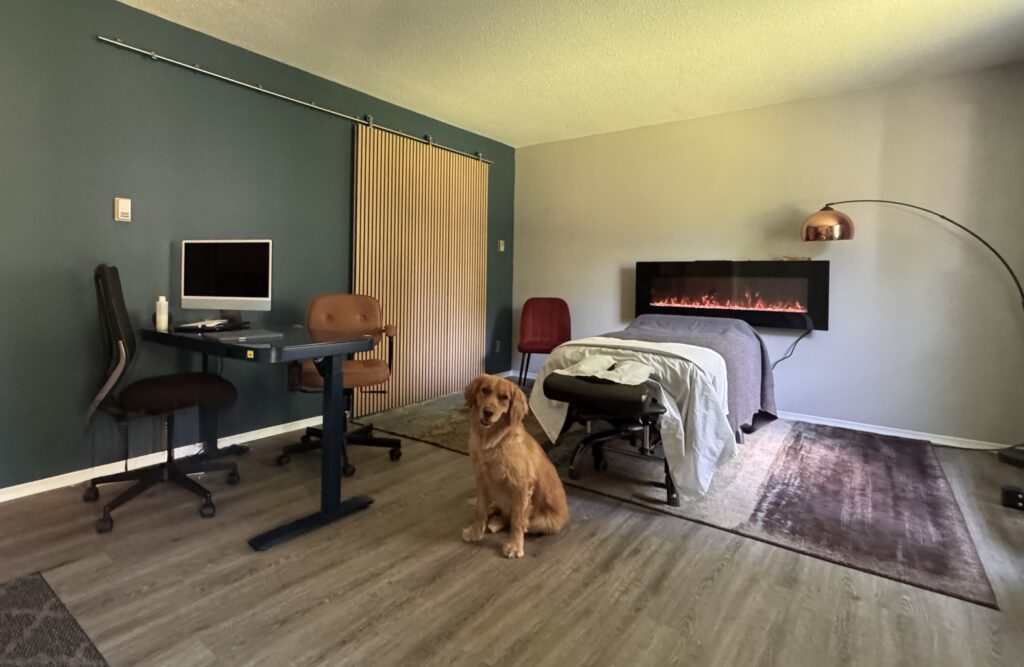
A massage session for gardeners with Bruno Panucci RMT starts with a short conversation about the season: what you have been planting, which side does the digging, whether you kneel or bend, and where the ache is loudest by evening. You set the pressure. You can adjust it, or stop, at any time. The scale runs from soft through medium to deep, and deep work is on request, never the default; a body that has already overdone it in the garden often does better with patient, moderate pressure than with force. Bruno tends to open with the low back and hips, since that is where most of the bending lands, then works the forearms, the shoulders, and the muscles around the knees, so the whole gardening chain is addressed in one 60-minute session. Treatment happens in the private treatment room at his Brantford in-home practice, draped to College of Massage Therapists of Ontario standards, with your consent for each area of work. Two friendly, calm dogs share the treatment room, and if you would rather they were not in during your session, just ask and Bruno will keep them out.
What helps the relief last through the growing season?
What helps massage relief last through a growing season is honest about its limits: the massage eases the soreness, but the garden rebuilds it every weekend, so how you work in between matters as much as the treatment. For chronic low back pain, the strongest evidence sits with staying active. A systematic review of physical and rehabilitation treatments found that exercise therapy improved pain, disability, and long-term function compared with usual care, while the data on massage alone were too limited to draw firm conclusions about lasting effect (van Middelkoop and colleagues, 2011). The takeaway for a gardener is practical: massage takes the edge off after a hard weekend, and simple habits keep it off, kneeling on a pad instead of the ground, standing up to stretch between beds, lifting bags with the legs, and switching hands on the trowel so one forearm does not carry the whole season. Book a session when the soreness builds, keep moving between them, and each visit starts from a better place. If any pain is sharp, spreading down a limb, or coming with numbness, that is a physician conversation, not a massage one.
Frequently asked questions
Should I book a massage before a big planting weekend or after?
Either can help, for different reasons. A session before a heavy weekend leaves you looser going in, while one after eases the soreness the work leaves behind. Many gardeners book after the first big push of the season, then settle into a rhythm from there. Bruno can suggest timing based on how your body responds.
Can massage help the sore forearms and hands from pruning and gripping tools?
Yes, and it is often the region gardeners forget to mention. Weeks of squeezing pruners and trowels leave the forearm muscles tight from wrist to elbow. Bruno works those muscles as part of a gardening session. Persistent numbness or tingling in the fingers, though, deserves a physician conversation first.
Will one session fix a low back sore from a season of gardening?
One session may ease the soreness and help you move more freely, but it will not undo a season in a single hour, and it would be dishonest to promise that. Massage relieves the ache while your habits in the garden decide the long game. A back that will not straighten or that sends pain down a leg should be checked by your physician.
Is massage for gardeners covered by extended health benefits?
Usually, yes. Treatment by a Registered Massage Therapist is reimbursable under most extended health plans. Bruno provides a compliant receipt after every session, which includes his name and RMT designation. Check your own plan for its annual limit. Direct billing is available for most insurers.
Book a massage for gardeners with Bruno in Brantford
Bruno Panucci RMT treats seasonal gardening tension at his in-home practice in Brantford, serving Brant County including Paris, St. George, Mt. Pleasant, and Burford, with occasional mobile visits on request. Sessions are $115 for 60 minutes, with receipts for most extended health plans and direct billing available for most insurers.
Text Bruno at 519-753-5544 (he prefers texts), call the same number, or book online. Want the whole gardening chain worked without the clock, or a time outside posted hours? Text him about a 90 minute or two hour session. He can often rearrange to fit you in, sometimes the same day.
A note on scope: This page is general information, not medical advice. Massage may ease the muscle soreness and stiffness that gardening leaves behind, but it does not diagnose or treat a disc, a joint, or a nerve problem, and results vary. Low back pain that will not ease, pain that spreads down a leg or arm, or numbness, tingling, or weakness deserves a physician conversation first. Bruno Panucci is a Registered Massage Therapist (RMT), and works within current RMT scope of practice.
Related reading
- easing a bending-sore low back
- what kneeling and squatting do to the hips
- sore shoulders from reaching and hauling
Sources
- Furlan AD, Yazdi F, Tsertsvadze A, Gross A, Van Tulder M, Santaguida L, Gagnier J, Ammendolia C, Dryden T, Doucette S, Skidmore B, Daniel R, Ostermann T, Tsouros S. A systematic review and meta-analysis of efficacy, cost-effectiveness, and safety of selected complementary and alternative medicine for neck and low-back pain. Evidence-Based Complementary and Alternative Medicine, 2012; 2012: 953139. doi.org/10.1155/2012/953139
- van Middelkoop M, Rubinstein SM, Kuijpers T, Verhagen AP, Ostelo R, Koes BW, van Tulder MW. A systematic review on the effectiveness of physical and rehabilitation interventions for chronic non-specific low back pain. European Spine Journal, 2011; 20: 19-39. doi.org/10.1007/s00586-010-1518-3
- Paukkunen M, Öberg B, Karppinen J, Ala-Mursula L, Ryynänen K, Holopainen R, Abbott A. Where is the patient in the records? Evaluating physiotherapists’ first visit in occupational health primary care pathway for low back pain. BMJ Open Quality, 2026. doi.org/10.1136/bmjoq-2025-003900
- College of Massage Therapists of Ontario, Standards of Practice.
- Government of Ontario. Massage Therapy Act, 1991, S.O. 1991, c. 27. ontario.ca/laws/statute/91m27