Bruno Panucci RMT
Hamstring Massage in Brantford: Tight and Strained Backs of the Legs
Quick answer: Hamstring massage in Brantford, with Bruno Panucci RMT, is hands-on Registered Massage Therapy that can ease the tight, sore feeling in the back of the thigh and help you move more comfortably. It supports comfort alongside a strengthening plan; it does not cure a strain or lastingly lengthen the muscle, and the strongest evidence for preventing hamstring injuries points to eccentric strengthening, not massage. A fresh or sharp hamstring injury needs your physician first. This page is general information, not medical advice.
The hamstrings are the group of three muscles down the back of the thigh, and they take a lot of load every time you walk fast, sprint, bend, or sit for hours. When they feel tight, ropey, or sore, gentle hands-on work can genuinely help them feel looser and calmer. Bruno Panucci RMT has spent 25 years as a Registered Massage Therapist in Brantford, and clients across Brantford and Brant County towns like Paris, St. George, Mt. Pleasant, and Burford come to his in-home practice with tight or overworked hamstrings from running, lifting, cycling, and long days at a desk. Hamstring work rarely stays in one spot, so it sits close to the recovery work runners and lifters lean on and to lower-back tension.
Bruno Panucci RMT, 25 years of practice: “Tight hamstrings are one of the most common things people bring me, and I am always honest about what my hands can and cannot do. I can help the back of your leg feel looser and less guarded, and most people walk out moving easier. What I cannot do is stretch a muscle permanently or fix a real tear on the table. If your hamstrings keep tightening up, the thing that actually holds up over time is getting them stronger, and I am glad to be one piece of that, not the whole plan.”
In short: hamstring massage is hands-on Registered Massage Therapy that can ease tightness and soreness in the back of the thigh and help you move more comfortably. It is comfort support, not a cure or a permanent stretch. For tight hamstrings that keep returning, strengthening is what the research backs, and massage sits alongside it rather than in place of it.
6 min read
Why do hamstrings get tight or strained?
The hamstrings are three muscles at the back of the thigh, built for both power and length, which is exactly why they get cranky. They stretch and contract hard during sprinting, kicking, and bending, and the biceps femoris long head in particular is the part most likely to strain (Hagos and colleagues, 2025). A tight hamstring and a strained hamstring are not the same thing. Tightness is a feeling of shortness, pulling, or fatigue, often from heavy training, long sitting, or simply doing more than usual, and it usually eases with movement and gentle work. A strain is an actual injury to the muscle fibres, often with a sharper, more sudden pain. In a narrative review of hamstring injuries, the main risk factors were prior injury history, neuromuscular deficiencies, excessive load, and the muscle and tendon architecture itself, with a high rate of recurrence a recurring theme (Hagos and colleagues, 2025). That last point matters: once a hamstring has been hurt, it is more likely to happen again, so how you rebuild it counts. Tight hamstrings also travel with tight hips and a tired lower back, which is why lower-back and hip tension often show up in the same visit.
Can massage help tight or strained hamstrings?
Massage can help tight or strained hamstrings feel better, and it is worth being honest about how. Hands-on work eases the sensation of tightness, can reduce guarding and soreness, and often leaves the back of the leg feeling looser and easier to move right after a session. What the evidence does not support is the idea that massage or rolling permanently lengthens the muscle. In one study, self-administered foam rolling of the hamstrings for up to two minutes, a common form of self-massage, did not produce a measurable improvement in knee-extension range of motion (Couture and colleagues, 2015). So the honest version is this: massage is comfort and tension support, not a stretch that sticks. It can make you feel better and move more freely in the moment, which has real value, especially if tight hamstrings are making training or sitting uncomfortable. But if the goal is hamstrings that stop getting tight and stop getting hurt, the evidence points at strengthening rather than hands-on work alone, and the two do their best work together. Bruno Panucci RMT would rather set that expectation up front than oversell what a session can do.
What does a hamstring massage session look like?
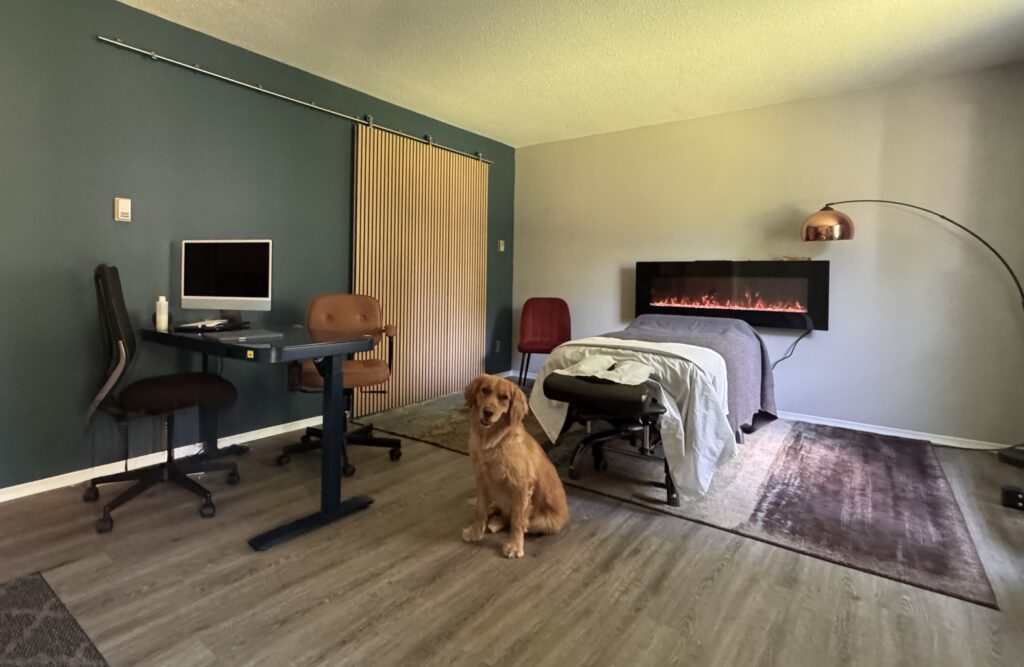
A hamstring massage session at Bruno’s Brantford in-home practice is straightforward and unhurried. You set the pressure, and you can adjust it, or stop, at any time. Bruno works the back of the thigh and the muscles around it, the glutes, calves, and lower back, because the hamstrings rarely act alone. Pressure runs on a gradient from soft through medium to deep, and it is always your call; deeper work is on request, never the default, and it is never the right tool on a fresh injury. Expect a mix of broad, settling strokes to calm the tissue and more focused work on the ropey spots, with check-ins along the way. Treatment is in a private treatment room, draped to College of Massage Therapists of Ontario standards, so only the area being worked on is uncovered. Two friendly, calm dogs share the treatment room and can be kept out on request. A 60-minute session is $115, and because the practice runs from Bruno’s own home the lower overhead keeps the price fair, so your receipts stretch your extended health benefits further.
Tight hamstring or strain: when to rest and see a doctor
Telling a tight hamstring from a strained one changes what you should do next, and massage is not the answer for every ache back there. A sudden, sharp pain during a sprint or a kick, a popping sensation, swelling, bruising, or weakness when you try to use the leg all point toward a strain or tear, and those need proper assessment, not deep massage on fresh tissue. Working hard into an acute strain can set healing back. Pain that shoots down the back of the leg from the buttock, with tingling or numbness, may not be the hamstring at all but the sciatic nerve, which is a different problem worth understanding on its own. When in doubt, start with your physician. Massage has its place once things settle, and gentle work can be part of a later recovery phase, but the first job is knowing what you are dealing with.
| What you notice | Tight or overworked hamstring | Hamstring strain (injury) |
|---|---|---|
| How it starts | Gradual, builds with training, sitting, or doing more than usual | Sudden, often mid-sprint or mid-kick |
| How it feels | Dull pulling, fatigue, a sense of shortness | Sharp pain, sometimes a pop |
| Other signs | Eases with gentle movement, no swelling | Swelling, bruising, or weakness may appear |
| First step | Gentle movement and hands-on work can help | Rest and get it assessed, not deep massage |
| Where massage fits | Comfort and tension support | Only later, gently, once it has been checked |
What actually helps prevent hamstring injuries?
Preventing hamstring injuries is mostly about building stronger, more resilient muscle, and this is where the evidence is clearest. A systematic review and meta-analysis of prevention programs in football found that exercise-based programs roughly halved the risk of hamstring strain injuries, a risk ratio of about 0.51, but the benefit depended heavily on sticking with the plan: players who kept their adherence high saw clear reductions, while low adherence showed no clear benefit, and the authors rated the certainty of the evidence as low (Gu and colleagues, 2026). Eccentric strengthening, especially exercises like the Nordic hamstring exercise, is repeatedly highlighted for its effectiveness in reducing the incidence of hamstring injuries (Hagos and colleagues, 2025), and a broader review of training strategies linked eccentric hamstring training to lower reported injury rates alongside gains in eccentric strength and fascicle length (Kłobuchowski and colleagues, 2026). Stretching on its own is less certain; it seems to help more when paired with strengthening than by itself (Hagos and colleagues, 2025). So where does massage fit? Honestly, as support, not prevention. It can keep the back of the leg feeling looser and more comfortable, which can make the strength work easier to stay consistent with, and consistency is exactly what the research rewards. But the muscle that does not strain is the strong one, and no amount of hands-on work replaces the strengthening. Bruno Panucci RMT will tell you the same at his Brantford practice: book the massage for how it makes you feel and move, keep it alongside the strength work, and talk to a physician or trainer about the right program for you.
Frequently asked questions
Is it safe to massage a pulled hamstring?
Not right away. A fresh hamstring strain, especially one with sharp pain, a pop, swelling, or bruising, needs assessment first, and deep massage on newly torn tissue can slow healing. Once it has been checked and has started to settle, gentle massage can be part of a later recovery phase. If you are not sure whether it is a strain, start with your physician, and Bruno will always err on the side of caution.
Does massage make hamstrings more flexible?
It can make them feel looser in the moment, which is real and useful, but the evidence that hands-on work or foam rolling lastingly lengthens the muscle is limited. In one study, foam rolling the hamstrings for up to two minutes did not measurably improve range of motion. For flexibility that holds, strengthening the muscle through its full range tends to do more than massage alone, and the two work well together.
How often should I get a hamstring massage?
There is no fixed rule. If regular sessions keep the back of your legs feeling looser and help you train or sit more comfortably, a steady rhythm can be worth it, and you can pace it to your budget and your training. Bruno would rather help you find a sustainable schedule than sell you a package, and he will suggest pairing it with strengthening for the longer-term payoff.
Can massage prevent hamstring injuries?
Not on its own. The strongest evidence for preventing hamstring injuries points to eccentric strengthening and consistent training programs, not massage. Massage can support comfort and help you stay consistent with training, which matters, but it is not a proven substitute for the strength work. Think of it as one honest piece of the plan, alongside your physician’s or trainer’s advice.
Book a hamstring massage with Bruno in Brantford
Bruno Panucci RMT offers hands-on Registered Massage Therapy for tight and overworked hamstrings at his in-home practice in Brantford, serving Brant County including Paris, St. George, Mt. Pleasant, and Burford, with occasional mobile visits on request. Sessions are $115 for 60 minutes. Receipts are provided for most extended health plans, with direct billing available for most insurers.
Text Bruno at 519-753-5544 (he prefers texts), call the same number, or book online. If you need a time the calendar does not show, a shorter session, or a 90-minute session, text him directly. He can often rearrange to fit you in, sometimes the same day.
A note on scope: This page is general information, not medical advice. Registered Massage Therapy can support comfort and ease muscle tension, but it does not cure a strain, permanently lengthen a muscle, or replace a strengthening or rehabilitation program. A sudden, sharp, or swelling hamstring injury, or pain that shoots down the leg with numbness, should be assessed by your physician. Bruno Panucci is a Registered Massage Therapist (RMT), and works within current RMT scope of practice.
Related reading
- Sports massage and recovery for runners and lifters
- When leg pain is the sciatic nerve, not the muscle
- Easing lower-back and hip tension
- Session lengths and rates
Sources
- Couture G, Karlik D, Glass SC, Hatzel BM. The Effect of Foam Rolling Duration on Hamstring Range of Motion. The Open Orthopaedics Journal, 2015; 9: 450-455. doi.org/10.2174/1874325001509010450
- Hagos A, Merchant AA, Kayani B, Yasen AT, Haddad FS. Risk factors and injury prevention strategies for hamstring injuries: a narrative review. EFORT Open Reviews, 2025. doi.org/10.1530/eor-2024-0135
- Gu J, Li Y, Wang Y, Zhang Y. Intervention components, training dose, and adherence in exercise-based prevention of hamstring strain injury in football: a systematic review and meta-analysis. Annals of Medicine, 2026. doi.org/10.1080/07853890.2026.2652116
- Kłobuchowski W, Skorulski M, Ornowski K, Roczniok R, Maszczyk A, Callegari B, Souza GS, Pietraszewski P, Kuliś S. Exercise-Based Strategies from Warm-Up to Training: A Systematic Review of Performance Enhancement and Injury Prevention. Sports, 2026; 14: 187. doi.org/10.3390/sports14050187
- College of Massage Therapists of Ontario, Standards of Practice.
- Government of Ontario. Massage Therapy Act, 1991, S.O. 1991, c. 27. ontario.ca/laws/statute/91m27