Bruno Panucci RMT
How Long Should a Massage Be? 30, 60, or 90 Minutes
Quick answer: For most people, a 60-minute massage is the right length, long enough for full-body work or real time on two or three problem areas. In massage dose research, benefits rose with more table time and plateaued at about 60 minutes per week. Bruno Panucci RMT offers Registered Massage Therapy in Brantford at $115 for 60 minutes; shorter and 90-minute sessions can often be arranged by text. This page is general information, not medical advice.
Session length is one of the few massage decisions you make before anyone’s hands touch a muscle, and it shapes everything that follows. Bruno Panucci RMT has practised massage therapy for 25 years, is registered with the College of Massage Therapists of Ontario (CMTO), and treats clients at his private in-home practice in Brantford, serving Brant County including Paris, St. George, Mt. Pleasant, and Burford. His standard session is 60 minutes at $115, set out on the services and pricing page. This guide compares 30, 60, and 90 minutes honestly, using the actual dose research rather than habit.
Bruno Panucci RMT, 25 years of practice: “The length question I hear most is whether an hour is really enough. After 25 years, my answer is that the hour is rarely the problem. A focused 60 minutes treats the back, neck, and shoulders properly without racing the clock. Where people go wrong is booking 30 minutes and expecting full-body work; that is asking a half hour to do an hour’s job. If you are torn, book the hour. By the end of it I will know your body well enough to tell you honestly whether 90 minutes would earn its keep.”
In short: a 60-minute massage is the evidence-backed standard for most adults. In dose-finding research, benefits increased with more total table time but plateaued at 60 minutes per week. A 30-minute session suits one focused area, and a 90-minute session suits several problem areas, a larger frame, or a slower pace.
6 min read
What does research say about how long a massage should be?
Massage dose research answers the length question more directly than most people expect. Perlman and colleagues (2012) randomized 125 adults with osteoarthritis of the knee to 30-minute or 60-minute massage sessions, delivered weekly or twice weekly, over eight weeks. The 60-minute groups improved by roughly 24 points on a standard arthritis pain and function index, against about 6 points for usual care, and the dose-response curve kept rising with more total table time before flattening at the 60-minutes-per-week dose. The authors concluded the once-weekly hour was optimal. The companion protocol paper is quietly useful too: Ali and colleagues (2012) report that the 30-minute and 60-minute protocols covered identical body regions, and what changed was the time spent on each. A shorter massage does not skip your legs; it hurries everything. One honest caveat: by 24 weeks, after treatment ended, the benefits were no longer significant, which is why how often you rebook matters as much as length. This is knee-arthritis research, a guide rather than a rule for every body. How the complete full-body session is paced has a dedicated walkthrough. A related booking question, when in the day to book, is answered on its own page.
Is a 30-minute massage worth it?
A 30-minute massage is worth it when the target is one specific area: a locked set of shoulders, one aggravated hip, a jaw that will not let go. Short, focused hands-on work is not a token gesture. Atkins and Eichler (2013) found that even 20 minutes of guided self-massage to the thigh muscles, done twice weekly, measurably improved pain, stiffness, and function in adults with knee osteoarthritis compared with a no-treatment group. If even guided self-massage can help that much, a half hour of focused hands-on work from a Registered Massage Therapist with 25 years of experience is genuine treatment. What a half hour cannot honestly deliver is full-body work; that is an hour’s job compressed until every region gets rushed. Bruno Panucci RMT’s online calendar lists the standard 60-minute session, and if a shorter appointment fits your body or your budget better, text him and he can often arrange one.
Why is a 60-minute massage the standard?
The 60-minute massage became the standard because the evidence and the practical logic point the same way. In the dose-finding trial above, benefits plateaued at the once-weekly hour, and the researchers noted that dose matched real-world practice and cost less to sustain. Separate evidence agrees: Chiranthanut and colleagues (2014) found that one-hour Thai massage sessions, given three times weekly for three weeks, eased knee osteoarthritis symptoms about as well as oral ibuprofen over that period. Different technique, same session length. In practice, an hour lets Bruno Panucci RMT work the back, neck, shoulders, and legs at a proper pace, or split real time between two or three regions that need it. At his Brantford in-home practice the 60-minute session is $115, a rate kept competitive by low overhead, so extended health benefits stretch further across the year.
When is a 90-minute massage worth booking?
A 90-minute massage earns its extra half hour in a few specific situations: several genuine problem areas rather than one or two, a larger or heavily muscled frame that simply takes longer to work through, or a body that needs twenty minutes just to stop bracing before deeper work is useful. It is also the honest choice if feeling rushed undoes the benefit. What a longer session is not is automatically better. The dose research above found returns flattening past an hour a week, so 90 minutes is a question of fit, not an upgrade. Bruno Panucci RMT keeps the online calendar simple with the 60-minute standard and arranges 90-minute and two-hour sessions by text, often within the same week and sometimes the same day.
How do you choose the right length for your body?
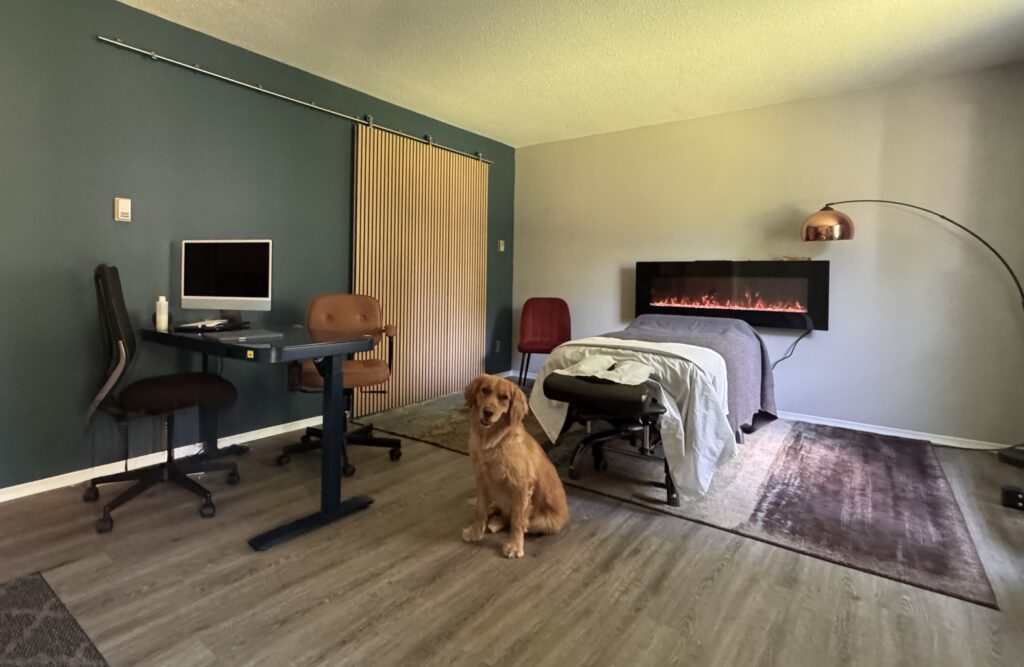
Choosing a massage length comes down to three questions: how many areas genuinely need work, what pace your body responds to, and what your schedule and benefits allow. One thing does not change with the clock: you set the pressure, and you can adjust it, or stop, at any time. The scale runs from soft through medium to deep, with the deepest work on request, and deep work across several areas takes more time, which nudges some people toward the longer session. If this is your first massage in a long while, or ever, the first-visit guide walks through intake, draping to College of Massage Therapists of Ontario standards, and the two friendly, calm dogs who share the treatment room, which Bruno will happily keep out on request. When in doubt, book the hour and decide the rest with Bruno once he has his hands on the problem.
| Length | Best suited to | Honest limitation | How to book |
|---|---|---|---|
| 30 minutes | One focused area: neck and shoulders, one hip, the jaw | Not enough time for genuine full-body work | Text Bruno to arrange |
| 60 minutes | Full-body work, or real time on two or three areas | Can feel brief if many areas all need deep work | Book online, $115 |
| 90 minutes | Several problem areas, larger frames, a slower pace | Longer is not automatically better; benefits plateau in research | Text Bruno to arrange |
Frequently asked questions
Is a 60-minute massage long enough for a full-body treatment?
For most adults, yes. Sixty minutes lets a Registered Massage Therapist work the back, neck, shoulders, and legs at a proper pace, or give focused time to two or three areas instead. If several areas all need deep work, ask Bruno about a longer session by text.
What can a 30-minute massage actually accomplish?
A half hour of Registered Massage Therapy is genuine treatment for one area, such as the neck and shoulders or a single tight hip. Research on short, focused massage work (including guided self-massage trials) found measurable improvements in pain and function. It is not enough time for full-body work, so keep the target narrow.
How much does a 60-minute massage cost in Brantford with Bruno Panucci RMT?
A 60-minute session at Bruno Panucci RMT’s in-home practice in Brantford is $115, with receipts that work with most extended health plans. For a shorter or longer session, text him at 519-753-5544 and he will confirm what he can arrange.
Can I book a 90-minute or two-hour massage with Bruno Panucci RMT?
Yes, by text. The online calendar lists the standard 60-minute session, and Bruno arranges 90-minute and two-hour appointments directly at 519-753-5544. He can often rearrange his schedule to fit you in, sometimes the same day.
Book the right session length in Brantford
Bruno Panucci RMT provides Registered Massage Therapy from his in-home practice in Brantford, serving Brant County including Paris, St. George, Mt. Pleasant, and Burford, with occasional mobile visits on request. The standard session is 60 minutes for $115, receipts work with most extended health plans, and direct billing is available for most insurers.
Text Bruno at 519-753-5544 (he prefers texts), call the same number, or book online. If you want a shorter session, a 90-minute or two-hour session, or a time the calendar does not show, text him directly. He can often rearrange to fit you in, sometimes the same day.
A note on scope: This page is general information, not medical advice. Massage therapy may ease muscle tension and support comfort, but it does not cure or treat any condition, and no session length changes that. The dose research cited here comes mainly from knee osteoarthritis trials, so treat it as a guide rather than a rule. For new, severe, or unexplained pain, numbness, weakness, or symptoms after an injury, see your physician first. Bruno Panucci is a Registered Massage Therapist (RMT), and works within current RMT scope of practice.
Related reading
- how often to book, answered honestly
- your first visit, step by step
- sessions and pricing at a glance
Sources
- Perlman AI, Ali A, Njike VY, Hom D, Davidi A, Gould-Fogerite S, Milak C, Katz DL. Massage therapy for osteoarthritis of the knee: a randomized dose-finding trial. PLoS ONE, 2012; 7(2): e30248. doi.org/10.1371/journal.pone.0030248
- Ali A, Kahn J, Rosenberger L, Perlman AI. Development of a manualized protocol of massage therapy for clinical trials in osteoarthritis. Trials, 2012; 13: 185. doi.org/10.1186/1745-6215-13-185
- Chiranthanut N, Hanprasertpong N, Teekachunhatean S. Thai massage, and Thai herbal compress versus oral ibuprofen in symptomatic treatment of osteoarthritis of the knee: a randomized controlled trial. BioMed Research International, 2014; 2014: 490512. doi.org/10.1155/2014/490512
- Atkins DV, Eichler DA. The effects of self-massage on osteoarthritis of the knee: a randomized, controlled trial. International Journal of Therapeutic Massage and Bodywork, 2013; 6(1). doi.org/10.3822/ijtmb.v6i1.119
- College of Massage Therapists of Ontario, Standards of Practice.
- Government of Ontario. Massage Therapy Act, 1991, S.O. 1991, c. 27. ontario.ca/laws/statute/91m27