Bruno Panucci RMT
Massage for Teachers in Brantford: Neck, Back, Stress
Quick answer: Massage for teachers is Registered Massage Therapy aimed at the classroom load: a neck bent over marking, a low back tired from standing all day, and shoulders that carry a term of stress. Bruno Panucci RMT treats that pattern at his Brantford in-home practice, $115 for 60 minutes, at the pressure you choose from soft through medium to deep. Receipts work with most extended health plans, the kind most teaching contracts carry. This page is general information, not medical advice.
Massage for teachers is Registered Massage Therapy aimed at the specific physical toll of the classroom: hours of standing while teaching, a neck and upper back bent over a stack of marking, a hand that grips a marker or a mouse all evening, and a nervous system that rarely powers down between the bell and the next lesson plan. Bruno Panucci RMT has treated that pattern for 25 years, and it arrives at his Brantford in-home practice from teachers across Brant County, Paris, St. George, Mt. Pleasant, and Burford. The research backs up what the body already knows. A systematic review of 44 studies and 15,972 teachers found the neck and lower back the two most affected regions, both at 47 percent, with an overall musculoskeletal complaint rate of 68 percent (Tahernejad and colleagues, 2024). Most bookings start with the neck and shoulder core of the pattern, but in a teaching body it rarely travels alone.
Bruno Panucci RMT, 25 years of practice: “Teachers arrive carrying two things at once. There is the physical load, the standing, the marking hunch, the arm that writes on a board all day, and there is the wind-down that never quite happens because the mind is still in the room. I can only work on the muscles, but a body that finally lets go for an hour tends to hand the rest a little breathing space. I would rather tell you that honestly than promise your whole week gets fixed on my table.”
In short: teaching builds a recognizable pattern, a tired neck and low back from standing and marking, plus muscle tension held by a stressful term. A massage session for teachers works that physical pattern directly, easing tight muscles for days to weeks, while the classroom keeps rebuilding it. It supports comfort. It is not a cure for the job.
6 min read
Why do teachers get neck and back pain?
Teachers get neck and back pain because the job combines the two things that build musculoskeletal complaints fastest: prolonged static postures and repeated small motions, held across a full working day. Writing on a board with the arm raised, leaning over desks, twisting between the class and the whiteboard, and marking with the neck flexed forward are all recognized contributors. In a cross-sectional study of primary and secondary teachers, the twelve-month rate of musculoskeletal complaints in one or more sites reached 61.5 percent, with the lower back most affected, then the neck (Gikaro and colleagues, 2025). Bruno Panucci RMT treats that load as one connected pattern rather than a single sore spot, because in a teaching body the neck, upper back, and low back tend to feed one another. Easing a tight neck while the standing-tired low back keeps pulling is only half the job.
What does a teaching day do, from neck to low back?
A teaching day loads the body from the head down, and each region has its own story. The neck flexes forward over marking and screens. The shoulders and upper back hold the arm through hours of writing and gesturing. The forearm and hand grip a marker, a pen, or a mouse well past the last bell. The low back absorbs the hours of standing, and standing is not the gentle option it sounds like: it reduces blood flow to the working muscles and brings on fatigue, back discomfort, and leg ache. Low back pain alone reached 51.5 percent among primary teachers in one study, where work stress, heavy lifting, higher body mass index, a history of back injury, and disturbed sleep were the independent predictors (Shegere and colleagues, 2025). The map in one view looks like this.
| Region | What the teaching day does to it | What the session does there |
|---|---|---|
| Neck and upper traps | Flexes forward over marking, screens, and reading | Slow work through the neck, upper traps, and base of the skull |
| Shoulders and upper back | Holds the arm through hours of board work and gesturing | Releases the shoulder and mid-back muscles that carry the load |
| Forearm and hand | Grips a marker, pen, or mouse past the last bell | Eases the working muscles from wrist to elbow |
| Low back | Absorbs hours of standing and twisting between class and board | Broad, unhurried work so standing-day fatigue lets go |
How does a massage session address the teaching load?
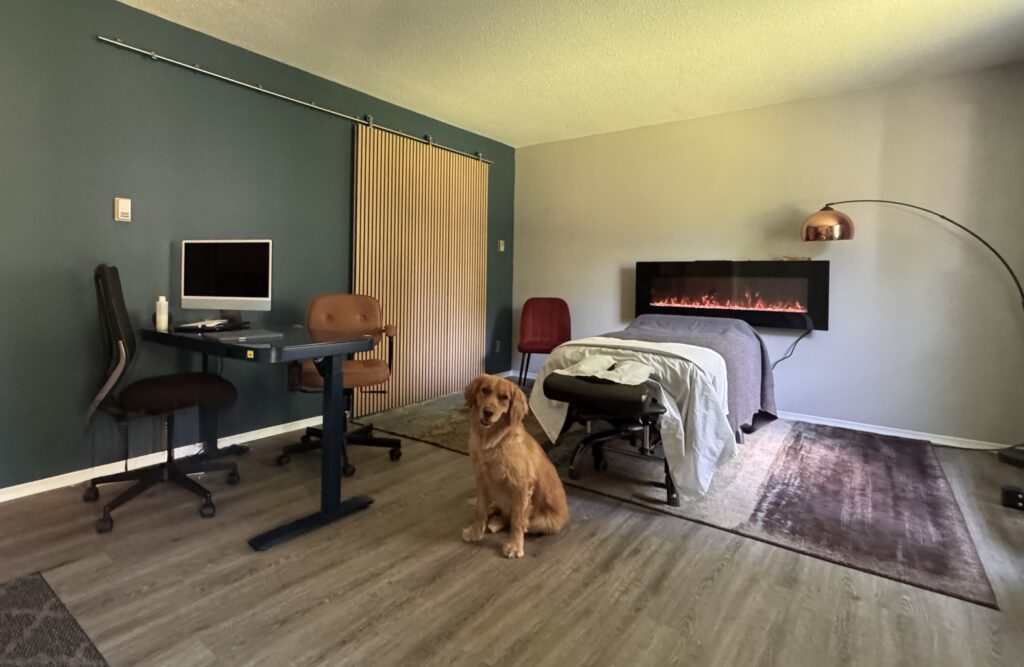
A massage session for teachers with Bruno Panucci RMT works the chain in an order that lets each region settle before the next. You set the pressure. You can adjust it, or stop, at any time. The scale runs from soft through medium to deep, and deep work is available on request, never the default; a tired teaching body often responds better to patient, moderate pressure than to force. Bruno typically opens through the neck and the base of the skull, moves into the shoulders and upper back where the writing arm anchors its tension, eases the marking-hand forearm, and finishes with broad work through the low back once its neighbours have loosened. If it has been a few months since your last massage, take a little less pressure the first time; like a bike ride after a long break, you can feel great during and sore after, and lighter to start means pleasant tenderness rather than soreness. Treatment happens in the private treatment room at his Brantford in-home practice, draped to College of Massage Therapists of Ontario standards, with your consent for each area worked. Two friendly, calm dogs share the room, and if you would rather they were not there, just ask and Bruno will keep them out for your visit.
Can massage help the stress teachers carry?
Massage cannot fix the workload that stresses teachers, and it is honest to say so plainly, but it can ease the physical tension that stress parks in the muscles. Stress is not a side note in this profession. A survey of Chinese primary teachers found at least mild anxiety symptoms in 44.5 percent of them, with perceived stress a strong and independent associated factor (Wang and colleagues, 2026). Stress at work also stood out as a predictor of teacher low back pain, more than tripling the odds in one study (Shegere and colleagues, 2025). Registered Massage Therapy works on the body, not the timetable: it can relax tight muscles, calm a keyed-up system for a while, and give an hour where nothing is owed to anyone. That is worth naming honestly for what it is, short-term relief and a genuine pause, not a treatment for anxiety. If low mood or anxiety is affecting your daily life, speak with your physician. For the muscle-tension side of a stressful term, massage for stress and tension is one supportive tool among several.
Will your extended health plan cover it?
Most teaching contracts carry the kind of extended health coverage that reimburses Registered Massage Therapy, so the benefit is often there and unused. After every session Bruno Panucci RMT provides an official Registered Massage Therapy receipt with everything your insurer needs. Coverage details vary by plan, so check your own annual limit and whether a physician referral is required, since some plans ask for one and others do not. Direct billing is available for most insurers. A session is $115 for 60 minutes at the Brantford in-home practice, a rate kept steady by low overhead. Ninety-minute sessions are available for a term that has really built up; text Bruno to arrange one. If you would like a walk-through of the reimbursement side, making the most of your massage benefits covers how the receipts and annual maximums usually work in Ontario.
Frequently asked questions
How often should a teacher book a massage?
There is no set prescription. Many teachers settle into every four to six weeks once the worst of the neck and back tension eases, and book more often through report-card season or exam marking. Bruno suggests a rhythm based on how long relief actually holds for you, not a package or a membership.
Is massage for teachers covered by benefits?
Usually, yes. Registered Massage Therapy is reimbursable under most extended health plans, the kind most teaching contracts include. Bruno provides an official receipt with everything your insurer needs after every session. Check your own plan for its annual limit and whether a physician referral is required.
Can massage help with teaching stress, not just sore muscles?
It helps the physical side. Massage can relax the muscle tension that stress builds and give you a real pause, and research links high perceived stress to both anxiety and back pain in teachers. It is not a treatment for anxiety itself. If stress or low mood is affecting your daily life, speak with your physician.
Can I book during the school year around my schedule?
Yes. If the online calendar shows nothing that fits between classes or after the bell, text Bruno directly. He can often rearrange to fit you in, sometimes the same day, and he can arrange a time outside the posted hours or a longer 90 minute session when a term has really built up.
Book a massage with Bruno in Brantford
Bruno Panucci RMT treats teaching-related neck, back, and standing-day tension at his in-home practice in Brantford, serving Brant County including Paris, St. George, Mt. Pleasant, and Burford, with occasional mobile visits on request. Sessions are $115 for 60 minutes, with an official Registered Massage Therapy receipt for most extended health plans and direct billing available for most insurers.
Text Bruno at 519-753-5544 (he prefers texts), call the same number, or book online. Need a time outside posted hours, or a longer 90 minute session after a heavy term? Text him. He can often rearrange to fit you in, sometimes the same day.
A note on scope: This page is general information, not medical advice. Massage may ease teaching-related muscle tension in the short term, but it does not diagnose or treat any underlying condition, and results vary. Persistent numbness, tingling, or weakness in an arm, or back pain that is severe or not settling, deserves a physician conversation first. Bruno Panucci is a Registered Massage Therapist (RMT), and works within current RMT scope of practice.
Related reading
- the neck and shoulder end of the marking hunch
- easing the muscle tension of a stressful term
- using your extended health benefits in Ontario
Sources
- Tahernejad S, Hejazi A, Rezaei E, Makki F, Sahebi A, Zangiabadi Z. Musculoskeletal disorders among teachers: a systematic review and meta-analysis. Frontiers in Public Health, 2024. doi.org/10.3389/fpubh.2024.1399552
- Gikaro JM, Goi GC, Taamala FH, Hamadi HH, Welema JC, Minduva ZM, Swai EA. Prevalence and factors associated with musculoskeletal disorders among primary and secondary school teachers. Frontiers in Public Health, 2025. doi.org/10.3389/fpubh.2025.1654131
- Shegere MM, Abdilahi AM, Ali SY, Farah NB, Adem BA, Nour AJ. Magnitude of low back pain and associated factors among primary school teachers in Borama City, Somaliland. BMJ Open, 2025. doi.org/10.1136/bmjopen-2025-099934
- Wang X, Hu Z, Zhong Y, Tao B. Anxiety among Chinese primary school teachers under the “double reduction” policy: prevalence and associated factors. Frontiers in Psychiatry, 2026. doi.org/10.3389/fpsyt.2026.1792092
- College of Massage Therapists of Ontario, Standards of Practice.
- Government of Ontario. Massage Therapy Act, 1991, S.O. 1991, c. 27. ontario.ca/laws/statute/91m27