Bruno Panucci RMT
Frozen Shoulder Massage in Brantford: Patience and Range
Quick answer: Massage for frozen shoulder in Brantford, with Bruno Panucci RMT, is patient, gentle Registered Massage Therapy that works the muscles around a stiff shoulder rather than forcing the joint. It will not thaw a frozen shoulder on a schedule, because adhesive capsulitis follows its own slow phases. What it can do is ease the aching, calm the guarding muscles of the neck, shoulder, and upper back, and keep you more comfortable through a long recovery led by your physician. This page is general information, not medical advice.
Frozen shoulder, known medically as adhesive capsulitis, is a condition in which the capsule around the shoulder joint thickens and tightens, so the shoulder becomes painful, stiff, and hard to move (Yang and colleagues, 2026). It tends to run a long, three-stage course, often over many months, and it usually settles in its own time rather than on anyone’s schedule. Bruno Panucci RMT has spent 25 years as a Registered Massage Therapist in Brantford, working with stiff, painful shoulders across Brantford and the Brant County towns of Paris, St. George, Mt. Pleasant, and Burford. His honest starting point is that massage is not a fix for the frozen capsule itself. It is comfort and support for the muscles that tense up around it, and it sits comfortably alongside the physiotherapy and medical care that lead a frozen-shoulder recovery. For a painful, guarding shoulder, that work overlaps closely with the wider shoulder-pain picture.
Bruno Panucci RMT, 25 years of practice: “The hardest thing to say to someone with a frozen shoulder is that I cannot rush it. In 25 years I have never met a shoulder that thawed faster because someone pushed harder. What I can do is take the load off the muscles that spend all day bracing around the sore joint, so the neck and shoulder blade stop screaming. People walk out looser and calmer, not cured. I would rather promise that and deliver it than sell a miracle that no honest therapist can give.”
In short: massage for frozen shoulder is gentle, patient Registered Massage Therapy that eases the muscle tension and aching that build up around a stiff shoulder. It does not treat, cure, or speed up adhesive capsulitis, which follows its own phases. It works best as comfort and support beside your physician’s and physiotherapist’s care, never in place of it.
6 min read
What is a frozen shoulder, and why is it so stiff?
A frozen shoulder is adhesive capsulitis, a condition where the connective-tissue capsule that wraps the shoulder joint thickens and contracts, leaving the shoulder painful and stiff with a real loss of range of motion (Yang and colleagues, 2026). The stiffness is the defining feature: unlike a simple strain, the shoulder resists movement even when someone else tries to lift it for you, because the tightness is in the joint capsule, not only the muscles. Researchers describe frozen shoulder as a common shoulder disorder marked by pain, stiffness, and reduced function, and note that it has a prolonged course and a tendency to recur (Yang and colleagues, 2026). Because the limitation lives in the capsule, no amount of massage can stretch it open, and forcing the joint tends to flare the pain rather than free it. What massage can reach is the second layer of the problem: the neck, upper back, and shoulder-blade muscles that quietly overwork for months as the body braces around a sore joint and starts favouring the other arm. Much shoulder pain is really the rotator cuff muscles and the tissues around them, covered on its own page.
Can massage help a frozen shoulder?
Massage can help a frozen shoulder feel more comfortable, but the honest version is narrower than the hopeful one. A review of external therapies for adhesive capsulitis, including manual techniques, found they can relieve shoulder pain and support range of motion, while also noting that high-quality evidence and standardized methods remain limited (Yang and colleagues, 2026). In plain terms, the research points in a helpful direction without proving massage changes the course of the condition. Frozen-shoulder recovery leans heavily on gentle, guided movement, and a broad Cochrane overview found that physical activity and exercise for chronic pain tend to improve pain and function with few adverse events, though the quality of evidence is low (Geneen and colleagues, 2017). Massage supports that movement-based care by easing the surrounding muscle tension so gentle exercises are less guarded, which is why it pairs naturally with firmer therapeutic work on the compensating muscles once the shoulder is out of its most painful stage. What it does not do is treat, cure, or speed the frozen capsule, and it belongs alongside your medical care.
A note on pressure: You set the pressure. You can adjust it, or stop, at any time. For a frozen shoulder, Bruno starts at the soft-through-medium end of the soft-to-medium-to-deep scale and stays well away from anything that provokes the joint. Deeper pressure is on request and is saved for the compensating muscles of the neck and upper back that can take it, never for the irritable capsule itself.
What does a frozen-shoulder session look like?
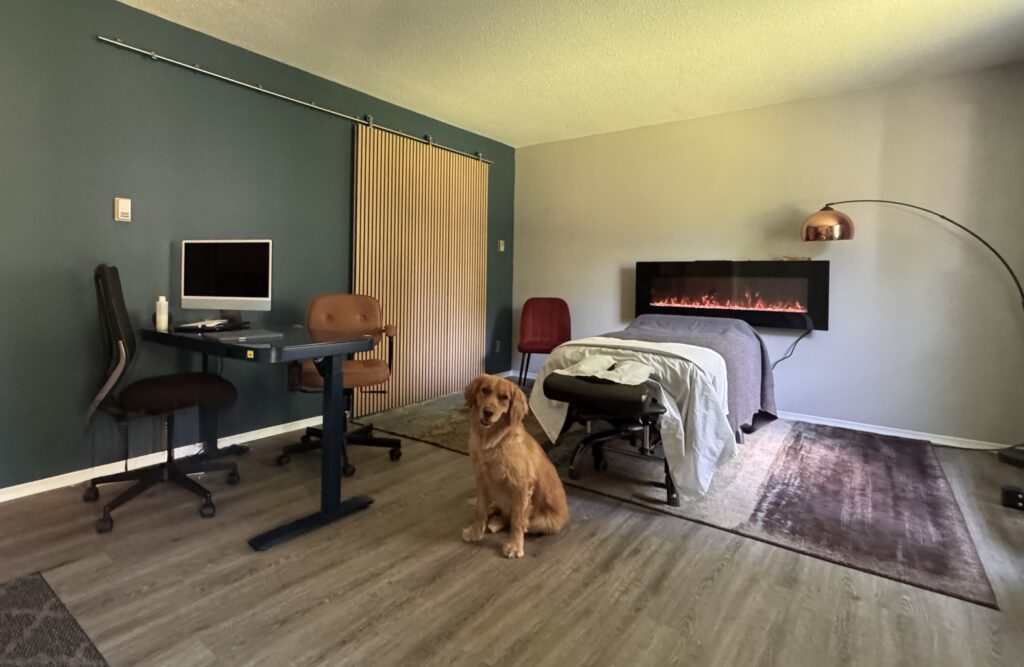
A frozen-shoulder massage session is built around the shoulder without provoking it, and it starts with your history: which stage you are in, what your physician or physiotherapist has advised, and which movements are worst. Bruno Panucci RMT works the muscles that carry the strain of a stiff shoulder, the neck, the upper back, the shoulder blade, and the arm, at a pressure you control, while treating the joint itself with real caution. Positioning matters more than usual here, because lying flat can pull on a sore shoulder, so supported side-lying and pillows are common. Treatment is in the private treatment room at his Brantford in-home practice, draped to College of Massage Therapists of Ontario standards. The table below shows how the work changes with what your shoulder can tolerate on the day.
| What you bring in | How the session adapts |
|---|---|
| Sharp pain with any shoulder movement (early, painful phase) | The joint is left alone. Gentle work stays on the neck, upper back, and shoulder blade to ease guarding. |
| Stiffness more than sharp pain (frozen phase) | Muscles around the joint are worked at medium pressure, with careful, pain-free movement only if it is comfortable. |
| Improving range, aching compensating muscles (thawing phase) | Firmer therapeutic work on the tight neck and upper-back muscles that have overworked for months, on request. |
| Lying flat pulls on the shoulder | Supported side-lying with pillows and bolsters, so the arm is never left hanging. |
| A flare after your last session | We ease off, note it, and stay lighter next time. Progress is never worth a flare. |
How massage fits the phases of recovery
Frozen shoulder moves through phases, and massage plays a different role in each one. In everyday clinical terms, adhesive capsulitis is usually described in three stages: a painful freezing stage, a stiff frozen stage, and a slow thawing stage. Yang and colleagues (2026) describe it as a condition with a prolonged course and a tendency to recur, which fits the way recovery unfolds slowly rather than on a schedule. Studies of newer physiotherapy techniques for the condition still describe it plainly as pain, stiffness, and reduced function that standard care works to improve over weeks of sessions (Rahman and colleagues, 2026), a reminder that recovery is measured in weeks and months, not single visits. In the painful early stage, gentle massage is about comfort and calming the muscles that brace against pain. In the frozen stage, it keeps the surrounding muscles from seizing up while your movement work does the slow job on the joint. In the thawing stage, when range is returning, firmer therapeutic work helps the overworked compensating muscles let go. Bruno Panucci RMT reads where you are and works within it, and he will always say when a session should stay light. Because frozen-shoulder care is a long partnership rather than a quick fix, it also helps to know what a first visit involves before you start.
How it works with your medical care
Massage for frozen shoulder works as one supporting part of a plan your physician leads. Adhesive capsulitis is a medical condition, and its diagnosis, imaging, injections, and any decision about physiotherapy or surgery belong with your doctor and physiotherapist. Registered Massage Therapy sits alongside that care as comfort and muscle support, in the same way gentle range-of-motion exercises and heat do. Bruno Panucci RMT is glad to work in step with what your healthcare team advises, and he will tell you plainly when something is outside what massage can help. A 60-minute session at his Brantford in-home practice is $115, receipts work with most extended health plans, and because the practice runs from his own home the lower overhead keeps the price fair, so your benefits stretch further across the series of visits a frozen shoulder often needs. Direct billing is available for most insurers.
Frequently asked questions
Can massage cure or speed up a frozen shoulder?
No. A frozen shoulder is caused by tightening inside the joint capsule, and massage cannot reach or release that, so it does not cure adhesive capsulitis or make it thaw faster. Frozen shoulder follows its own slow phases over many months. What massage can do is ease the aching and muscle tension that build up around the stiff joint, which helps you stay more comfortable through a recovery led by your physician and physiotherapist.
Will the massage hurt my frozen shoulder?
It should not. Bruno keeps the pressure at the soft-to-medium end and stays away from anything that provokes the joint, working mainly on the neck, upper back, and shoulder-blade muscles that overwork around a stiff shoulder. You set the pressure and can adjust it or stop at any time. Forcing a frozen shoulder tends to flare the pain rather than free it, so a good session for this condition is patient and gentle, not aggressive.
Which stage of frozen shoulder is best for massage?
Massage can help in every stage, but the work changes. In the early painful stage it stays gentle and focuses on calming the guarding muscles rather than the joint. In the frozen stage it keeps the surrounding muscles from seizing while your movement work continues. In the thawing stage, firmer therapeutic work on the tired compensating muscles is often welcome. Tell Bruno which stage you are in and what your care team has advised, and the session adapts.
Should I see a doctor before booking a massage for my shoulder?
Yes, a stiff, painful shoulder should be assessed by your physician so you know what you are dealing with, since frozen shoulder can look like other shoulder problems. Massage is comfort and muscle support, not a diagnosis or a treatment for the condition itself. If your shoulder pain is sudden, severe, follows an injury, or comes with numbness or weakness, see your physician before booking. Bruno works alongside your medical care, not instead of it.
Book a frozen-shoulder massage with Bruno in Brantford
Bruno Panucci RMT offers gentle, patient Registered Massage Therapy for stiff and painful shoulders at his in-home practice in Brantford, serving Brant County including Paris, St. George, Mt. Pleasant, and Burford, with occasional mobile visits on request. Sessions are $115 for 60 minutes, and a shorter or lighter session is always a valid choice for a sore shoulder. Receipts are provided for most extended health plans, with direct billing available for most insurers.
Text Bruno at 519-753-5544 (he prefers texts), call the same number, or book online. If you need a time the calendar does not show, a shorter session, or a 90-minute session, text him directly. He can often rearrange to fit you in, sometimes the same day. Two friendly, calm dogs share the treatment room and can be kept out on request if you prefer.
A note on scope: This page is general information, not medical advice. Frozen shoulder is a real medical condition, and its diagnosis and management belong with your physician and physiotherapist; massage is comfort and muscle support, not a treatment or a cure. If your shoulder pain is sudden, severe, follows an injury, or comes with numbness, weakness, or fever, see your physician before booking massage. Bruno Panucci is a Registered Massage Therapist (RMT), and works within current RMT scope of practice.
Related reading
- easing a painful, guarding shoulder
- firmer work on the compensating muscles
- what to expect at your first visit
Sources
- Yang J, Gao Y, Zhang G. Progress in the Treatment of Adhesive Capsulitis with External Therapies of Traditional Chinese Medicine: A Comprehensive Review. Journal of Pain Research, 2026. doi.org/10.2147/jpr.s609518
- Rahman MR, Halder P, Hossain ME, Ashfaquzzaman M, Mahmud MN, Paul RC, Sheikh MS, Utshab KZ, Hasan MM, Hossain MM. Adding reciprocal inhibition to conventional physiotherapy for adhesive capsulitis of the shoulder in Bangladesh: a study protocol for a randomised controlled trial. BMJ Open, 2026. doi.org/10.1136/bmjopen-2025-108667
- Geneen LJ, Moore RA, Clarke C, Martin D, Colvin LA, Smith BH. Physical activity and exercise for chronic pain in adults: an overview of Cochrane Reviews. Cochrane Database of Systematic Reviews, 2017; Issue 4: CD011279. doi.org/10.1002/14651858.cd011279.pub3
- College of Massage Therapists of Ontario, Standards of Practice.
- Government of Ontario. Massage Therapy Act, 1991, S.O. 1991, c. 27. ontario.ca/laws/statute/91m27