Bruno Panucci RMT
Massage for Cyclists in Brantford: Neck, Back, and Legs
Quick answer: Massage for cyclists is Registered Massage Therapy aimed at the pattern riding builds: a hunched neck and upper back, tight hip flexors, and hard-working quads and calves. Bruno Panucci RMT works that whole pattern at his Brantford in-home practice, $115 for 60 minutes, at the pressure you choose from soft through medium to deep. It can ease tension and support recovery, but it does not cure injuries or replace a proper bike fit. This page is general information, not medical advice.
Massage for cyclists is Registered Massage Therapy shaped around what time in the saddle does to a body: a neck held in extension to watch the road, a rounded upper back, hands and forearms loaded on the bars, hip flexors folded shut, and quads, calves, and glutes that never really switch off on a long ride. Bruno Panucci RMT has treated that pattern for 25 years, and it arrives at his Brantford in-home practice on road cyclists, gravel riders, and weekend commuters from across Brant County, Paris, St. George, Mt. Pleasant, and Burford. Riders who train hard often book it as part of their recovery routine, though the tension usually spans more of the body than a sore spot or two.
Bruno Panucci RMT, 25 years of practice: “You can often read a keen cyclist off the top of the shoulders and the front of the hips. The neck has been craning up for hours, so the base of the skull and the upper traps are wound tight, and the hip flexors have learned the folded shape of the pedal stroke. I can ease all of that, and most riders feel looser and move better afterward. What I will always tell you straight is that a massage does not correct your saddle or your bar height. If the same ache keeps returning after every long ride, the real fix is usually the fit, not more of me.”
In short: cycling loads the body in one long, held position, so the neck, upper back, hips, and legs tighten together rather than one at a time. Massage can ease that built-up tension and help a rider recover between sessions, while bike fit and strength work are what keep it from coming back.
6 min read
Why does cycling leave you tight in the neck, back, and legs?
Cycling leaves you tight in several places at once because the riding position is one shape held for a long time, and the body adapts to the shape it spends the most hours in. On the bike your neck extends to keep your eyes up the road, your upper back rounds over the bars, your hands and forearms carry weight and brake, your hips stay folded through every pedal stroke, and your quads, calves, and glutes do the driving. None of it happens in isolation, which is why chasing one sore muscle tends to underwhelm. Bruno Panucci RMT treats the cyclist’s body as a connected chain rather than a single complaint. Here it is at a glance.
| Region | What riding does to it | What the session works on there |
|---|---|---|
| Neck and upper traps | Held in extension to watch the road; the upper traps hold the head up | Slow work at the base of the skull, the neck, and the upper traps |
| Upper back and shoulders | Rounds over the bars while the chest shortens | Releases the chest, then the mid-back muscles that resist the round |
| Hands, wrists, forearms | Carry body weight and brake for the length of the ride | Eases the forearm and hand muscles loaded on the bars |
| Hips and glutes | Hip flexors fold shut; the glutes work under load | Lengthens the front of the hip and works the glutes |
| Quads, calves, hamstrings | Drive every pedal stroke and rarely switch off | Broad, unhurried work through the big leg muscles |
What can massage do for a cyclist’s neck and shoulders?
A cyclist’s neck and shoulders carry the cost of looking up the road. In a riding position the head tips back slightly so the eyes stay level, and the muscles at the base of the skull and along the upper trapezius hold that posture for the whole ride. Over a long season that steady, low-grade effort becomes the stiff, gripping tightness many riders feel once they climb off. You set the pressure. You can adjust it, or stop, at any time. Massage for the neck and shoulders works slowly through those muscles and the tissue around the shoulder blades to ease the holding pattern, and Bruno keeps the scale soft through medium to deep, with deep work on request rather than by default, because a wound-up neck usually answers better to patience than to force. A focused neck and shoulder treatment is often where a rider’s first appointment starts.
Can massage help a cyclist’s lower back?
A cyclist’s lower back is one of the most common places the sport shows up. Bent forward over the bars for hours, the low back holds a sustained forward-flexed position while the legs drive underneath it. Lower back pain is one of the most common overuse complaints among cyclists and is frequently linked to bike setup, and a systematic review found that individualized bike-fitting, tailored to the rider, appeared to be an effective strategy for reducing it (Barrajon and colleagues, 2026). That is worth being honest about: massage can ease the muscular tension a ride builds along the lower back and hips, and many riders feel real relief, but it does not change your saddle height or reach. A session focused on the lower back eases the load the tissue is carrying; if the same ache returns after every long ride, a proper bike fit is usually the more lasting answer. Treatment happens in the private treatment room at Bruno’s Brantford in-home practice, draped to College of Massage Therapists of Ontario standards, with your consent for each area.
What about tight hips, quads, and cyclist’s knee?
A cyclist’s legs and hips do the actual work, so they take the actual load. The quads, calves, hamstrings, and glutes fire through every pedal stroke, while the hip flexors stay short in the folded riding position. That workload has a way of concentrating into specific problems: common overuse injuries in cyclists include Achilles tendinopathy, patellofemoral pain, and iliotibial band syndrome (Navarro-Martinez and colleagues, 2026). Patellofemoral pain in particular, the ache felt around the front of the knee, is a frequent cyclist complaint, and an expert consensus on managing it in recreational riders built the self-management programme around strengthening exercises and education (Masoudi and colleagues, 2026). Massage fits into that picture as support, not cure. Easing tight quads, calves, and the muscles around a cranky IT band can leave a rider more comfortable and easier to move, while the strengthening and any fit changes do the work of keeping the problem away. Persistent knee pain, or pain that sharpens under load, is worth a conversation with your physician before you assume it is only muscular.
How should a cyclist use massage for training and recovery?
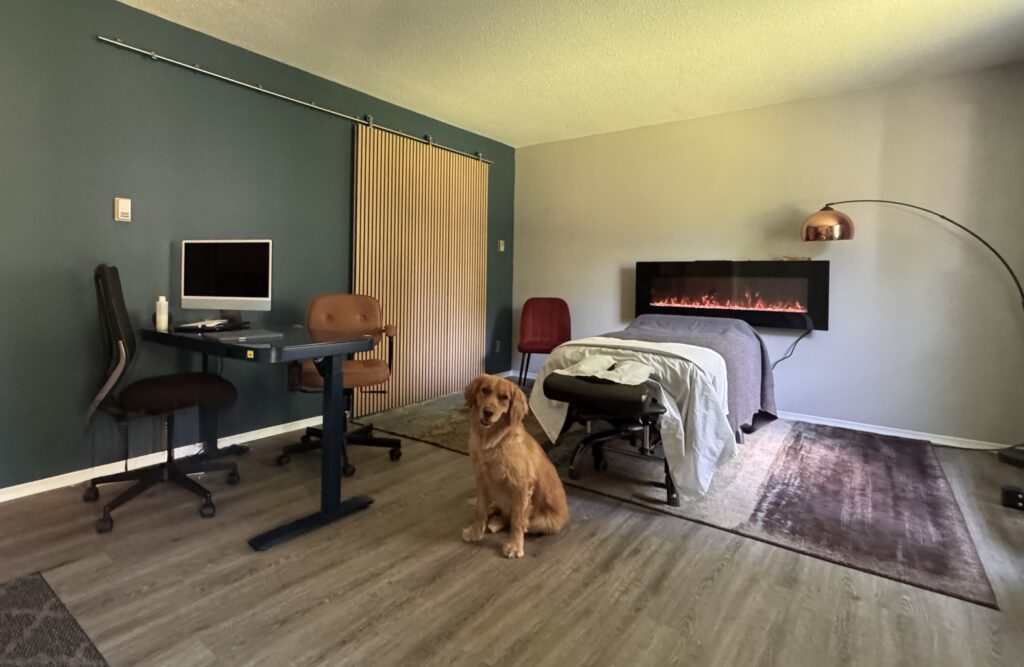
Fitting massage around training works best when you treat it as recovery support, not a performance switch. There is no single right time; many riders book after a hard block or a long event, when the legs are heavy, and space their appointments by how training is going rather than by a fixed schedule. One common idea is worth clearing up: massage does not flush lactic acid or toxins out of the muscles, and it will not speed the body’s healing on its own. What it can reasonably do is ease the tightness and soreness that stack up across a training week, which is often enough to help a rider feel readier for the next ride. A session runs $115 for 60 minutes at Bruno’s in-home practice in Brantford, and if you want the legs and back given unhurried time, you can text him about a 90 minute session. Two friendly, calm dogs share the treatment room, and they can be kept out if you would rather. Receipts work with most extended health plans, with direct billing available for most insurers.
Frequently asked questions
Is it better to get a massage before or after a ride?
Most cyclists book massage as recovery, so after a hard ride or a big event is the common choice, once the effort is done. A firm, deep massage right before a race is not ideal, because it can leave the muscles feeling worked rather than fresh. If you want something pre-ride, keep it light and brief. Bruno can tailor the pressure and pacing to where you are in your training.
Can massage fix cyclist’s knee or IT band pain?
Massage does not fix the underlying cause, and it would be dishonest to say it does. It may ease the tight quads, calves, and hip muscles around a sore knee or IT band and leave you more comfortable, but strengthening work and often a bike fit are what address the source. Knee pain that persists or sharpens under load deserves a conversation with your physician.
How often should a cyclist book a massage?
There is no set rule. Many riders come in every few weeks through their main season and less often over the winter, adjusting to how their body feels and how hard they are training. Bruno suggests a rhythm based on how long the relief actually holds for you, not a package.
Does massage flush lactic acid or toxins after a long ride?
No. Massage does not flush lactic acid or remove toxins, and it does not detox the body; that is a myth worth setting aside. What it can do is ease the muscle tightness and soreness that build up across a training week, which many riders find helps them feel readier for the next ride.
Book a cyclist’s massage with Bruno in Brantford
Bruno Panucci RMT treats cycling tension at his in-home practice in Brantford, serving Brant County including Paris, St. George, Mt. Pleasant, and Burford, with occasional mobile visits on request. Sessions are $115 for 60 minutes, with receipts for most extended health plans and direct billing available for most insurers.
Text Bruno at 519-753-5544 (he prefers texts), call the same number, or book online. Riding a hard block and want the legs and back given proper time? Text him about a 90 minute or two hour session, or a time outside the posted hours. He can often rearrange to fit you in, sometimes the same day.
A note on scope: This page is general information, not medical advice. Registered Massage Therapy can ease cycling-related muscle tension and support recovery, but it does not diagnose or treat injuries, cure any condition, or replace a proper bike fit, and results vary. Sudden or severe pain, a joint that gives way, numbness or tingling in the hands or legs, or knee pain that keeps sharpening under load should be checked by your physician first. Bruno Panucci is a Registered Massage Therapist (RMT), and works within current RMT scope of practice.
Related reading
- Easing a stiff neck and shoulders
- Massage for a sore lower back
- Sports and recovery massage in Brantford
Sources
- Barrajon C, Legaz-Arrese A, Cirer-Sastre R, Lopez-Laval I, Sitko S. Effects of Bike-Fitting on Lower Back Pain in Cyclists: A Systematic Review. Cureus, 2026. doi.org/10.7759/cureus.101718
- Navarro-Martinez D, Zahonero J, Vera P, Marti-Marti J, Huertas F, Barrios C. Effect of Power Output and Pedaling Cadence on Plantar Pressures in Professional Cyclists with Overuse Injuries. Sports, 2026; 14(5): 184. doi.org/10.3390/sports14050184
- Masoudi A, Bello B, Chemane N, Useh U, Magida N. Reaching a consensus on a patellofemoral pain syndrome self-management programme for recreational cyclists in Saudi Arabia: A modified Delphi study. South African Journal of Physiotherapy, 2026; 82(1): 2271. doi.org/10.4102/sajp.v82i1.2271
- College of Massage Therapists of Ontario, Standards of Practice.
- Government of Ontario. Massage Therapy Act, 1991, S.O. 1991, c. 27. ontario.ca/laws/statute/91m27