Bruno Panucci RMT
Massage for Farmers in Brantford: The Body a Season Wears Down
Quick answer: Massage for farmers is Registered Massage Therapy aimed at the wear a season of farm work leaves in the low back, shoulders, hands, and forearms. Bruno Panucci RMT treats that pattern at his Brantford in-home practice, $115 for 60 minutes, at the pressure you choose from soft through medium to deep. Massage can ease the stored tension, but it does not undo the workload or prevent the next strain. This page is general information, not medical advice.
Massage for farmers is Registered Massage Therapy aimed at the specific wear a season of farm work leaves in a body: a low back that has bent and lifted since spring, shoulders that have hauled and reached, and hands and forearms that grip tools from dawn. Bruno Panucci RMT has treated that pattern for 25 years, and it arrives at his Brantford in-home practice attached to farmers from across Brant County, Paris, St. George, Mt. Pleasant, and Burford. The booking usually begins with work on the low back that farm labour loads first, though on a farm body the tension rarely stays in one place.
Bruno Panucci RMT, 25 years of practice: “I can tell harvest is over by who walks in. A farmer’s low back has been folding forward since the spring, the shoulders have hauled and reached all season, and the hands do not want to open all the way anymore. I am not going to tell you one hour undoes a year of that. What I can do is take the load down a few notches, work the places the season parked its tension, and send you back to the next job moving easier. I would rather promise you that than something I cannot keep.”
In short: farm work loads the same joints for months at a stretch. The low back bends and lifts, the shoulders reach and haul, and the hands and forearms grip tools all day. Massage can ease that stored tension and help you move more comfortably. It does not undo the workload, speed healing, or prevent the next strain.
6 min read
What does a season of farm work do to the body?
A season of farm work loads the body the way few other jobs do: long hours of bending, lifting, reaching overhead, and gripping, repeated for months without a real off-switch. Musculoskeletal disorders are the predictable result. Reviewing agricultural work, Kaur and colleagues (2026) describe musculoskeletal disorders as a significant but under-researched occupational health burden among farming populations. The low back tends to carry the most of it. In a systematic review of low back pain studies, Louw and colleagues (2007) noted one included study in which farming raised the odds of low back pain roughly fourfold compared with people not doing farm work. Bruno Panucci RMT has treated that pattern for 25 years across Brantford and the farming towns of Brant County. Massage does not change the workload, but it can ease what the workload leaves behind.
Which parts of a farmer’s body does massage help most?
The parts of a farmer’s body that massage helps most are the ones the work loads hardest: the low back, the shoulders, and the hands and forearms. Each region tells on itself. The low back absorbs the bending and lifting. The shoulders and upper back take the overhead work, the hauling, and the reaching held for long stretches, which is why shoulder tension from repeated overhead work is so common by the end of a season. The hands and forearms grip tools, gates, and equipment thousands of times a day, and they are often the last thing to let go at night. A session works the region that is loudest for you, in an order that makes each one easier to treat.
| Region | What farm work does to it | What the session does there |
|---|---|---|
| Low back and hips | Hours of bending, lifting, and twisting through the day | Broad, unhurried work through the low back and the muscles around the hips |
| Shoulders and upper back | Overhead work, hauling, and reaching, held for long stretches | Releases the upper back and the muscles around the shoulder joint |
| Hands and forearms | Constant gripping of tools, gates, and equipment | Works the forearms from wrist to elbow to ease a grip that will not switch off |
| Neck | Looking down at close work and up at high work all day | Slow work through the neck and the base of the skull |
How much pressure should a farmer choose, and what is a session like?
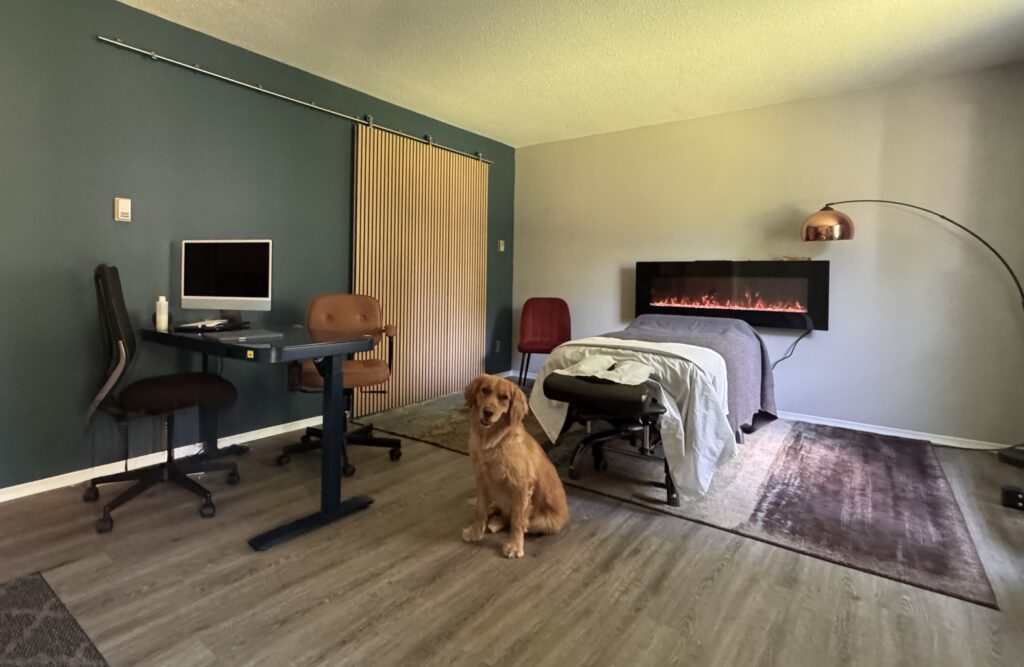
A massage session for a farmer starts with a simple rule: you set the pressure. You can adjust it, or stop, at any time. The scale runs from soft through medium to deep, and the deepest work is available on request, never the default. Farm clients often ask for deep pressure straight away, and Bruno Panucci RMT can deliver it, but a body that has been worked hard all season often responds better to steady, moderate pressure than to force. If it has been months since your last massage, a little less pressure the first time leaves you with pleasant tenderness rather than soreness. Treatment happens in the private treatment room at his Brantford in-home practice, draped to College of Massage Therapists of Ontario standards, with your consent for each area of work. Two friendly, calm dogs share the room, and they can be kept out if you have allergies or would simply rather they were not there.
When in the farming season should you book a massage?
The right time to book a massage as a farmer is whenever the season is loading you hardest, and again when it lets up. Through planting and harvest, regular sessions can keep the tension from stacking week over week. In the quieter months, a session helps the body recover from what the busy stretch left behind. Massage eases the pattern; it does not prevent the next strain, and honest conditioning between visits does more of the preventing. Presented at the 3rd IPLeiria International Health Congress, Leitão and colleagues (2016) reported that a workplace exercise program reduced musculoskeletal pain complaints across the neck, shoulders, low back, and knees among a group of workers. The lesson for a farm body is that movement and simple conditioning around the work, not only treatment after it, carry the long game.
Do farmers and rural workers in Brant County have massage covered?
Coverage for massage depends on your plan, and it varies a lot across a farm community. Employed farm and rural workers often carry extended health benefits that reimburse Registered Massage Therapy, and Bruno provides a receipt with his name and RMT designation after every session so you can claim it. Many self-employed farmers have no such plan, which is where the in-home model earns its keep: working from his own in-home practice keeps overhead low, so the rate stays fair at $115 for 60 minutes, and a private-pay session does not have to feel like a luxury. Direct billing is available for most insurers. Bruno serves clients across Brant County, from Brantford out to the surrounding farming towns, with a limited number of mobile visits on request.
Frequently asked questions
Can massage fix an injury from farm work?
No, and it would be wrong to claim it can. Massage may ease muscle tension and help you move more comfortably, but it does not diagnose or heal an injury. A fall, a crush, or pain from a machinery incident needs a physician first. Once you are cleared, massage can support the recovery around it.
Do I need to shower after a day in the field before a session?
No. Come as you are. A bit of dust or a full work day on you is completely normal and expected, and it changes nothing about the treatment. The room is private and the work is clinical.
Should farmers just ask for the deepest pressure?
Not by default. Deep pressure is available on request, but a body worn down by a season often responds better to steady, moderate pressure than to force. You set the pressure and can change it, or stop, at any time.
Will my benefits cover massage, and can I claim it?
If you have an extended health plan that includes Registered Massage Therapy, usually yes. Bruno Panucci RMT provides a compliant receipt with his name and RMT designation after every session, so you can submit it; check your plan for its annual limit. Direct billing is available for most insurers.
Book a massage with Bruno in Brantford
Bruno Panucci RMT treats farm-work tension at his in-home practice in Brantford, serving Brant County including Paris, St. George, Mt. Pleasant, and Burford, with a limited number of mobile visits on request. Sessions are $115 for 60 minutes, with receipts for most extended health plans and direct billing available for most insurers.
Text Bruno at 519-753-5544 (he prefers texts), call the same number, or book online. Need a time outside the posted hours, after a long day in the field, or a longer 90 minute or two hour session? Text him directly. He can often rearrange to fit you in, sometimes the same day.
A note on scope: This page is general information, not medical advice. Massage may ease farm-related muscle tension in the short term, but it does not diagnose or treat underlying conditions, and results vary. Sudden or severe back pain, pain after a fall or a machinery incident, or numbness, tingling, or weakness in an arm or leg deserves a physician conversation first. Bruno Panucci is a Registered Massage Therapist (RMT), and works within current RMT scope of practice.
Related reading
- Massage for the low back that farm work loads first
- Easing shoulder pain from overhead and hauling work
- Registered Massage Therapy across Brant County
Sources
- Kaur G, Qureshi I, Bagde A. Agriculture-related musculoskeletal disorders among farming populations in rural India: focus on vulnerable communities, protocol for a scoping review. BMJ Public Health, 2026. doi.org/10.1136/bmjph-2025-004555
- Louw QA, Morris LD, Grimmer-Somers K. The prevalence of low back pain in Africa: a systematic review. BMC Musculoskeletal Disorders, 2007; 8: 105. doi.org/10.1186/1471-2474-8-105
- Leitão C, Velosa F, Carecho N, Coelho L. Prevention of musculoskeletal disorders through an exercise protocol held in labour context. In: Proceedings of the 3rd IPLeiria’s International Health Congress. BMC Health Services Research, 2016; 16(Suppl 3): O103. doi.org/10.1186/s12913-016-1423-5
- College of Massage Therapists of Ontario, Standards of Practice.
- Government of Ontario. Massage Therapy Act, 1991, S.O. 1991, c. 27. ontario.ca/laws/statute/91m27