Bruno Panucci RMT
Massage for Truck Drivers in Brantford: Seated All Day
Quick answer: Massage for truck drivers is Registered Massage Therapy aimed at the seated-all-day body: a loaded low back, a held-still neck and shoulders, and muscles fatigued by hours of whole-body vibration. Bruno Panucci RMT works that pattern at his Brantford in-home practice, $115 for 60 minutes, at the pressure you choose from soft through medium to deep. Massage may ease the muscular ache and stiffness; it does not fix a disc problem or remove the vibration exposure itself. This page is general information, not medical advice.
Massage for truck drivers is Registered Massage Therapy shaped around one long-haul reality: a body held in a driving posture for hours, absorbing seat vibration, with few chances to stand and reset. Bruno Panucci RMT has treated that pattern for 25 years, and it arrives at his Brantford in-home practice attached to drivers from across Brant County, Paris, St. George, Mt. Pleasant, and Burford. The complaint is usually the low back first, then the neck and shoulders. Most bookings begin with focused work through the low back, because in a driving body that region carries the biggest share of the load.
Bruno Panucci RMT, 25 years of practice: “A driver’s low back tells me how long the last haul was before they say a word. The seat holds you in one shape and hums underneath you for hours, so the muscles never get to switch off. I can loosen what the road tightened and give you real relief for the week. What I cannot do is take the miles back out of your spine, and I will always be straight with you about that line.”
In short: long-distance driving loads the low back, locks the neck and shoulders in a fixed gaze, and adds hours of seat vibration that keeps muscles working with no break. A massage built for drivers eases that muscular fatigue and stiffness. It does not undo the exposure or repair a joint, so it works best paired with movement and a physician when something is more than muscle.
6 min read
Why do truck drivers get low back and neck pain?
Truck drivers get low back and neck pain because the job stacks three things the body dislikes: prolonged sitting, a fixed posture, and long hours doing it. A cross-sectional study of professional drivers found chronic pain concentrated exactly where a cab holds you, with the upper back, lower back, shoulders, and neck the most affected regions, and it reported that longer daily shift hours sharply raised the odds of pain in each (Gopakumar and colleagues, 2025). A study of taxi drivers found a similar picture, with 83 percent reporting pain in at least one region over a year and the lower back, neck, and right shoulder leading the list (Marín-Berges and colleagues, 2026). The pattern is not random. It is the driving position, held and repeated, until the muscles that maintain it stay switched on. Bruno Panucci RMT treats that held pattern as connected work, not as one sore spot. The same held-posture chain shows up in trades and site work too, which is why manual and seated trades share a lot of it.
What does whole-body vibration do to a driver’s back?
Whole-body vibration is the low, constant shaking transmitted from the seat into the body over a driving shift, and it is one of the recognized occupational loads on a driver’s spine. A cross-sectional study of 632 workers who spend their shifts in vibrating seats, long-haul truck drivers and heavy machine operators, measured seat vibration and found a 12-month chronic low back pain prevalence of 42.5 percent across the whole group, with exposure at or above the standard action value associated with a higher rate of chronic low back pain (adjusted relative risk 1.22) (Nyarubeli and colleagues, 2026). Length of exposure matters as much as intensity: a longitudinal study of public transportation drivers found low back pain correlated with tenure, independent of age and other factors, pointing to cumulative exposure over a career rather than any single bad trip (Popescu and colleagues, 2025). Here honesty matters, and it is the guard Bruno keeps on this whole topic. Massage does not reduce vibration exposure and it does not reverse changes inside a joint or disc. What it can do is ease the muscular fatigue and guarding that build on top of the exposure, which is a real and worthwhile part of how a driving body feels day to day.
What does a massage session for a driver actually work on?
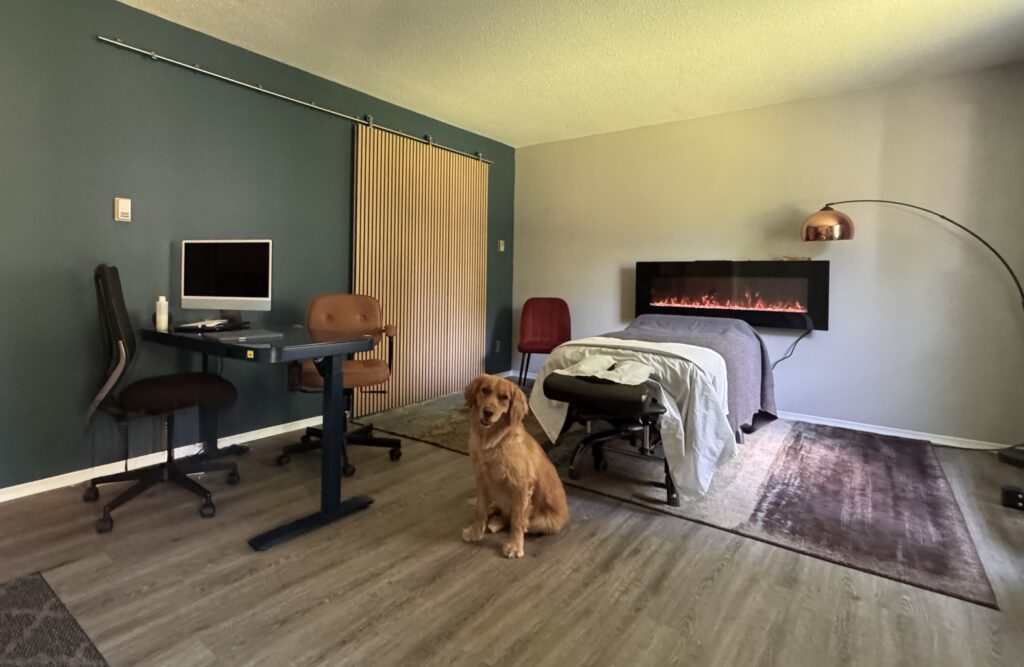
A massage session for a driver works through the regions the cab loads, in an order that makes each one easier to treat. You set the pressure. You can adjust it, or stop, at any time. The scale runs from soft through medium to deep, and deep work is on request, never the default, because a fatigued driving body often responds better to patient, moderate pressure than to force. Bruno Panucci RMT typically opens the low back and hips where the seated load concentrates, then works the mid-back and shoulders that hold the wheel and the mirrors, and finishes at the neck and the base of the skull that carry a fixed forward gaze. Treatment happens in the private treatment room at his Brantford in-home practice, draped to College of Massage Therapists of Ontario standards, with your consent for each area. Two friendly, calm dogs share the treatment room, and if you would rather they were not in during your session, just ask and Bruno will keep them out.
What can massage help with, and what is out of its lane?
Massage for drivers has a clear lane, and staying inside it is the point. It can ease muscular tension, stiffness, and the fatigue that a shift of sitting and vibration leaves in the low back, hips, shoulders, and neck, and it can make the between-haul days more comfortable. It is not a fix for a disc problem, a pinched nerve, or the vibration exposure itself, and it would be dishonest to sell it as one. The evidence here is about symptom burden and quality of life, not cure: drivers with pain in two or more regions reported meaningfully worse physical quality of life, which is where easing the muscular layer genuinely helps (Marín-Berges and colleagues, 2026). One line matters more than the rest. Numbness, pins and needles, or pain shooting down a leg is a signal to see your physician first, before booking massage, because that can point to something a Registered Massage Therapist is not the right person to treat on its own.
What keeps the relief lasting between hauls?
What makes driver-massage relief last is what happens between sessions, and being straight about that beats overselling the table. Massage eases the pattern; the seat and the miles rebuild it, so movement does most of the preventing. Every driver study points the same way, toward breaking up the unbroken sitting: micro-breaks to stand and walk when a stop allows, a minute of moving before climbing back in, and small setup changes like seat and lumbar adjustment. The research on tenure and cumulative exposure is really an argument for starting these habits early rather than waiting for the pain to settle in (Popescu and colleagues, 2025). Bruno Panucci RMT will talk through a rhythm that fits your route, not a package, and each session starts from a better baseline when a little daily movement is doing its part.
Frequently asked questions
How often should a truck driver book a massage?
There is no fixed prescription. Many drivers settle into every three to five weeks once the worst of the tension eases, and shorten the gap during long-haul stretches. Bruno suggests a rhythm based on how long relief actually holds for you, never a prepaid package.
Can massage fix low back pain caused by driving?
Massage can ease the muscular tension, stiffness, and fatigue that driving builds, which often makes daily life more comfortable. It does not repair a disc or remove vibration exposure. If you have numbness, tingling, or pain running down a leg, see your physician first.
Is massage for drivers covered by benefits?
Usually, yes. Registered Massage Therapy is reimbursable under most extended health plans. Bruno provides an official Registered Massage Therapy receipt with everything your insurer needs after each session; check your own plan for its annual limit. Direct billing is available for most insurers.
I sit for ten hours a day. Should I choose deep pressure?
Not necessarily. A fatigued driving body often responds better to patient, moderate pressure than to heavy force. You set the pressure, from soft through medium to deep, and deep work is only ever on request. You can adjust it, or stop, at any point in the session.
Book a massage with Bruno in Brantford
Bruno Panucci RMT treats driving-related low back, shoulder, and neck tension at his in-home practice in Brantford, serving Brant County including Paris, St. George, Mt. Pleasant, and Burford, with occasional mobile visits on request. Sessions are $115 for 60 minutes, with an official Registered Massage Therapy receipt for most extended health plans and direct billing available for most insurers.
Text Bruno at 519-753-5544 (he prefers texts), call the same number, or book online. Driving through and need a time the calendar does not show, or a longer 90-minute or two-hour session? Text him. He can often rearrange to fit you in, sometimes the same day.
A note on scope: This page is general information, not medical advice. Registered Massage Therapy may ease driving-related muscle tension and stiffness in the short term, but it does not diagnose or treat disc problems, nerve compression, or the vibration exposure itself, and results vary. Numbness, tingling, or pain radiating down a leg deserves a physician conversation first. Bruno Panucci is a Registered Massage Therapist (RMT), and works within current RMT scope of practice.
Related reading
- low back massage, the driver’s first stop
- the seated and manual trades pattern
- finding a maintenance rhythm that fits your route
Sources
- Nyarubeli I, Sakwari G, Chombo S, Reuben S, Msangi N, Duguza R, Francis B, Lwaho S, Omar A, Mduma J. Whole-body vibration exposure and chronic low back pain among heavy machine operators and long-haul truck drivers in Tanzania: a cross-sectional study. Frontiers in Public Health, 2026. doi.org/10.3389/fpubh.2026.1735367
- Gopakumar G, V A, Surathkumaar H, T R, Viswanath S, Joseph J. Prevalence of Musculoskeletal Disorders and Associated Risk Factors Among Professional Drivers in Chromepet, Chengalpattu District: A Cross-Sectional Study. Cureus, 2025. doi.org/10.7759/cureus.85655
- Marín-Berges M, Gómez-Bruton A, Lizana PA, Cáceres M, Magaña P, Iguacel I. Association between musculoskeletal disorders and health-related quality of life in Chilean and Spanish taxi drivers. AIMS Public Health, 2026. doi.org/10.3934/publichealth.2026005
- Popescu FG, Bolocan C, Oancea M, Drăgoi II, Herisanu N, Oancea C, Kundnani NR, Handra CM, Oțelea MR, Surducan DA. Work-Related Disorders in Public Transportation Drivers and the Length of Exposure. Journal of Clinical Medicine, 2025. doi.org/10.3390/jcm14145018
- College of Massage Therapists of Ontario, Standards of Practice.
- Government of Ontario. Massage Therapy Act, 1991, S.O. 1991, c. 27. ontario.ca/laws/statute/91m27