Bruno Panucci RMT
Rotator Cuff Massage in Brantford: The Muscles Around the Joint
Quick answer: Rotator cuff massage in Brantford, with Bruno Panucci RMT, is Registered Massage Therapy for the muscles and soft tissue around the shoulder, not a fix for the joint itself. Easing tension in the rotator cuff, the neck, and the upper back may reduce pain and help the shoulder move more comfortably, and the evidence is strongest when hands-on work sits alongside exercise. Massage supports the shoulder. It does not repair a torn tendon or replace your physician. This page is general information, not medical advice.
The rotator cuff is a group of four muscles and their tendons that wrap the shoulder and hold the ball of the joint steady in its socket while the arm moves. When those muscles are overworked, guarded, or irritated, the whole shoulder can ache, catch, or feel weak overhead. Bruno Panucci RMT has spent 25 years as a Registered Massage Therapist in Brantford, working with shoulders across Brantford and the Brant County towns of Paris, St. George, Mt. Pleasant, and Burford, and he is clear about what soft-tissue work can and cannot do here. Massage addresses the muscles around the joint, the tension patterns in the neck and upper back that pull on the shoulder, and the guarding that builds up when a shoulder has hurt for a while. It is one honest part of a wider look at shoulder pain, not a cure for what is happening inside the joint.
Bruno Panucci RMT, 25 years of practice: “I tell people the same thing about shoulders that I wish someone had told me early on. I do not work on the joint. I work on the muscles around it, and on the neck and upper back that are usually part of the story. A stiff, protective shoulder relaxes when the tissue around it lets go, and that can buy real relief. But if the pain is sharp, if the arm is genuinely weak, or if it woke you at night, that is a conversation with your doctor first, and I will say so.”
In short: rotator cuff massage is Registered Massage Therapy for the muscles and soft tissue around the shoulder joint. It aims to ease tension, calm guarding, and improve comfort and movement, and it works best paired with the exercises a healthcare provider prescribes. It does not repair tendons, and it is not a substitute for a proper diagnosis when something is genuinely wrong inside the shoulder.
6 min read
What is rotator cuff massage, and what does it work on?
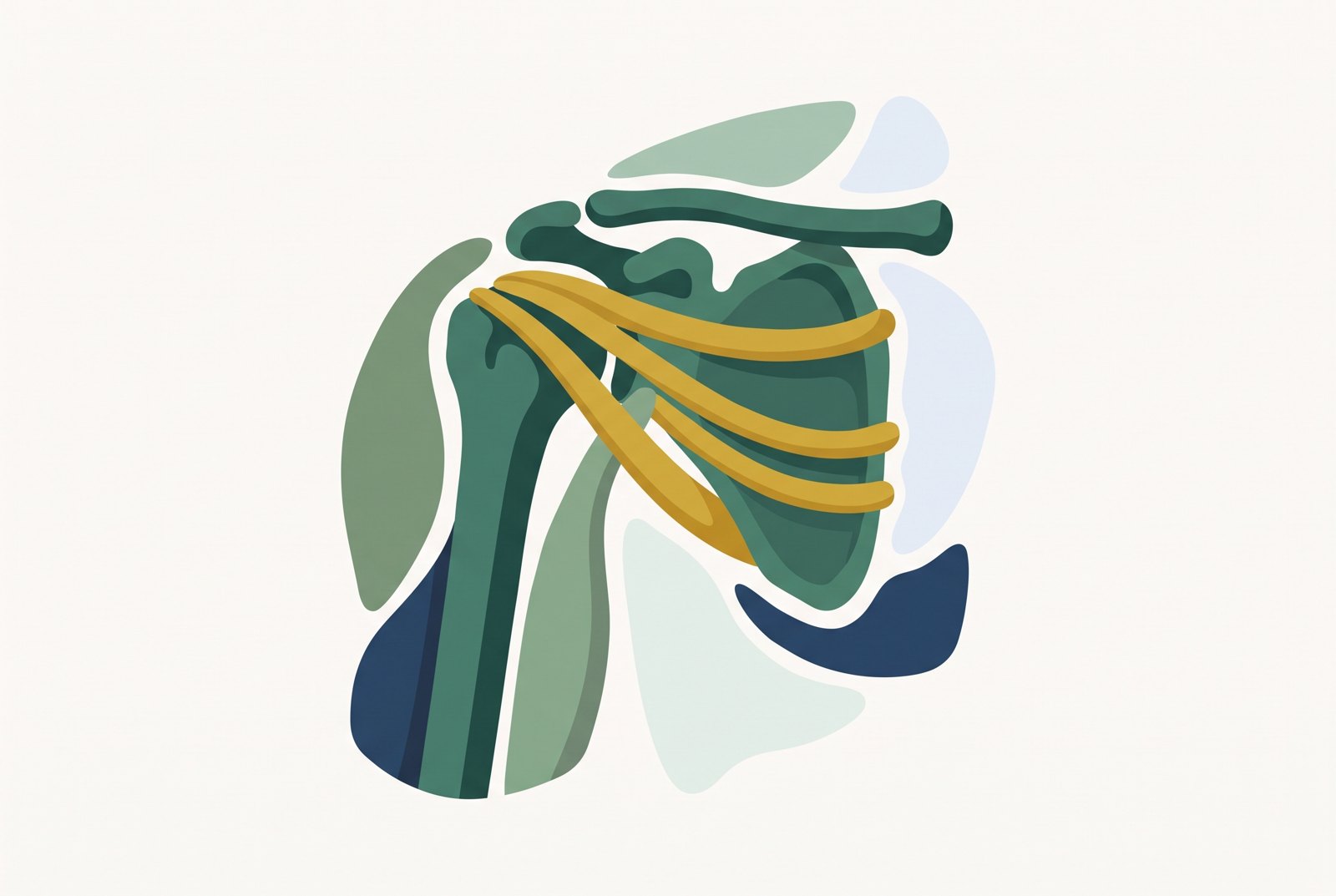
Rotator cuff massage is Registered Massage Therapy focused on the muscles and soft tissue that surround and stabilize the shoulder, rather than on the joint capsule or the tendons deep inside it. The rotator cuff itself is four muscles, the supraspinatus, infraspinatus, teres minor, and subscapularis, and their job is to keep the shoulder centred and controlled. Around them sit the neck, the trapezius, and the muscles of the upper back and chest, all of which influence how the shoulder sits and moves. When a shoulder has been sore, these muscles tend to tighten and guard, which limits movement and adds its own ache on top of the original problem. Massage can ease that surrounding tension and guarding, which is where the comfort often comes from. Bruno Panucci RMT works this area at the pressure you choose, from soft through medium to deep, and you set that pressure, adjust it, or stop at any time. Firmer work is on request, never the default, because an irritated shoulder rarely responds well to force. When the whole joint stiffens instead, that is a frozen shoulder, which follows its own slow arc.
What about shoulder impingement?
Shoulder impingement is one of the most common reasons a shoulder hurts with overhead movement, and it overlaps closely with rotator cuff problems. In a clinical review, Al Hammadi and colleagues (2025) describe shoulder impingement syndrome, also called subacromial impingement, as a spectrum that includes rotator cuff tendinopathy, partial or complete tears, and inflammation of the bursa, where structures get compressed in the narrow space under the tip of the shoulder blade. Their review notes that conservative care, meaning organized physiotherapy and sometimes injections, is advised first, with surgery reserved for cases where conservative treatment fails. That ordering matters for how massage fits in. Soft-tissue work is part of the conservative, hands-on side of the picture, aimed at easing the muscle tension and posture that surround an impinged shoulder, and it sits comfortably beside firmer therapeutic work when a client asks for it and the shoulder tolerates it. It does not widen the space under the acromion or change the joint’s structure.
Does massage help rotator cuff shoulder pain?
Massage may help rotator cuff shoulder pain, and the honest version of the evidence is that hands-on work does best as one part of a plan rather than a standalone cure. In a network meta-analysis of eleven randomized trials, Lo and colleagues (2025) found that combination therapy, meaning exercise plus manual therapy, appeared to be the most effective non-invasive approach for improving pain and function in rotator cuff-related shoulder pain, while cautioning that wide confidence intervals left real uncertainty. Reviewing a related shoulder condition, Robles-Pérez and colleagues (2025) reported that manual therapy applied to the upper back, with or without exercise, reduced pain and disability in subacromial pain syndrome, especially in the short term, and supported including such hands-on strategies within a rehabilitation program. What both point to is that the exercise a provider prescribes is central, and that manual work is a complement to it. That is why Bruno frames rotator cuff massage in Brantford as support that eases tension and helps you move, alongside the strengthening your physiotherapist or physician recommends, not in place of it.
What does a rotator cuff massage session look like?
A rotator cuff massage session starts with a conversation, not a technique. Bruno Panucci RMT asks what brought the shoulder on, what makes it worse, whether it disturbs your sleep, and what a doctor or physiotherapist may already have told you, because that shapes what is safe and useful to do. From there the work usually addresses more than the shoulder itself: the neck, the upper back, the chest, and the shoulder blade muscles all feed into how a rotator cuff behaves. You set the pressure, and you can adjust it or stop at any time, which matters more here than almost anywhere, because a guarded shoulder needs to be coaxed rather than forced. Treatment is in the private treatment room at his Brantford in-home practice, draped to College of Massage Therapists of Ontario standards, with a 60-minute session at $115. Two friendly, calm dogs share the treatment room and can be kept out on request. Conservative, hands-on care of this kind is exactly what current practice favours, and it pairs naturally with recovery-focused massage for people keeping active while a shoulder settles.
| Rotator cuff massage can | Rotator cuff massage cannot |
|---|---|
| Ease tension in the muscles around the shoulder | Repair a torn tendon or heal a tear |
| Calm the guarding that builds up when a shoulder hurts | Widen the space under the acromion or change joint structure |
| Address neck, upper-back, and chest tension that pulls on the shoulder | Diagnose the cause of your shoulder pain |
| Support comfort and movement alongside prescribed exercise | Replace physiotherapy, imaging, or a physician’s care |
When should you see a physician instead?
A physician should lead when the shoulder points to something beyond tired, tight muscle. Massage is not the right first step if you have sudden, severe shoulder pain, if the arm is genuinely weak or you cannot lift it, if the shoulder followed a fall or injury, if there is numbness or pins and needles down the arm, or if the pain reliably wakes you at night. A conservative, exercise-first approach is the recognized standard for rotator cuff-related shoulder pain: in a survey of physiotherapy practice, Pamboris and colleagues (2026) found that clinicians overwhelmingly favoured exercise and education, with most avoiding routine imaging, injections, and surgical referral. Bruno Panucci RMT works within that conservative picture, on the muscle side of it, and he is glad to work in step with your physician or physiotherapist. If a shoulder is not improving, or if any of those warning signs are present, get it properly assessed first. Massage can still support you afterward, but it should not stand in for a diagnosis.
Frequently asked questions
Can massage fix a rotator cuff tear?
No. Massage works on the muscles and soft tissue around the shoulder, not on the torn tendon itself, so it cannot repair or heal a tear. What it may do is ease the surrounding muscle tension and guarding that add to the pain and stiffness. A suspected tear should be assessed by a physician, and Bruno is glad to work alongside that care rather than in place of it.
Is deep pressure better for a sore shoulder?
Not usually. An irritated or guarded shoulder tends to respond better to lighter, patient work than to force, which is why Bruno starts from the soft end of the soft-through-medium-to-deep scale and adds pressure only if you ask. You set the pressure and can change it or stop at any time. Deep-tissue work is available on request, but it is offered, not imposed.
Should I do exercises as well as massage?
Almost certainly, yes. The research is strongest when hands-on work is paired with exercise rather than used alone, and exercise is the core of most rotator cuff care. Massage in Brantford with Bruno Panucci RMT is meant to complement the strengthening your physiotherapist or physician prescribes, easing tension so you can move and progress more comfortably.
How many sessions will my shoulder need?
There is no fixed number, because it depends on how long the shoulder has been sore, what is driving it, and how it responds. Bruno would rather help you find a sustainable rhythm than sell you a package, and his clinical experience often lets him keep the number of visits sensible. If the shoulder is not improving with conservative care, that is a sign to have it reassessed by a physician.
Book a rotator cuff massage with Bruno in Brantford
Bruno Panucci RMT offers Registered Massage Therapy for the muscles around the shoulder at his in-home practice in Brantford, serving Brant County including Paris, St. George, Mt. Pleasant, and Burford, with occasional mobile visits on request. Sessions are $115 for 60 minutes, at the pressure you choose. Receipts are provided for most extended health plans, with direct billing available for most insurers.
Text Bruno at 519-753-5544 (he prefers texts), call the same number, or book online. If you need a time the calendar does not show, a shorter session, or a 90-minute session, text him directly. He can often rearrange to fit you in, sometimes the same day.
A note on scope: This page is general information, not medical advice. Registered Massage Therapy can support comfort and movement around the shoulder, but it does not repair tendons, diagnose the cause of your pain, or cure any condition. See your physician if you have sudden or severe shoulder pain, genuine weakness in the arm, pain after a fall, numbness down the arm, or pain that wakes you at night. Bruno Panucci is a Registered Massage Therapist (RMT), and works within current RMT scope of practice.
Related reading
- massage for shoulder pain more broadly
- firmer therapeutic and deep-tissue work
- recovery-focused sports massage
- rates and session lengths
Sources
- Lo CS, Chen KC, Shih JC, Cheng B, Chao WC. Comparative Effectiveness of Combination Versus Single-Modality Physiotherapy for Rotator Cuff-Related Shoulder Pain: A Systematic Review and Network Meta-Analysis. Journal of Clinical Medicine, 2025; 14(13): 4765. doi.org/10.3390/jcm14134765
- Robles-Pérez R, Vallejo-Martínez R, Carrasco-Uribarren A, Jiménez-Del-Barrio S, Hernández-Lázaro H, Ceballos-Laita L. Thoracic Manual Therapy With or Without Exercise Improves Pain and Disability in Subacromial Pain Syndrome: A Systematic Review of Randomized Trials. Healthcare, 2025; 13(19): 2479. doi.org/10.3390/healthcare13192479
- Al Hammadi MI, Shah ZA, Rathod RK, Seddik MA. Shoulder Impingement Pain Syndrome: Pathophysiology, Diagnosis, and a Review of Current Treatment Strategies. Cureus, 2025; 17(9): e92045. doi.org/10.7759/cureus.92045
- Pamboris GM, Plakias S, Papacharalambous C, Pavlou K, Smythe A, Christakou A, Paraskevopoulos E. Rotator Cuff-Related Shoulder Pain: A Survey of Current Physiotherapy Practice in Cyprus. Clinics and Practice, 2026; 16(1): 11. doi.org/10.3390/clinpract16010011
- College of Massage Therapists of Ontario, Standards of Practice.
- Government of Ontario. Massage Therapy Act, 1991, S.O. 1991, c. 27. ontario.ca/laws/statute/91m27