Bruno Panucci RMT
Massage for Arthritis in Brantford: Comfort, Not a Cure
Quick answer: Massage for arthritis in Brantford, with Bruno Panucci RMT, is gentle Registered Massage Therapy that works the muscles around stiff, sore joints rather than the joints themselves. For many people with arthritis it may ease muscle tension, calm the nervous system, and make movement feel a little easier for a while. It supports comfort alongside your physician’s plan, and it does not treat, cure, or reverse arthritis. This page is general information, not medical advice.
Arthritis is joint disease, so the honest first thing to say is that massage does not touch the arthritis itself. What it can work on are the muscles, tendons, and soft tissue around an affected joint, which tend to tighten and ache when a joint is stiff or guarded. Bruno Panucci RMT has spent 25 years as a Registered Massage Therapist in Brantford, and his arthritis clients, across Brantford and Brant County towns like Paris, St. George, Mt. Pleasant, and Burford, come in for that surrounding tension and the general ease a calm session brings, not for a fix. Registered Massage Therapy for arthritis is comfort-focused symptom support offered alongside your doctor’s care, and it usually sits at the gentle end of soft, unhurried work rather than deep, forceful pressure.
Bruno Panucci RMT, 25 years of practice: “I am careful with the word help when someone has arthritis, because I cannot change what is happening inside the joint, and I will not pretend otherwise. What I can often do is loosen the muscles that have been bracing around a sore knee or a stiff hand, and give the person an hour where the whole body settles. Sometimes that is enough to move a little easier for a day or two. I would rather promise that honestly than sell a cure that does not exist.”
In short: massage for arthritis is gentle Registered Massage Therapy that eases the muscle tension and stress around affected joints, not the joint disease itself. Some people with arthritis find regular, light sessions soothing and helpful between visits to their doctor. The benefits are modest, tend to be temporary, and always belong alongside medical care, never in place of it.
6 min read
Can massage help arthritis pain?
Massage may ease some of the pain that comes with arthritis, but the useful version of the answer separates the joint from everything around it. Pain in arthritis is not a simple readout of joint damage. In a review of pain in osteoarthritis and rheumatoid arthritis, researchers noted that pain severity often correlates poorly with the visible joint damage on an X-ray, and that the nervous system’s own processing of pain plays a real part in how much a person hurts (Lee and colleagues, 2011). That matters here, because the muscle tension, guarding, and stress that build up around a sore joint are exactly the parts a Registered Massage Therapist can work with. Bruno Panucci RMT sees this often in Brantford: easing the tight muscles around an arthritic knee or hand, and giving the nervous system an hour to quiet down, can leave a person feeling looser and more comfortable, even though nothing about the joint disease has changed. The effect tends to be modest and temporary, which is why gentleness and regularity matter more than force. For persistent, long-term pain of many kinds, there is a wider guide on what massage can offer.
What massage works on, and what it cannot reach
Massage for arthritis works on soft tissue, the muscles, tendons, and fascia that surround and support a joint, and it cannot reach or repair the joint itself. Arthritis pain also has layers that hands cannot undo. Studies of osteoarthritis describe both an inflammatory component and, over time, changes in the nerves that carry pain signals, so the discomfort is not only mechanical (Orita and colleagues, 2011, in a laboratory model). Massage does not remove inflammation, rebuild cartilage, or reverse any of that. What it can do is address the secondary tension: when a joint hurts, the muscles around it often tighten to protect it, and that guarding can become its own source of ache. Working those muscles gently, alongside a warm room and an unhurried pace, is where the comfort comes from. This is honest, within-scope work. If you would like a sense of how the same principle applies to specific joints, the pages on stiffness and ache around the knee and tension through the hip go into more detail for those areas. The morning version, morning stiffness that eases with movement, is untangled on its own page.
What does an arthritis-friendly session look like?
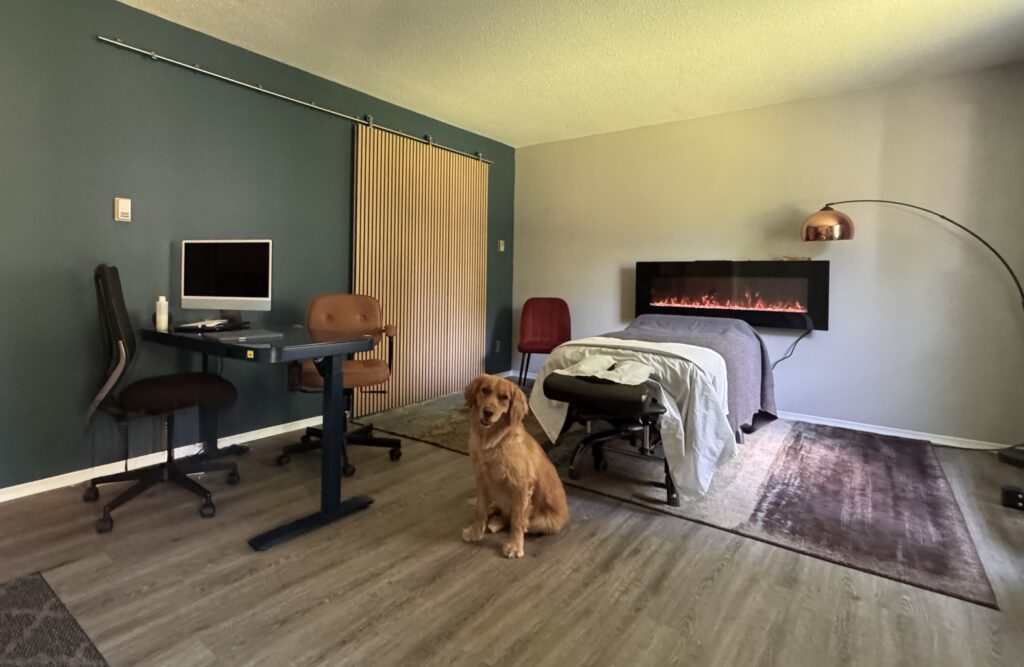
An arthritis-friendly massage session is built around your joints on the day, not a fixed routine. It starts with a short conversation about which joints are affected, how they feel today, and anything your physician has advised. Bruno then works the muscles around the affected areas rather than forcing the joints through movement, keeps pressure light to begin with, and checks in often. A calm, warm setting is part of the treatment, not decoration: research on musculoskeletal pain finds that a good chunk of the relief people feel comes from the context of care itself, the therapeutic touch, the unhurried attention, and the reassurance of an experienced practitioner (Rossettini and colleagues, 2018). Treatment is in the private treatment room at his Brantford in-home practice, draped to College of Massage Therapists of Ontario standards. Two friendly, calm dogs share the treatment room, and they can be kept out on request if you prefer. The table below shows how common arthritis concerns shape the session.
| Your concern | How the session adapts |
|---|---|
| Stiff, tender joints | Work stays on the muscles around the joint, not on forcing the joint itself. |
| A flare-up in one area | That joint is left alone or barely touched, and work moves to calmer areas. |
| Sensitive skin or easy bruising | Lighter pressure, slower strokes, and a check that no medication makes this a caution. |
| Hands or fingers affected | Gentle, focused work on the forearm and hand muscles, at your comfort. |
| Cold, aching joints | A warm room, a warm table, and extra blankets, added or removed as you like. |
| Trouble getting comfortable | Supported positioning with pillows and bolsters, and side-lying if lying flat is hard. |
How much pressure is right for arthritic joints?
Pressure for arthritis starts gentle, and you are in charge of it the whole way. You set the pressure. You can adjust it, or stop, at any time. The scale runs from soft through medium to deep, and for arthritis Bruno usually stays toward the soft-to-medium end, because forcing deep pressure into muscles that are already guarding a painful joint tends to backfire. Deep tissue work is on request, and it is rarely the right tool over or around an inflamed joint. If a joint is actively flared, hot, or swollen, that area is left alone. There is a simple piece of advice Bruno gives anyone returning to massage after a long gap: take a little less pressure the first time. Like riding a bike after months off, you can feel great during the session and sore the next day, so lighter to start means pleasant looseness rather than soreness. With arthritis, that caution is worth doubling down on.
How massage fits with your arthritis care
Massage for arthritis is one supportive piece of a plan that your physician leads. Arthritis is a real medical condition, and its diagnosis, medication, and overall management belong with your doctor, rheumatologist, or physiotherapist. The treatments with the strongest evidence for arthritis, particularly osteoarthritis of the knee and hip, are things like exercise and staying active, which clinical guidelines consistently place at the centre of care (Zadro and colleagues, 2019). Registered Massage Therapy sits alongside that, as comfort and tension relief, not as a replacement for the movement and medical care that do the heavy lifting. Bruno Panucci RMT is glad to work in step with your healthcare team, and he will say plainly when something is outside what massage can help. A 60-minute session at his Brantford in-home practice is $115, receipts work with most extended health plans, and because the practice runs from his own home the lower overhead keeps the price fair, so your benefits stretch further across a series of gentle visits.
Frequently asked questions
Can massage cure or reverse arthritis?
No. Massage cannot cure arthritis, rebuild cartilage, or reverse joint disease, and anyone who tells you otherwise is overselling it. What massage can do is ease the muscle tension and stress that build up around a sore, stiff joint, which may leave you more comfortable for a while. It is symptom support offered alongside your physician’s care, never a treatment for the condition itself.
Is massage safe if I have rheumatoid arthritis or a flare-up?
Often yes for the muscles around calm joints, but a joint that is actively flared, hot, or swollen is left alone. Because rheumatoid arthritis is an inflammatory condition and some medications thin the skin or affect bruising, tell Bruno what you have and what you take, and check with your physician if you are unsure. He keeps pressure light, works around affected joints, and adjusts to how you respond.
How often should someone with arthritis get a massage?
There is no single rule. Because the benefits tend to be modest and temporary, many people find that regular, gentle sessions help more than occasional intense ones. The right rhythm depends on your joints, your energy, and your budget. Bruno would rather help you find a sustainable pace than sell you a package, and a shorter session is always a valid choice.
Should I get a massage instead of exercise for my arthritis?
No, they are not interchangeable. For arthritis, especially of the knee and hip, exercise and staying active have the strongest evidence and belong at the centre of your care. Massage is a comfort measure that can sit alongside that movement and your medical plan, easing tension so activity feels a little more manageable. It does not replace the exercise your physician or physiotherapist recommends.
Book an arthritis-friendly massage with Bruno in Brantford
Bruno Panucci RMT offers gentle, comfort-focused Registered Massage Therapy for people with arthritis at his in-home practice in Brantford, serving Brant County including Paris, St. George, Mt. Pleasant, and Burford, with occasional mobile visits on request. Sessions are $115 for 60 minutes, and a shorter or lighter session is always a valid choice. Receipts are provided for most extended health plans, with direct billing available for most insurers.
Text Bruno at 519-753-5544 (he prefers texts), call the same number, or book online. If you need a time the calendar does not show, a shorter session, or a 90-minute session, text him directly. He can often rearrange to fit you in, sometimes the same day.
A note on scope: This page is general information, not medical advice. Arthritis is a real medical condition, and its diagnosis and management belong with your physician; massage is symptom support, not a treatment or a cure. See your physician before starting massage if a joint is hot, red, and swollen, if you have a fever, or if pain is new, severe, or unexplained. Bruno Panucci is a Registered Massage Therapist (RMT), and works within current RMT scope of practice.
Related reading
- easing tension around a stiff knee
- soft-tissue work for the hip
- gentle sessions built for older clients
- the calm, soft-pressure end of the work
Sources
- Lee YC, Nassikas NJ, Clauw DJ. The role of the central nervous system in the generation and maintenance of chronic pain in rheumatoid arthritis, osteoarthritis and fibromyalgia. Arthritis Research and Therapy, 2011; 13: 211. doi.org/10.1186/ar3306
- Orita S, Ishikawa T, Miyagi M, et al. Pain-related sensory innervation in monoiodoacetate-induced osteoarthritis in rat knees that gradually develops neuronal injury in addition to inflammatory pain. BMC Musculoskeletal Disorders, 2011; 12: 134. doi.org/10.1186/1471-2474-12-134
- Zadro J, O’Keeffe M, Maher C. Do physical therapists follow evidence-based guidelines when managing musculoskeletal conditions? Systematic review. BMJ Open, 2019; 9: e032329. doi.org/10.1136/bmjopen-2019-032329
- Rossettini G, Carlino E, Testa M. Clinical relevance of contextual factors as triggers of placebo and nocebo effects in musculoskeletal pain. BMC Musculoskeletal Disorders, 2018; 19: 27. doi.org/10.1186/s12891-018-1943-8
- College of Massage Therapists of Ontario, Standards of Practice.
- Government of Ontario. Massage Therapy Act, 1991, S.O. 1991, c. 27. ontario.ca/laws/statute/91m27