Bruno Panucci RMT
Knee Pain Massage in Brantford: The Muscles Around It
Quick answer: Knee pain massage in Brantford with Bruno Panucci RMT does not treat the knee joint itself. It treats the muscle system around it, the quadriceps, hamstrings, calves, and hip muscles that move and guard the knee. For an arthritic knee, massage may ease the surrounding muscle guarding and stiffness, while exercise and strengthening remain the first-line care. Sessions are $115 for 60 minutes, at the pressure you choose. This page is general information, not medical advice.
Knee pain massage is soft-tissue treatment of the muscles that surround and control the knee, not hands-on work on the cartilage or joint capsule inside it. That distinction is the whole page. Bruno Panucci RMT has spent 25 years working on knees across Brantford and Brant County, from runners and warehouse workers to gardeners and people managing osteoarthritis in Paris, St. George, Mt. Pleasant, and Burford. The knee is a hinge caught between big muscle groups, and when it aches, those muscles are almost always part of the story. That patient, layered work is the core of Bruno’s lower-limb therapeutic sessions.
Bruno Panucci RMT, 25 years of practice: “People point at the kneecap, and the first place I put my hands is up on the thigh, in the quads. After 25 years of knees, they are hardly ever really about the knee. The joint is a hinge that lives or dies by the muscles pulling on it from above and below. Loosen those, and the knee usually gets a say back.”
In short: massage does not fix an arthritic or injured knee joint, and it is fair to say so plainly. What it can do is release the quadriceps, hamstrings, calves, and hip muscles that tighten and guard around a sore knee, which often eases pain and movement while your first-line care, usually exercise, does the structural work.
6 min read
Why is knee pain massage mostly about the muscles around the knee?
Knee pain massage is mostly about the muscles around the knee because the knee is a hinge with almost no muscle of its own. It is moved and stabilized by the quadriceps pulling from the thigh above, the hamstrings and calves crossing behind and below, and the hip and glute muscles that steer how the whole leg tracks. When one of those groups is tight, weak, or overworked, the load lands on the joint, and the joint is what starts to hurt. So a Registered Massage Therapist treating a knee spends most of the session on the thigh, the calf, and the hip, working around the joint rather than into it, to ease the pull on a hinge caught in the middle. The table below maps the usual complaints to where the hands-on work actually goes.
| Knee complaint | Where the massage work actually goes | See a physician first when |
|---|---|---|
| Ache around or under the kneecap (“runner’s knee”) | Quadriceps, especially the inner quad, plus the hip and glute muscles that steer the kneecap | The knee locks, catches, or gives way |
| Stiff, creaky, arthritic knee (osteoarthritis) | Thigh and calf muscles that guard around the joint, to ease stiffness and comfort | The joint is hot, red, and swollen, or there is fever with the swelling |
| Pain at the outer knee (IT-band region) | The hip and thigh muscles that feed the IT band, not the band itself | There was a pop at the moment of injury, then swelling or instability |
| Sore knee after squats, ladders, or kneeling | Quadriceps, hamstrings, and calves that took the load | Deep calf pain, heat, or swelling in one leg |
| Tightness behind the knee | Hamstring and calf attachments behind the joint | Night pain that wakes you, or unexplained weight loss |
Can massage help an arthritic (osteoarthritic) knee?
Massage can help the comfort of an arthritic knee, but it does not treat the arthritis itself. Osteoarthritis is wear and change in the joint, and no hands-on work reverses that. What massage may do is ease the muscle guarding and stiffness that build up around a sore knee, which can make the leg feel looser for a while. The evidence for massage in knee osteoarthritis is genuine but limited: a review by Zhang and colleagues in Bone Research (2016) noted that alternative treatments including massage may be beneficial but lack strong evidence for efficacy. The first-line care is clearer. Yao and colleagues, in Signal Transduction and Targeted Therapy (2023), summarize the international OARSI guidance that exercise is a core treatment recommended for all osteoarthritis patients, shown to reduce painful movement and improve function. So the honest framing is this: massage supports, it does not replace. It can make the strengthening your physician or physiotherapist prescribes more comfortable to do, and that is a real, useful role. For osteoarthritis specifically, arthritis comfort work is described on its own page.
Runner’s knee, worker’s knee, and the IT band, honestly
Overuse knee pain follows patterns, and naming yours helps you get the right work. The runner and cyclist often feel it under the kneecap or along the outer knee, where repeated bending loads the quadriceps and the tissues that track the kneecap. The trades worker, tiler, or gardener feels it after squats, ladders, and kneeling, when the quads, hamstrings, and calves take the strain over a long day. A common request is to “release the IT band” for outer-knee pain, and this is where a Registered Massage Therapist should be straight with you: the iliotibial band is tough connective tissue anchored to bone, and it does not stretch or let go under a thumb. The tension that tugs on it comes from the muscles feeding it, the tensor fasciae latae, the glutes, and the outer quad, so that is where the work goes. Because so much of knee tracking is set at the hip, a knee session often travels up to the cranky hip above it, where a lot of lower-limb trouble actually starts. Pain along the IT band down the outer thigh is a distinct problem with a dedicated guide.
What a knee-pain massage session involves
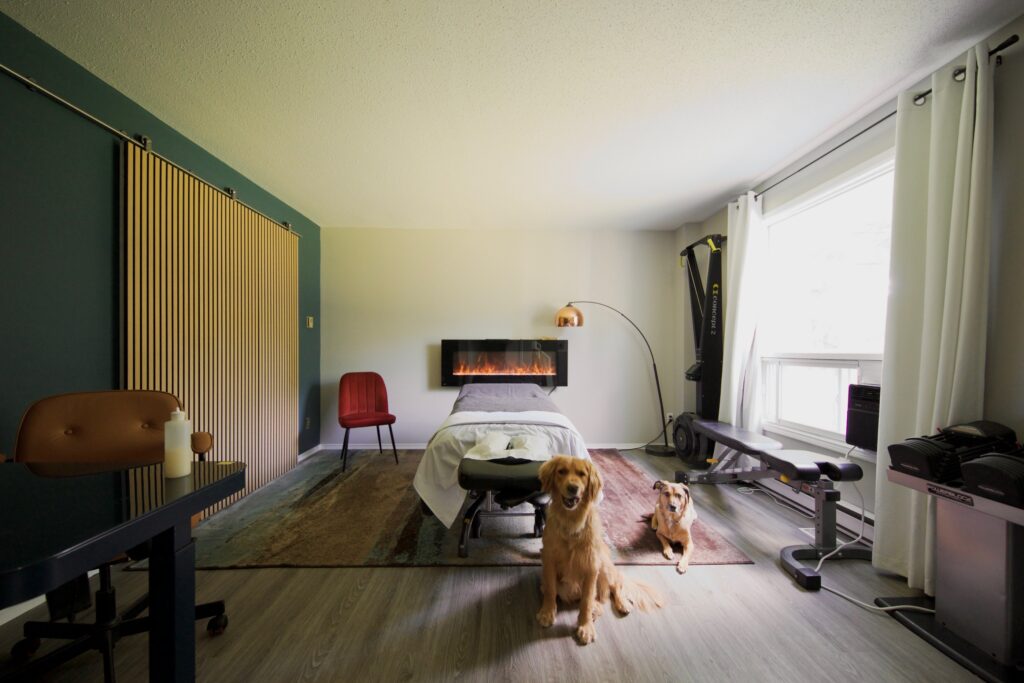
A knee-pain massage session starts with you in control of the pressure. You set the pressure, from soft through medium to deep, and you can adjust it, or stop, at any time. Deep work is available on request, never the default; with a lifelong weight-training background Bruno has the strength to work firmly when a leg wants it, and the control to ease off the moment you say so. After a short intake, treatment happens in the private treatment room at Bruno’s Brantford in-home practice, draped to College of Massage Therapists of Ontario standards so only the leg being worked on is uncovered. Expect most of the hour on the thigh, calf, and hip rather than the kneecap, because that is where the tension lives. Most people book 60 minutes at $115; for both legs and the hips, text Bruno about a 90-minute session.
When should you see a physician first about knee pain?
Most knee pain is muscular or overuse-related and safe to treat with massage, but some knees need a physician before any hands-on work. Book your doctor first, not a massage, if any of these are true:
- The knee is hot, red, and swollen, especially with a fever.
- The knee locks, catches, or gives way underneath you.
- You felt or heard a pop at the moment of an injury, then swelling.
- Night pain that wakes you, or knee pain with unexplained weight loss.
- Deep pain, heat, or swelling in one calf, which can signal a clot and needs urgent care.
None of these mean massage is never an option. They mean a diagnosis comes first, and massage may then support the muscles around whatever your physician finds. For the ordinary tight, tired, overworked knee that most people carry, massage with a Registered Massage Therapist is a reasonable, low-risk place to start.
Frequently asked questions
Can massage therapy cure knee arthritis?
No. Massage does not treat the joint or reverse arthritis. It may ease the muscle guarding and stiffness around an arthritic knee for a while, which can make movement more comfortable, but exercise and strengthening remain the first-line care. Bruno will tell you honestly what it can and cannot do.
Does knee pain massage work on the knee itself?
Mostly no. The work is on the quadriceps, hamstrings, calves, and hip muscles that move and guard the knee, with careful attention around the joint rather than into it. That muscle system is where massage earns its keep for knee pain.
Can you massage the IT band for outer knee pain?
Not really. The iliotibial band is tough connective tissue anchored to bone and does not stretch or release under a thumb. Bruno works the hip and thigh muscles that feed it, which is where the tension pulling on the band actually comes from.
Is knee massage covered by insurance in Ontario?
Generally yes. Treatment by a Registered Massage Therapist is reimbursable under most extended health plans, and Bruno provides a compliant receipt after every session in Brantford. Check your own plan for its annual limit and any referral rule.
Book a knee-pain massage with Bruno in Brantford
Bruno Panucci RMT treats knee pain and the muscles around it at his in-home practice in Brantford, serving Brant County including Paris, St. George, Mt. Pleasant, and Burford, with occasional mobile visits on request. Sessions are $115 for 60 minutes, with receipts for most extended health plans and direct billing available for most insurers.
Text Bruno at 519-753-5544 (he prefers texts), call the same number, or book online. Need a time the calendar does not show, or a 90-minute or two-hour session for both legs and hips? Text him directly. He can often rearrange to fit you in, sometimes the same day.
A note on scope: This page is general information, not medical advice. Massage may ease the muscles and guarding around a sore knee, but it does not diagnose, treat, or cure osteoarthritis or any joint condition, and it is not a substitute for exercise, physiotherapy, or medical care. For the warning signs listed above, or any new severe knee pain, see your physician first. Bruno Panucci is a Registered Massage Therapist and works within current RMT scope of practice.
Related reading
- recovery around sport and training
- foot mechanics below the knee
- how many sessions make sense
- rates and booking
Sources
- Zhang W, Ouyang H, Dass CR, Xu J. Current research on pharmacologic and regenerative therapies for osteoarthritis. Bone Research, 2016; 4: 15040. doi.org/10.1038/boneres.2015.40
- Yao Q, Wu X, Tao C, Gong W, Chen M, Qu M, Zhong Y, He T, Chen S, Xiao G. Osteoarthritis: pathogenic signaling pathways and therapeutic targets. Signal Transduction and Targeted Therapy, 2023; 8: 56. doi.org/10.1038/s41392-023-01330-w
- College of Massage Therapists of Ontario, Standards of Practice.