Bruno Panucci RMT
IT Band Syndrome Massage in Brantford: The Hip-to-Knee Line
Quick answer: IT band syndrome massage in Brantford, with Bruno Panucci RMT, works the hip and thigh muscles that pull on the iliotibial band, not the band itself, since the band is dense tissue that does not stretch out under thumbs. For runners and cyclists, Registered Massage Therapy can ease the surrounding tension and support your return to training, but the real fix is load management, and massage sits alongside that, not instead of it. It does not cure IT band syndrome. This page is general information, not medical advice.
Iliotibial band syndrome is one of the most common overuse injuries in runners and cyclists, usually felt as a sharp or burning pain on the outside of the knee that shows up at a predictable point in a run and settles with rest. The iliotibial band itself is a long, tough sheet of connective tissue running down the outside of the thigh from the hip to just below the knee, and it is far too dense to be loosened by pressure alone. Bruno Panucci RMT has spent 25 years as a Registered Massage Therapist in Brantford, working with active people across Brant County towns like Paris, St. George, Mt. Pleasant, and Burford, and his approach here is to treat the muscles that tension the band, the glutes, the tensor fasciae latae at the hip, and the quads, rather than chase the band. If you want the wider picture on the joint that hurts, our page on massage for knee pain covers how the outside of the knee fits in.
Bruno Panucci RMT, 25 years of practice: “The first thing I tell a runner with IT band pain is that I am not going to hammer the band, because you cannot foam-roll or thumb a structure that strong into submission, and trying just hurts. What I can do is settle down the hip and the outside of the thigh so the band stops getting yanked on every stride. The other honest part: if your mileage jumped a few weeks ago, my hands are not the answer to that. The answer is fixing how fast you ramped up. I will say so, and I would rather you hear it from me than pay for treatments that skip the real cause.”
In short: IT band syndrome massage is Registered Massage Therapy aimed at the hip and thigh muscles that load the iliotibial band, meant to ease tension and support your training, not to stretch or cure the band. It works best paired with sensible load management and any plan from your physician or physiotherapist. Massage manages symptoms. It does not fix a training error on its own.
6 min read
What is IT band syndrome, and what actually causes it?
IT band syndrome is an overuse injury, not a one-off strain, and understanding that changes how you treat it. The pain sits on the outside of the knee where the iliotibial band passes over the bony bump of the thigh bone, and it is usually irritation from repeated friction and compression at that point rather than damage to the band itself. The most common trigger is a training error, specifically a sudden jump in how much or how hard you are running or riding. Research on athletes across many sports has found that periods of rapid training-load intensification and accumulated load are exactly when soft-tissue injuries cluster (Jones and colleagues, 2017). In plain terms, the knee did not fail because you are weak; it flared because the workload climbed faster than the tissue adapted. Hill training, a lot of downhill, worn shoes, and always running the same camber of road can all pile on. This is why Bruno Panucci RMT starts every IT band conversation in Brantford with your recent training, because the cause is usually in your calendar, not just your leg. A broader guide for what runners need covers recovery and realistic expectations.
Can massage release a tight IT band?
Massage cannot stretch or lengthen the iliotibial band, and any therapist who promises to is overselling it. The band is dense connective tissue anchored firmly along the thigh, and it is not designed to give under hand pressure, a foam roller, or a thumb. What massage genuinely can do is reduce tension in the muscles that pull on the band, the gluteals, the tensor fasciae latae at the hip, and the quadriceps and hamstrings along the thigh. When those muscles are calmer, the band is under less constant tug, and the outside of the knee often gets a break. For general exercise soreness, massage is one of several techniques people use, with honestly mixed evidence behind it (Harty and colleagues, 2019), so Bruno frames it as useful support rather than a cure. This is the same tension-focused, communication-first work described on our page about muscle tension and trigger points, applied to the hip and thigh. You set the pressure, and you can adjust it, or stop, at any time.
What does an IT band massage session look like?
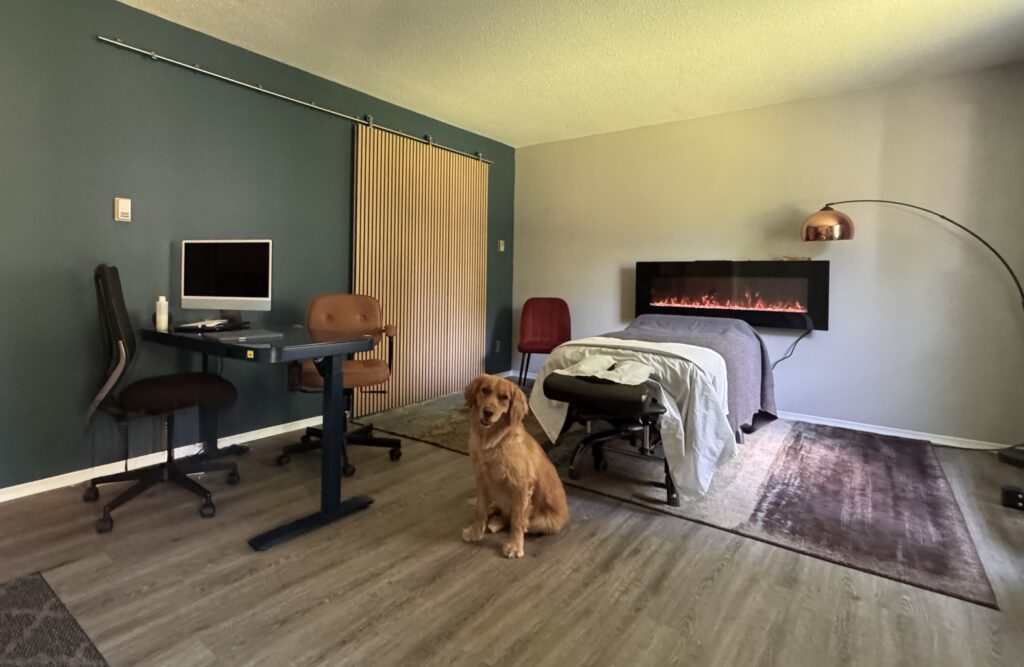
An IT band massage session at Bruno’s Brantford in-home practice spends most of its time above the knee, not on it. After a short intake about your training and where exactly the pain lives, Bruno works the gluteal muscles, the tensor fasciae latae at the hip, and the quads and hamstrings down the thigh, using the pressure you choose from the soft-through-medium-to-deep scale. Deep, firm work is available on request, and because he is a larger, stronger therapist with a lifelong weight-training background he can deliver it with control, but forceful pressure straight onto an angry, inflamed outer knee is usually the wrong move, so the deep work stays on the muscle bellies rather than the sore spot. Treatment is in a private treatment room, draped to College of Massage Therapists of Ontario standards. A 60-minute session is $115, and receipts work with most extended health plans, with direct billing available for most insurers. Two friendly, calm dogs share the treatment room, and they can be kept out on request.
| Area | What Bruno does there | Why it helps the band |
|---|---|---|
| Gluteal muscles | Broad, sustained pressure to ease tension and support hip control | Weak or tight glutes let the hip drop, loading the band harder |
| Tensor fasciae latae (front of hip) | Focused work on the small muscle that feeds directly into the band | A tight TFL keeps constant tension on the band above the knee |
| Quadriceps and hamstrings | Length-wise work down the thigh, pressure to your comfort | Balanced thigh muscles reduce the pull across the outer knee |
| The outer knee itself | Gentle, minimal handling if it is inflamed | Forceful pressure on the sore point tends to flare it, not fix it |
| Calf and lower leg | General ease-down work as needed | Keeps the whole running chain from compensating |
Why load management matters more than any massage
Load management is the real treatment for IT band syndrome, and massage is a helper alongside it. Because the injury is driven by doing too much too soon, the fix is almost always about how you build your training, not how hard someone rubs your leg. The evidence here is unusually clear: excessive and rapid increases in training load are responsible for a large share of non-contact soft-tissue injuries, and athletes accustomed to sensibly built-up loads tend to get hurt less than those who spike suddenly (Gabbett, 2016). For a runner, that means backing off the volume that set it off, rebuilding gradually, and giving the tissue time to adapt, ideally with guidance from a physician or physiotherapist who can assess your gait and strength. Bruno Panucci RMT is glad to work in step with that plan. Massage can keep the hip and thigh comfortable while you rebuild, and that is a genuine role, but it will not outrun a training calendar that ramps too fast. If you would rather train harder without getting hurt, the honest path is training smarter, and no amount of Registered Massage Therapy replaces that.
How massage fits your return to running
Returning to running after IT band syndrome works best as a staged process, and massage supports the middle of it. Once the sharp knee pain has settled and you are cleared to rebuild mileage, regular sessions can keep the hip and thigh loose during the weeks when your body is re-adapting to load, which is exactly the window when tension tends to creep back. This is the same recovery-support role covered on our sports massage page, where the goal is comfort and consistency rather than a quick fix. There is also a broader benefit worth naming honestly: a single session of exercise reliably lifts mood and lowers stress (Basso and Suzuki, 2017), and getting back to running you enjoy is part of feeling like yourself again, so keeping the return comfortable has value beyond the knee. Bruno offers this at his in-home practice in Brantford, serving Brant County, with occasional mobile visits on request. Rebuild gradually, keep the surrounding muscles happy, and let massage do the supporting-role job it is actually good at.
Frequently asked questions
Should I foam-roll my IT band before a massage?
Rolling directly on the band is usually painful and does not lengthen it, since the band is dense connective tissue that does not stretch under pressure. If rolling the muscles above it, like the quads and glutes, feels good to you, that is fine, but there is no need to grind on the sore outer thigh before you come in. Bruno works those muscles for you and keeps the pressure to what you choose.
Does massage on the hip and thigh actually help knee pain?
It can, indirectly. The pain sits at the outer knee, but the tension driving it usually comes from the hip and thigh muscles that load the band. Easing those muscles takes some of the constant pull off the knee, which often helps. It is symptom support, not a cure, and it works best alongside sensible load management and any plan from your physician or physiotherapist.
How many massage sessions will I need for IT band syndrome?
There is no fixed number, and Bruno would rather help you find a sustainable rhythm than sell a package. Many active people find that occasional sessions during a careful return to running are enough to keep the hip and thigh comfortable. The bigger lever is your training build, so if the pain keeps returning, the fix is usually in your mileage, not more appointments.
Should I see a doctor or physiotherapist too?
Yes, especially if the pain is sharp, keeps coming back, or stops you running. IT band syndrome is an overuse injury, and a physician or physiotherapist can assess your gait, strength, and training and guide the rebuild. Massage sits alongside that care as symptom support. If the knee locks, swells, or gives way, see your physician before booking massage.
Book an IT band massage with Bruno in Brantford
Bruno Panucci RMT offers hip-and-thigh-focused Registered Massage Therapy for IT band syndrome at his in-home practice in Brantford, serving Brant County including Paris, St. George, Mt. Pleasant, and Burford, with occasional mobile visits on request. Sessions are $115 for 60 minutes, at the pressure you choose from soft through medium to deep. Receipts are provided for most extended health plans, with direct billing available for most insurers.
Text Bruno at 519-753-5544 (he prefers texts), call the same number, or book online. If the calendar does not show a time that works, or you want a shorter or 90-minute session, text him directly. He can often rearrange to fit you in, sometimes the same day.
A note on scope: This page is general information, not medical advice. IT band syndrome is an overuse injury best managed with load management and, where needed, care from your physician or physiotherapist; massage is symptom support, not a treatment or a cure. If your knee locks, swells, gives way, or the pain is severe or worsening, stop and see your physician. Bruno Panucci is a Registered Massage Therapist (RMT), and works within current RMT scope of practice.
Related reading
- where the outer knee fits in
- recovery support for active people
- easing tension and trigger points
- rates and session lengths
Sources
- Gabbett TJ. The training-injury prevention paradox: should athletes be training smarter and harder? British Journal of Sports Medicine, 2016; 50: 273-280. doi.org/10.1136/bjsports-2015-095788
- Jones CM, Griffiths PC, Mellalieu SD. Training load and fatigue marker associations with injury and illness: a systematic review of longitudinal studies. Sports Medicine, 2017; 47: 943-974. doi.org/10.1007/s40279-016-0619-5
- Harty PS, Cottet ML, Malloy JK, Kerksick CM. Nutritional and supplementation strategies to prevent and attenuate exercise-induced muscle damage: a brief review. Sports Medicine – Open, 2019; 5: 1. doi.org/10.1186/s40798-018-0176-6
- Basso JC, Suzuki WA. The effects of acute exercise on mood, cognition, neurophysiology, and neurochemical pathways: a review. Brain Plasticity, 2017; 2: 127-152. doi.org/10.3233/bpl-160040
- College of Massage Therapists of Ontario, Standards of Practice.
- Government of Ontario. Massage Therapy Act, 1991, S.O. 1991, c. 27. ontario.ca/laws/statute/91m27