Bruno Panucci RMT
Massage for Runners in Brantford: Legs, Recovery, and Honesty
Quick answer: Massage for runners is Registered Massage Therapy aimed at the legs and hips that carry a running habit: calves, hamstrings, quads, glutes, the IT band, and the low back. Bruno Panucci RMT treats runners at his Brantford in-home practice, $115 for 60 minutes, at the pressure you choose from soft through medium to deep. The honest read on the research: massage can ease muscle soreness and help you feel recovered, but it does not speed the deep repair or prevent injury on its own. This page is general information, not medical advice.
Massage for runners is soft-tissue work focused on the specific load a running stride puts through the body: the calves and Achilles that push off, the hamstrings and quads that swing and brake the leg, the glutes that stabilize each landing, the iliotibial band down the outer thigh, and the low back that absorbs the rest. Bruno Panucci RMT has treated that pattern for 25 years, and runners arrive at his Brantford in-home practice from across Brant County, Paris, St. George, Mt. Pleasant, and Burford, usually after a mileage jump or a race. Much of a runner’s complaint overlaps with the work on the broader sports-massage side of the practice, but a running body has its own signature, and it is worth naming honestly.
Bruno Panucci RMT, 25 years of practice: “I will tell runners the plain truth up front, because they tend to want facts, not a sales pitch. A good session loosens the calf and hamstring, quiets a cranky IT band, and gets you off the table feeling lighter and less sore. What it does not do is repair the muscle faster or make you injury-proof. Runners who treat me as one tool alongside sensible mileage and their strength work get the most out of it. The ones who expect a rub to undo a training error are usually back with the same complaint.”
In short: massage can reliably ease a runner’s muscle soreness and improve how recovered you feel, which is worth a lot mid-training. The research does not show it speeding the underlying repair or preventing running injuries by itself. It works best as one honest piece of a plan that also includes load management and strength work.
6 min read
Does massage actually help runners, or just feel good?
Massage helps runners in a real but specific way, and the honest version is more useful than the hyped one. When researchers compared recovery strategies after a half-marathon, massage was beneficial for reducing muscle soreness and for improving how recovered runners felt, more so than doing nothing, but it had no beneficial effect on the objective fatigue markers, the blood and muscle measures of actual damage and repair (Wiewelhove and colleagues, PLoS ONE, 2018). That is the whole picture in one sentence: massage moves the soreness and the sense of recovery, not the underlying biology of repair. For a runner mid-training, feeling less sore and more ready is genuinely valuable, because pain itself drags down performance. Bruno Panucci RMT frames it that way with every runner: Registered Massage Therapy is a comfort and readiness tool, not a shortcut through the recovery your body still has to do on its own time.
Where does running load land, and what does a session work?
Running load lands in a predictable chain of tissues, and a runner’s session follows that chain rather than chasing one sore spot. Most running injuries are overuse injuries, roughly four in five, built from repeated loading rather than a single bad step, and the knee is the most common site (van der Worp and colleagues, PLoS ONE, 2015). The mechanics behind that are load-dependent: as speed, incline, and fatigue climb, the pelvis moves more, and that added motion can raise the load carried by the iliotibial band, the hamstrings, and the lumbar spine (Kovše and colleagues, Frontiers in Sports and Active Living, 2025). A session works down the same map, and a runner recognizes their own pattern in it.
| Region | What running loads it | What the session does there |
|---|---|---|
| Calves and Achilles | Push-off and landing, thousands of times per run | Slow, patient work through the calf and toward the Achilles |
| Hamstrings and quads | Swing the leg forward and brake it on each stride | Broad work along the back and front of the thigh |
| Glutes and hips | Stabilize every single-leg landing | Releases the glutes and the deeper hip that fatigue quietly |
| IT band and outer thigh | Loaded more as pelvic motion rises with speed and fatigue | Works the muscles feeding the band, not the band forced flat |
| Low back | Absorbs the load the legs and pelvis pass upward | Unhurried work at the end so the relief settles and holds |
Can massage help common running injuries like IT band and runner’s knee?
Massage can play a supporting role in common running injuries, but the evidence is clear that it is a helper, not the main treatment, and saying so is the honest thing to do. For iliotibial band syndrome, which makes up about ten percent of running injuries, a systematic review found that hip abductor strengthening exercise is the common thread across effective programs, sometimes augmented by shockwave or manual therapy (Sanchez-Alvarado and colleagues, Frontiers in Sports and Active Living, 2024). Manual work sits in the “augmented by” slot, not at the centre. Runner’s knee, the patellofemoral kind, tells a similar story: in a trial that added manual therapy, including IT band release and deep friction massage, to hip and knee exercises, the manual-therapy group improved, but not beyond exercise alone (Abdo and colleagues, Scientific Reports, 2025). So massage may ease the tension and discomfort around an IT band or a sore knee and make the strengthening work more tolerable, which is worth having; it is not a substitute for the loading program that actually resolves these problems. If a specific injury is your reason for booking, the focused guides on IT band syndrome and runner’s knee and knee pain go deeper than this overview does.
When should a runner book, before or after a hard effort?
Timing a runner’s massage comes down to what you want from it, and there is no single right answer. After a hard race or a long run, massage is well suited to easing the muscle soreness and helping you feel recovered, which is exactly what the half-marathon recovery research supports (Wiewelhove and colleagues, PLoS ONE, 2018). The one caution is that firm, deep work on freshly damaged muscle in the first day or so can add to the soreness before it helps, so soft to medium pressure is the sensible default right after a big effort. You set the pressure. You can adjust it, or stop, at any time. For a session before a goal race, most runners do best keeping it a few days out and on the lighter side, so nothing feels worked-over on race morning. In an ordinary training week, a maintenance session between hard blocks is the most common rhythm. Text Bruno Panucci RMT about where it sits in your week and he will match the pressure and focus to it.
What does a runner’s session look like at Bruno’s in-home practice?
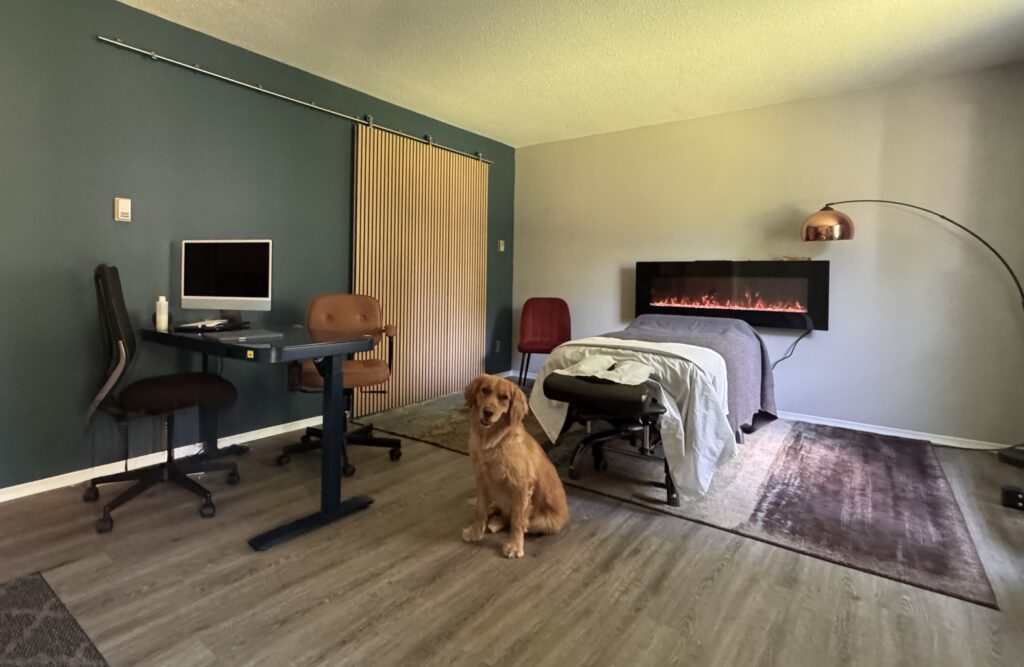
A runner’s session with Bruno Panucci RMT is straightforward, private, and built around your legs and your training. Treatment happens in the private treatment room at his Brantford in-home practice, draped to College of Massage Therapists of Ontario standards, with your consent for each area of work. The pressure runs from soft through medium to deep, deep work is on request and never the default, and a leg full of race soreness often does better with patient, moderate pressure than with force. Bruno typically opens the big movers, calves, hamstrings, and quads, then the glutes and hips, gives the IT band and outer thigh the attention runners ask about most, and finishes at the low back. Sessions are $115 for 60 minutes, a rate kept steady by low overhead, and Registered Massage Therapy receipts work with most extended health plans, so many runners use benefits they already carry. Two friendly, calm dogs share the treatment room, and if you have allergies or would simply rather they were not in the room, ask and Bruno keeps them out for your session. Direct billing is available for most insurers.
Frequently asked questions
Will massage prevent running injuries?
No, and it would be dishonest to promise it. The research on runners does not show massage preventing injuries on its own. Most running injuries are overuse injuries built from training load, so managing your mileage and doing your strength work do the preventing. Massage can ease soreness and tension alongside that plan.
How soon after a race can I get a massage?
You can book within a day or two, but keep it soft to medium at first. Firm, deep work on freshly damaged muscle can add to the soreness before it helps. A lighter session right after a race is well matched to easing soreness and helping you feel recovered. Save deeper work for later in the week.
Can massage fix my IT band or runner’s knee?
It can help, but it is a supporting player, not the fix. For both IT band syndrome and runner’s knee, the evidence points to hip and knee strengthening as the core treatment, with manual therapy as a useful add-on. Massage may ease the surrounding tension and make the strengthening more tolerable, which is worth having.
Is massage for runners covered by insurance?
Usually, yes. Treatment by a Registered Massage Therapist is reimbursable under most extended health plans. Bruno provides a compliant receipt after every session, which includes his name and RMT designation; check your own plan for its annual limit. Direct billing is available for most insurers.
Book a runner’s massage with Bruno in Brantford
Bruno Panucci RMT treats runners at his in-home practice in Brantford, serving Brant County including Paris, St. George, Mt. Pleasant, and Burford, with occasional mobile visits on request. Sessions are $115 for 60 minutes, with receipts for most extended health plans and direct billing available for most insurers.
Text Bruno at 519-753-5544 (he prefers texts), call the same number, or book online. Training around a race, or want a longer table for tired legs? Text him about a 90 minute or two hour session, or a time outside the posted hours. He can often rearrange to fit you in, sometimes the same day.
A note on scope: This page is general information, not medical advice. Registered Massage Therapy can ease muscle soreness and support how recovered you feel, but it does not repair tissue faster, prevent running injuries on its own, or replace treatment for a diagnosed injury. Sharp, sudden, or worsening pain, a joint that gives way, or pain that will not settle deserves a physician conversation first. Bruno Panucci is a Registered Massage Therapist (RMT), and works within current RMT scope of practice.
Related reading
- how sports massage fits a training plan
- the IT band syndrome guide for runners
- what massage can and cannot do for knee pain
Sources
- Wiewelhove T, Schneider C, Döweling A, Hanakam F, Rasche C, Meyer T, Kellmann M, Pfeiffer M, Ferrauti A. Effects of different recovery strategies following a half-marathon on fatigue markers in recreational runners. PLoS ONE, 2018; 13(11): e0207313. doi.org/10.1371/journal.pone.0207313
- van der Worp MP, ten Haaf DS, van Cingel R, de Wijer A, Nijhuis-van der Sanden MW, Staal JB. Injuries in runners; a systematic review on risk factors and sex differences. PLoS ONE, 2015; 10(2): e0114937. doi.org/10.1371/journal.pone.0114937
- Sanchez-Alvarado A, Bokil C, Cassel M, Engel T. Effects of conservative treatment strategies for iliotibial band syndrome on pain and function in runners: a systematic review. Frontiers in Sports and Active Living, 2024; 6: 1386456. doi.org/10.3389/fspor.2024.1386456
- Abdo N, Youssef EF, Ibrahim MM. Efficacy of adding manual therapy to hip and knee exercises in patients with patellofemoral pain syndrome: a double-blinded randomized controlled clinical trial. Scientific Reports, 2025; 15: 17453. doi.org/10.1038/s41598-025-17453-9
- Kovše J, Papuga I, Drobnič M, Buyukaslan A, Strojnik V, Supej M. Alterations in pelvic kinematics with speed, incline, and fatigue in female runners. Frontiers in Sports and Active Living, 2025; 7: 1721641. doi.org/10.3389/fspor.2025.1721641
- College of Massage Therapists of Ontario, Standards of Practice.
- Government of Ontario. Massage Therapy Act, 1991, S.O. 1991, c. 27. ontario.ca/laws/statute/91m27