Bruno Panucci RMT
Plantar Fasciitis Massage in Brantford: Foot Pain Help
Quick answer: Plantar fasciitis massage will not repair the plantar fascia, but it is a reasonable comfort-and-mobility complement for stubborn heel and arch pain. Bruno Panucci RMT treats it at his in-home practice in Brantford for $115 per 60 minute session, working the calves and feet, because tight calves load the fascia. You set the pressure, from soft through medium to deep. This page is general information, not medical advice. One joint up, the same logic applies on the knee pain page.
Plantar fasciitis is the most common cause of heel pain: an overload irritation of the plantar fascia, the band of tissue along the sole of the foot. Its signature is first-step pain, a sharp stab under the heel with the first steps out of bed that eases as the foot warms up, then returns after long standing. Bruno Panucci RMT has spent 25 years working on feet and calves for clients across Brantford and Brant County, including Paris, St. George, Mt. Pleasant, and Burford. Massage is not the fix for plantar fasciitis, and this page is honest about that. What Registered Massage Therapy can do is ease the tight calf and foot muscles that pull on the fascia, and keep day-to-day life more comfortable while the tissue settles. Rates match every other session, at the standard session rate.
Bruno Panucci RMT, 25 years of practice: “People bring me a foot, and I start asking about their calves. Nine times out of ten the heel is where it hurts, but the trouble is upstream, in a calf tight as a bootlace and an ankle that barely bends. I can make the foot feel better for a while, and some people need that to get through a workday. I just tell them the truth: my hands are the comfortable part of the plan, not the whole plan. The stretching and the sensible shoes are what move the needle.”
In short: plantar fasciitis is first-step heel pain from an overloaded plantar fascia, and tight calves are usually part of the load. Massage can ease those calf and foot muscles for short-term relief, but works most reliably alongside calf stretching, load management, and footwear changes, not instead of them.
5 min read
What is plantar fasciitis, and why does the first step hurt most?
Plantar fasciitis is an overload irritation of the plantar fascia, the band of connective tissue that supports the arch of the foot. Despite the name, which points to inflammation, longer-standing cases are now often described as a fasciopathy, meaning the tissue turns degenerative and thickened rather than simply inflamed. The classic pattern is first-step pain: the fascia tightens overnight, so the first steps in the morning feel like a stab under the heel, easing as you walk and returning after long standing. Risk climbs with a sudden jump in walking or running, long hours on hard floors, unsupportive shoes, and tight calves. Bruno Panucci RMT sees this pattern often in Brantford: plantar fasciitis is a loading problem of the foot, not a knot you can rub out. Beyond heel pain, general foot and lower-leg massage has its own honest page.
Why is plantar fasciitis foot pain half calf work?
Plantar fasciitis foot pain is often half calf work because the calf and the fascia are mechanically linked. The calf muscles, the gastrocnemius and soleus, feed into the Achilles tendon, which attaches to the heel bone, the same heel bone the plantar fascia pulls on from the underside. When the calves are tight and the ankle cannot bend far enough, more load transfers through the heel and into the fascia with every step. That is why treating only the sore spot under the heel disappoints, and why the trials showing any benefit from hands-on work almost always pair foot treatment with stretching of the calf and the fascia. In a session, Bruno works the calves and ankle, not just the foot. The foot is where it hurts. The calf is often where the load lives. The the calf and Achilles above the heel often feed heel pain, and have a dedicated guide. Trouble at the a sprained ankle, once the swelling settles, has its own guide.
What does a plantar fasciitis massage session involve?
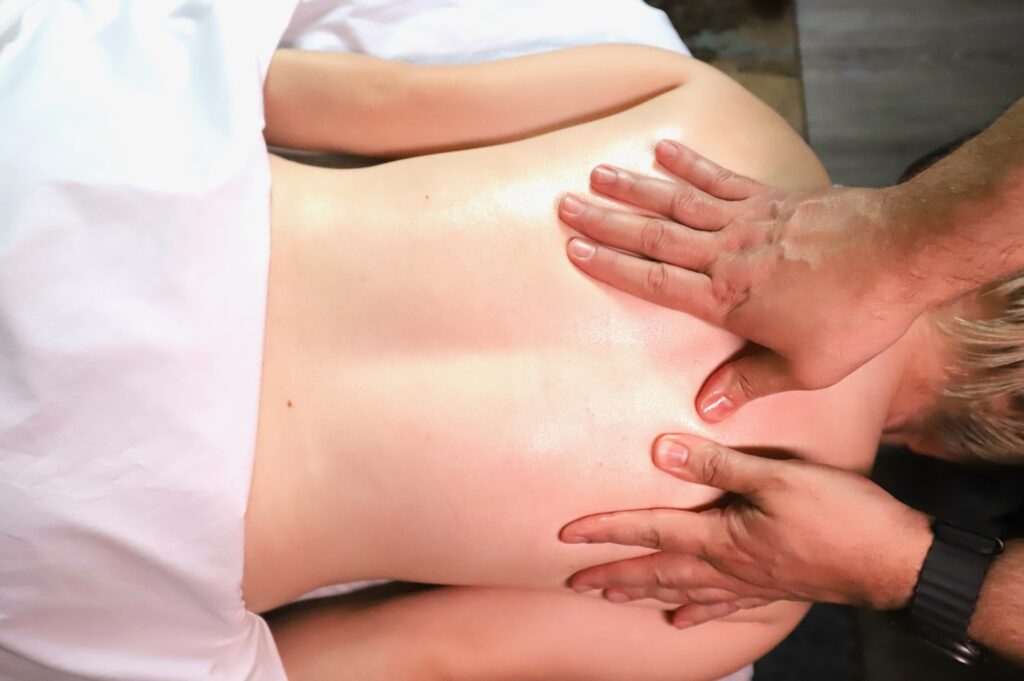
A plantar fasciitis massage session with Bruno Panucci RMT covers more than the foot itself. You set the pressure, and you can adjust it, or stop, at any time, which matters because foot work can be surprisingly intense. Treatment moves through the calves, the ankle, the sole of the foot, and sometimes the hips, since the whole lower limb shares the load. Pressure runs from soft through medium to deep, and the deepest work is on request, never the default. The sole can be too sensitive for more than a moderate touch, and that is fine. Bruno combines the foot work with focused lower-limb deep-tissue work on the calves, then finishes with gentle stretching. Everything happens in the private treatment room at his Brantford in-home practice, draped to College of Massage Therapists of Ontario standards, so only the area being worked on is uncovered.
What can massage do for plantar fasciitis, and what can it not?
Massage for plantar fasciitis can ease tight calf and foot muscles, calm the local discomfort, and support the mobility work that changes the fascia over time. The evidence is modest. A systematic review of manual therapy (Clar and colleagues, 2014) found moderate evidence that hands-on treatment of the foot and ankle, combined with exercise and stretching, gives short-term relief for plantar fasciitis, while manual therapy alone adds little. What massage cannot do is repair a degenerative fascia, dissolve a heel spur, or replace what carries the load: calf stretching, load management, footwear changes, and physiotherapy strengthening. Anyone promising to cure plantar fasciitis with massage alone is overselling. The table below sets honest expectations.
| What you are feeling | What massage can honestly do | Physician or podiatrist first? |
|---|---|---|
| First-step heel pain in the morning, easing as you walk | Ease calf and foot tension and add short-term comfort, alongside stretching and load changes | No, but pair it with footwear and loading advice |
| Arch and heel ache after long standing or a jump in training | May reduce the calf tightness pulling on the fascia; most effective combined with exercise | No, unless months pass with no improvement |
| Numbness, tingling, or burning spreading into the foot | Not the main answer; this suggests a nerve, not just the fascia | Yes, see a physician |
| Heel pain with night pain, fever, or after a fall or injury | Not appropriate until you are assessed | Yes, physician first |
| Heel pain unchanged after months of good care | Limited; time to reassess the diagnosis and the plan | Yes, physician or podiatrist |
When should you see a physician or podiatrist first?
Most plantar fasciitis is a straightforward loading problem, safe to treat with massage as part of a wider plan. Some heel pain needs a diagnosis first. See your family physician or a podiatrist first if any of these are true:
- Numbness, tingling, or burning spreading into the foot or toes, which points to a nerve rather than the fascia.
- Heel pain that wakes you at night or is present at rest, rather than easing as you move.
- Redness, swelling, warmth, or fever around the heel, or feeling generally unwell.
- Heel pain that has not improved over several months despite stretching, footwear changes, and rest.
- Heel pain that began after a fall or injury.
None of these mean massage is off the table forever. The foot needs a diagnosis first, and Registered Massage Therapy may then support whatever plan your physician or podiatrist sets.
Frequently asked questions
Can massage cure plantar fasciitis?
No, and anyone who says so is overselling. Massage can ease the tight calf and foot muscles that load the fascia and add real comfort, but the fascia settles through calf stretching, gradual loading, footwear changes, and time. Bruno Panucci RMT is upfront that his hands are the comfortable part of the plan, not the whole plan.
Does the massage work on my foot or my calf?
Usually both, and often the calf more than you expect. The calf connects through the Achilles to the same heel bone the plantar fascia pulls on, so loosening tight calves and a stiff ankle takes load off the foot. That is why foot-pain work is often half calf work.
Will the foot massage hurt?
It can be, so you set the pressure and can adjust it or stop at any time. Pressure runs from soft through medium to deep, the deepest on request. The sole of the foot is sensitive, and there is no need to push into sharp pain to get a benefit.
When should I see a doctor instead of booking a massage?
See your physician or a podiatrist first if you have numbness or burning spreading into the foot, heel pain at night or at rest, fever or swelling, pain after a fall, or heel pain that has not improved over several months. Those signs need a diagnosis before massage.
Book a plantar fasciitis massage with Bruno in Brantford
Bruno Panucci RMT treats plantar fasciitis, heel pain, and calf tension at his in-home practice in Brantford, serving Brant County including Paris, St. George, Mt. Pleasant, and Burford, with occasional mobile visits on request. Sessions are $115 for 60 minutes, with receipts for most extended health plans and direct billing available for most insurers.
Text Bruno at 519-753-5544 (he prefers texts), call the same number, or book online. Need a time the calendar does not show, or a 90 minute or two hour session? Text him directly. He can often rearrange to fit you in, sometimes the same day.
A note on scope: This page is general information, not medical advice. Registered Massage Therapy may ease the muscles around plantar fasciitis and support your comfort and mobility, but it does not diagnose foot conditions, repair the plantar fascia, or replace load management, footwear changes, or physiotherapy. For the warning signs above, or heel pain that is not improving, see your physician or a podiatrist first. Bruno Panucci is a Registered Massage Therapist and works within current RMT scope of practice.
Related reading
- runners’ recovery sessions
- how intense foot work should feel
- coming in from the county
- before your first appointment
Sources
- Clar C, Tsertsvadze A, Court R, Lewando Hundt G, Clarke A, Sutcliffe P. Clinical effectiveness of manual therapy for the management of musculoskeletal and non-musculoskeletal conditions: systematic review and update of UK evidence report. Chiropractic & Manual Therapies, 2014; 22: 12. doi.org/10.1186/2045-709X-22-12
- Bronfort G, Haas M, Evans R, Leininger B, Triano J. Effectiveness of manual therapies: the UK evidence report. Chiropractic & Osteopathy, 2010; 18: 3. doi.org/10.1186/1746-1340-18-3
- College of Massage Therapists of Ontario, Standards of Practice.