Bruno Panucci RMT
Massage for Nurses in Brantford: Shifts, Feet, and Sleep
Quick answer: Massage for nurses is Registered Massage Therapy aimed at what a nursing body actually carries: hours on the feet, a low back loaded by lifting and turning patients, and a nervous system worn thin by rotating shifts and short sleep. Bruno Panucci RMT works that pattern at his Brantford in-home practice, $115 for 60 minutes, at the pressure you choose from soft through medium to deep. Receipts work with most extended health plans, the kind most hospital and agency jobs carry. This page is general information, not medical advice.
Massage for nurses is Registered Massage Therapy shaped around shift work: long stretches upright, a low back that lifts and repositions people all day, feet and calves that never fully unload, and the specific tiredness that comes from sleeping when the rest of the world is awake. Bruno Panucci RMT has treated that pattern for 25 years, and it walks into his Brantford in-home practice attached to nurses, personal support workers, and paramedics from across Brant County, Paris, St. George, Mt. Pleasant, and Burford. The booking often opens with the low back that does the lifting, but in a nursing body the back is rarely the only thing asking.
Bruno Panucci RMT, 25 years of practice: “I can usually tell a nurse by the way the calves and the low back argue with each other. Twelve hours upright, a couple of awkward patient transfers, then a drive home before the body has cooled down. What most of them actually want is not just less pain, it is one hour where nobody needs anything from them. I keep the room quiet, the pressure yours, and the dogs settle in the corner. If you come off nights, tell me, and I take the pressure down a notch so you leave loose, not tender.”
In short: nursing loads the body from the ground up and the clock sideways. The feet and calves stay switched on, the low back carries every lift and turn, the neck and shoulders hold the tension of a busy floor, and rotating shifts keep the nervous system from ever fully settling. A session built for a nurse works that whole load in one hour and gives the sleep-starved part of the system a chance to downshift.
6 min read
Why do nurses carry tension so differently from desk workers?
Nurses carry tension differently from desk workers because the load is dynamic, not static. A desk body is held in one shape for hours; a nursing body is up, bending, lifting, bracing, and pivoting through most of a shift, then doing it again on little sleep. The result is a mix of the two worst worlds: the sustained postural strain of standing plus the acute strain of manual handling. Bruno Panucci RMT treats that combination as a whole rather than a single sore spot, because the low back that twinged during a transfer is usually connected to tight calves, guarded hips, and shoulders that spent the shift braced. Registered Massage Therapy will not rewrite a schedule or lighten a patient load, and it is honest to say so, but it can ease the muscular cost the job leaves behind, so the next shift starts from a looser baseline instead of a stacked one.
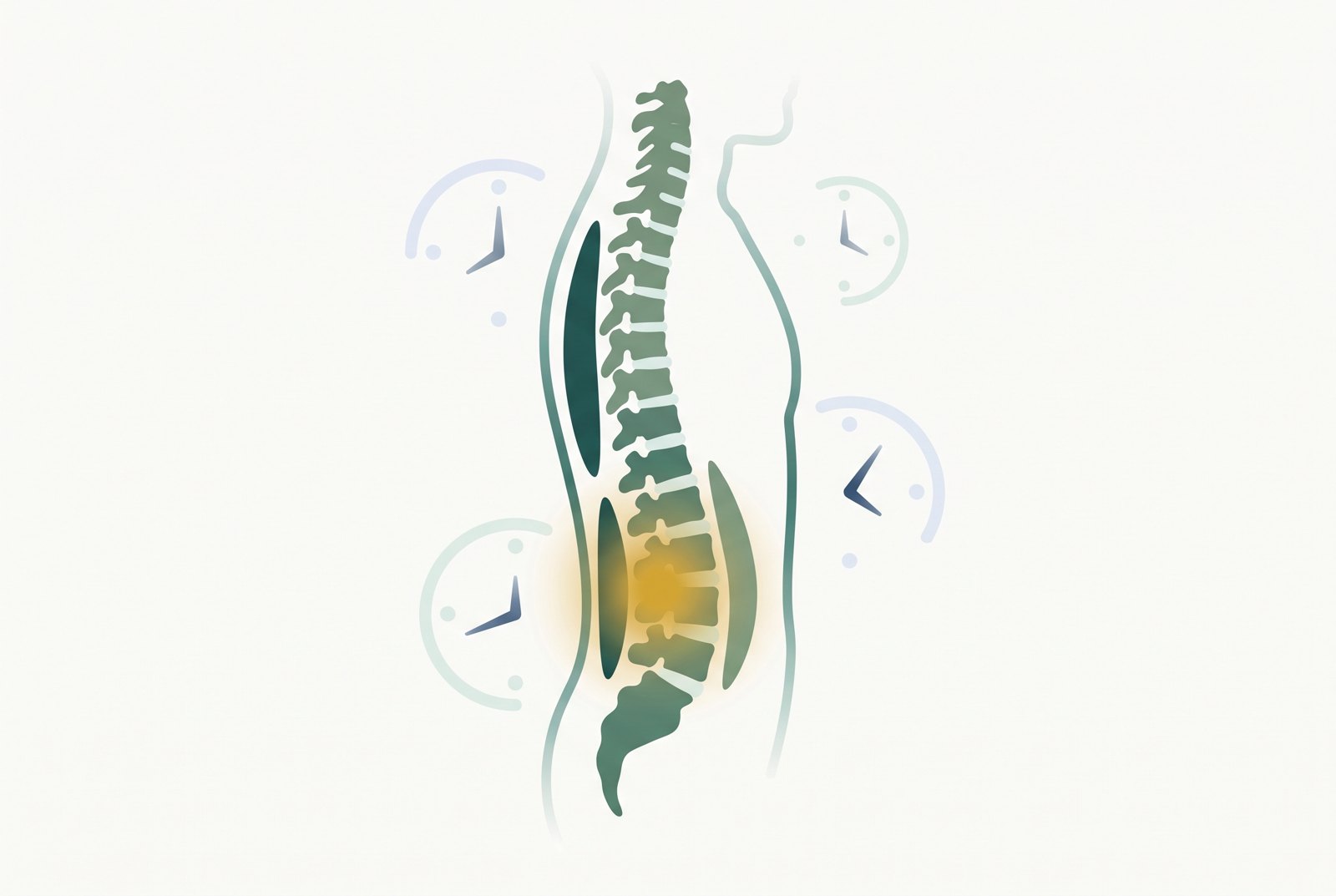
What does a twelve-hour shift do to feet, calves, and low back?
A twelve-hour shift loads the body from the floor up, and each region hands its strain to the next. The feet and calves stay under load for the whole stretch, so the calves shorten and the arches ache. The hamstrings and hip flexors tighten from bracing and half-sitting. The low back becomes the hinge for every lift, turn, and reposition, and it quietly tallies the total. The neck and shoulders hold the tension of a floor that never quite slows down. A narrative review of rehabilitation for older patients with rheumatoid arthritis noted that massage therapies can offer pain relief and improved flexibility alongside other approaches (Fedorchenko and colleagues, 2025), a fair description of what focused soft-tissue work does for tired, over-braced muscle. The map for a nursing body, worked in one session, looks like this. A whole page on tired, worked feet covers what a day of standing does.
| Region | What a shift does to it | What the session does there |
|---|---|---|
| Feet and calves | Under load for the whole shift; calves shorten, arches ache | Unhurried work through the calves and the soles to unload them |
| Hips and hamstrings | Brace and half-sit through transfers, so they tighten and guard | Lengthens the back of the leg and settles the guarding hips |
| Low back | The hinge for every lift, turn, and reposition | Broad, patient work once the legs and hips have let go |
| Neck and shoulders | Held braced through a busy floor, phone and chart at the ready | Slow release through the upper traps and the base of the skull |
| Nervous system | Rotating shifts keep it from ever fully settling | A quiet hour with soft-to-medium pace to let it downshift |
Can massage help with shift work, poor sleep, and burnout?
Massage may ease some of what shift work does to a body, and it is worth being precise about which parts. It does not fix a schedule, cure fatigue, reset a circadian clock, or flush anything out of the system, and any page that promises those things is overselling. What the research points to is more modest and still useful. A systematic review and network meta-analysis of non-pharmacological therapies for chronic fatigue found that massage was associated with reduced physical fatigue, mental fatigue, anxiety, and depression compared with conventional care, while cautioning that the evidence has real limitations (Zhang and colleagues, 2026). A randomized controlled trial of early postpartum massage similarly reported eased physical discomfort, lower negative mood, and improved positive mood (Yamasaki and colleagues, 2026). None of that makes massage a treatment for burnout, but for a nurse coming off a run of nights, an hour of settled, unhurried touch that eases the muscular load and lets the nervous system quiet down is a reasonable, evidence-aware thing to book. If low mood, exhaustion, or sleep trouble is persistent, that is a conversation for your physician, not a massage table. Bruno Panucci RMT keeps that line clear, and one honest thread here is what massage can and cannot do for stress.
What does a massage session for a nurse look like?
A session for a nurse with Bruno Panucci RMT is built around how you arrive and how much sleep you have had. You set the pressure. You can adjust it, or stop, at any time. The scale runs from soft through medium to deep, and deep work is available on request, never the default; a body that just finished a run of shifts often responds better to patient, moderate pressure than to force. Bruno typically starts low, at the calves and feet that carried the day, then works the hamstrings and hips, the low back once its neighbours have released, and finishes at the neck and shoulders. Treatment happens in the private treatment room at his Brantford in-home practice, draped to College of Massage Therapists of Ontario standards, with your consent for each area of work. Two friendly, calm dogs share the room and settle quietly; if you have an allergy or would simply rather they were not there, ask and Bruno keeps them out. If it has been months since your last massage, say so, because a lighter first session leaves you pleasantly loose rather than sore.
A note on scope: This page is general information, not medical advice. Registered Massage Therapy may ease the muscle tension and stress that shift work leaves behind, but it does not diagnose or treat any condition, and it is not a substitute for sleep, rest, or care. Persistent exhaustion, low mood, chest pain, numbness, or a sudden change in a symptom deserves a conversation with your physician first. Bruno Panucci is a Registered Massage Therapist (RMT), and works within current RMT scope of practice.
Booking around shifts, and will hospital benefits cover it?
Booking around a rotating roster is the practical part, and it is where texting helps most. Bruno Panucci RMT keeps a $115 rate for 60 minutes at his Brantford in-home practice, held steady by low overhead, and if the online calendar shows nothing that fits your rotation, a text can often surface a time it does not list, sometimes the same day. A 90-minute session, useful when the whole chain from feet to shoulders needs unhurried attention, can be arranged the same way. Registered Massage Therapy receipts are accepted by most extended health plans, and hospital and agency positions are precisely the jobs that tend to carry those plans, so the benefit often sits unused. Direct billing is available for most insurers. Complementary therapies including massage have shown benefits for pain, fatigue, anxiety, and sleep quality in a systematic review, though the effects were mixed and therapy-specific (Guerra-Martín and colleagues, 2026), which is the honest frame for booking: a genuine, if modest, support, not a cure.
Frequently asked questions
I work rotating shifts and Bruno’s calendar never fits. Can I still book?
Usually, yes. Text Bruno at 519-753-5544 with a couple of times that suit your rotation, and if the online calendar does not show them he can often rearrange to fit you in, sometimes the same day. Texting works far better than trying to force your roster onto the posted slots.
Is massage for nurses covered by hospital or agency benefits?
Usually, yes. Treatment by a Registered Massage Therapist is reimbursable under most extended health plans, the kind most hospital and agency positions include. Bruno provides a compliant receipt after every session, with his name and RMT designation on it; check your own plan for its annual limit.
I’m coming straight off a night shift. Should I still get a massage?
You can, and it is worth telling Bruno you are off nights so he keeps the pressure lighter and the pace slow. A gentler session leaves you loose and calm rather than tender, which is usually what a sleep-short body actually wants before it heads home to rest.
Will massage fix the fatigue and burnout from shift work?
No, and it would be dishonest to say so. Massage may ease the muscle tension and lower the stress that shift work leaves behind, but it does not repair lost sleep or resolve burnout. If exhaustion or low mood is persistent, that is a conversation for your physician.
Book a massage around your shifts in Brantford
Bruno Panucci RMT treats shift-worn nursing bodies at his in-home practice in Brantford, serving Brant County including Paris, St. George, Mt. Pleasant, and Burford, with occasional mobile visits on request. Sessions are $115 for 60 minutes, with receipts for most extended health plans and direct billing available for most insurers.
Text Bruno at 519-753-5544 (he prefers texts), call the same number, or book online. Working a roster that never lines up with the posted hours, or want the whole chain done without the clock in a 90-minute or two-hour session? Text him directly. He can often rearrange to fit you in, sometimes the same day.
Related reading
- massage and the sleep that shift work steals
- the low back that does the lifting
- easing the stress a busy floor leaves behind
Sources
- Zhang Y, Zhou Y, Xu H, Zhang C, Guo L, Zi A, Xu Y, Xu M, Liu T. Comparative effectiveness of non-pharmacological traditional Chinese medicine therapies for chronic fatigue syndrome: a systematic review and network meta-analysis. Frontiers in Medicine, 2026. doi.org/10.3389/fmed.2026.1804710
- Yamasaki A, Sakamoto N, Edamitsu Y, Ishibashi M, Kimura F, Igarashi T. Effects of early postpartum massage on physical discomfort, mood, and emotional well-being: A randomized controlled trial. European Journal of Midwifery, 2026. doi.org/10.18332/ejm/216378
- Fedorchenko Y, Zimba O, Qumar AB, Yessirkepov M, Kocyigit BF. Physical activity of older patients with rheumatoid arthritis. Rheumatology International, 2025. doi.org/10.1007/s00296-025-05901-8
- Guerra-Martín MD, Delgado-Saldaña I, Magni E, Calderón-Fernández M, Borrallo-Riego Á. Potential Benefits of Complementary Therapies for Women with Breast Cancer Undergoing Oncological Treatment: A Systematic Review. Healthcare, 2026. doi.org/10.3390/healthcare14111588
- College of Massage Therapists of Ontario, Standards of Practice.
- Government of Ontario. Massage Therapy Act, 1991, S.O. 1991, c. 27. ontario.ca/laws/statute/91m27