Bruno Panucci RMT
Massage and Sleep: Can a Session Help You Rest?
Quick answer: Many people sleep unusually well the night after a massage, and Bruno Panucci RMT hears it constantly at his Brantford in-home practice. The research is real but modest: in people with chronic pain, moderate-level evidence suggests massage may improve sleep and ease anxiety. A session can calm a keyed-up nervous system and quiet the muscle aches that interrupt sleep, but it does not treat insomnia disorder or replace sleep medicine. This page is general information, not medical advice.
Massage for sleep is not a treatment for insomnia. It is what tends to happen to your sleep after Registered Massage Therapy settles the body down. Bruno Panucci RMT has spent 25 years working on people across Brantford and Brant County, from Paris and St. George to Mt. Pleasant and Burford, and the most common thing they report back is a good night’s sleep after a session. That lines up with how the body works and, cautiously, with the research. It is not a cure, and this page says so plainly. If gentle is what you are after, that is squarely his craft too, through his soft-pressure relaxation sessions.
Bruno Panucci RMT, 25 years of practice: “The thing I hear more than almost anything is, I slept like a rock that night. I have heard it for 25 years. That is what people tell me, not a study, and it is usually the night of the massage, not a fix for a sleep problem. But a body that has stopped bracing does rest easier. If you sleep badly most nights, see your doctor. If you just want one good night to start, an evening session is a fair place to begin.”
In short: people often sleep well the night after a massage because the session lowers nervous-system arousal and eases the muscle aches that interrupt rest. The evidence in chronic-pain groups is modest but real. Massage supports a better night; it does not treat insomnia disorder.
6 min read
Can a massage actually help you sleep?
A massage can help you sleep a little. The strongest fair statement comes from a UK evidence report on manual therapies (Bronfort and colleagues, 2010), which found moderate-level evidence that massage may help improve sleep and reduce anxiety in people living with chronic pain. Massage therapy has also been widely used to ease insomnia in specific groups, including people going through cancer treatment (Mao and colleagues, 2022). What you will not find is proof that it cures a sleep disorder. So the honest promise is narrow but worth having: if pain, tension, or a racing mind is part of why you sleep badly, a session may loosen the grip on all three for a night or two. Bruno Panucci RMT would rather tell you that than sell a cure. A guide for students and poor sleep covers stress, sleep, and student plans. If leg cramps that wake you are part of the picture, that has a dedicated honest guide. If waking up stiff is your pattern, there is a page on what it means.
Why a session can make the night after easier
A massage session tends to make the night after easier for three plain reasons, none of them magic. First, arousal comes down. A calm, unhurried hour of Registered Massage Therapy shifts the body out of go-mode, and it is hard to fall asleep while your system is still revving. Second, sore, guarding muscles stop interrupting you. If a tight low back or a knotted shoulder keeps waking you when you roll over, easing it removes one of the things pulling you out of sleep. Third, the quiet hour is its own reset: a warm, private room, no phone, nothing to solve, which people underrate. You set the pressure, from soft through medium to deep. You can adjust it, or stop, at any time. Deep work is there on request, never the default, and for sleep most people do better toward the soft-to-medium end. For shift-working nurses and the toll of nights, there is a dedicated page.
What massage will not do for insomnia
What massage will not do is treat insomnia as a disorder. Chronic insomnia, the kind that runs on for months, is a medical issue, and the frontline treatment is not massage. It is usually cognitive behavioural therapy for insomnia (CBT-I) and, where appropriate, care from your physician. Massage does not replace either. It also will not fix sleep problems driven by sleep apnea, restless legs, a thyroid issue, or a medication. If your sleep has been broken for weeks, the useful move is a talk with your physician, not a standing massage appointment. Where massage fits is alongside all of that, as something that may help you rest on a given night. Bruno Panucci RMT is a Registered Massage Therapist, not a sleep physician, and says so.
Timing your session: evenings and the night-after effect
If sleep is the goal, lean toward the back half of the day. The calm, downshifted feeling after a massage is strongest in the hours right after, so an evening or late-afternoon session lets it carry into bedtime instead of wearing off during a busy day. Most people notice it the night of the massage: a nudge toward one good night, not a switch you flip once. A few small things help it land. If the best hour to book matters for winding down, the sleep page goes deeper.
| What helps | Why it helps |
|---|---|
| An evening or late-afternoon slot | The calm feeling is strongest in the hours right after, so it reaches bedtime instead of fading during the day. |
| A pressure you can relax under | Sleep follows ease, not effort. A manageable pressure keeps your nervous system settled, not braced. |
| Not rushing off the table | The still few minutes at the end are part of the effect; racing out undoes some of it. |
| Your normal wind-down afterward | Dim light and less screen time still matter. Massage supports the night; it does not replace good sleep habits. |
One thing that does not matter: there is no need to chug water afterward to flush anything out, because massage does not release toxins. And because a racing mind is so often the real culprit behind a bad night, the same session that helps you sleep is doing much of its work on tension and worry, which is the stress side of the story.
A quiet evening session in Brantford
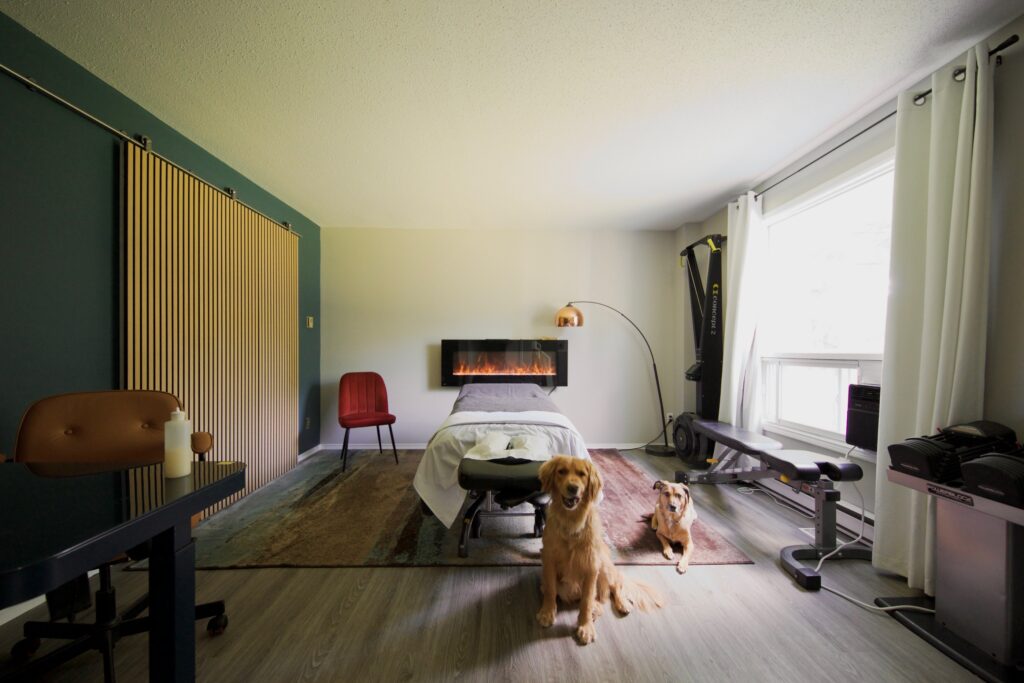
A massage aimed at sleep works best somewhere genuinely quiet, and that is what Bruno Panucci RMT offers: a private treatment room in his Brantford in-home practice, draped to College of Massage Therapists of Ontario standards, with no busy waiting room and no rush. Two friendly, calm dogs share the space, and if allergies or preference mean you would rather they stayed out of the room, just ask. A 60-minute session is $115, kept low by the small overhead of his own home, and because Bruno is a Registered Massage Therapist your receipt works with most extended health plans.
Frequently asked questions
Will a massage help me sleep the same night?
Often, yes, especially if pain, tension, or a busy mind is keeping you up. Most people notice it the night of the session, not as a lasting change. Moderate-level evidence in chronic-pain groups supports massage helping sleep, though it is not guaranteed or a cure.
Can massage cure insomnia?
No. Chronic insomnia is a medical condition, and the frontline treatments are cognitive behavioural therapy for insomnia (CBT-I) and care from your physician, not massage. A session with Bruno Panucci RMT may help you rest on a given night, but it does not treat a sleep disorder or replace medical care.
What time of day is best for a sleep-focused massage?
Evening or late afternoon tends to work best, so the calm feeling carries into bedtime instead of fading during the day. If the online calendar looks full, text Bruno Panucci RMT directly; he can often fit in an evening or off-hours time in Brantford, sometimes the same day.
Should I choose firm or gentle pressure for better sleep?
For sleep, most people do better toward the soft-to-medium end. You set the pressure, from soft through medium to deep, and you can adjust it or stop at any time. Deep work is there on request, never the default, and a session you can fully relax under is the one most likely to help you rest.
Book a sleep-friendly massage with Bruno in Brantford
Bruno Panucci RMT works from a quiet in-home practice in Brantford, serving Brant County including Paris, St. George, Mt. Pleasant, and Burford. Sessions are $115 for 60 minutes, with receipts for most extended health plans and direct billing available for most insurers.
Text Bruno at 519-753-5544 (he prefers texts), call the same number, or book online. Want an evening slot the calendar does not show, or a 90-minute or two-hour session to fully unwind? Text him directly. He can often rearrange to fit you in, sometimes the same day.
A note on scope: This page is general information, not medical advice. Massage may help you rest on a given night, but it does not diagnose or treat insomnia or any sleep disorder, and results vary. Chronic insomnia, or sleep tied to conditions like sleep apnea, belongs with your physician first. Bruno Panucci is a Registered Massage Therapist and works within current RMT scope of practice.
Related reading
- Evening and short-notice booking
- What a first session looks like
- Session lengths and rates
- When tension keeps you up with headaches
Sources
- Bronfort G, Haas M, Evans R, Leininger B, Triano J. Effectiveness of manual therapies: the UK evidence report. Chiropractic & Osteopathy, 2010; 18: 3. doi.org/10.1186/1746-1340-18-3
- Mao JJ, Pillai GG, Andrade CJ, et al. Integrative oncology: addressing the global challenges of cancer prevention and treatment. CA: A Cancer Journal for Clinicians, 2022; 72(2): 144-164. doi.org/10.3322/caac.21706
- College of Massage Therapists of Ontario, Standards of Practice.