Bruno Panucci RMT
Massage for Students in Brantford: Stress, Sleep, and Budget
Quick answer: Massage for students is Registered Massage Therapy aimed at the pattern student life builds: exam stress, hunched study posture, backpack shoulders, and the broken sleep that comes with a heavy term. Bruno Panucci RMT works that pattern at his Brantford in-home practice, $115 for 60 minutes, at the pressure you choose from soft through medium to deep. Many student and parent health plans reimburse RMT receipts, so the cost is often partly covered. Massage may ease tension and support rest; it does not cure anxiety or fix sleep on its own. This page is general information, not medical advice.
Massage for students is Registered Massage Therapy shaped around the way a term loads a young body: shoulders rounded over a laptop, a neck bent toward notes for hours, a jaw clenched through an exam, and sleep that shortens as deadlines stack up. Bruno Panucci RMT has treated stress-and-posture patterns for 25 years, and students arrive at his Brantford in-home practice from Wilfrid Laurier and Conestoga campuses and from high schools across Brant County, Paris, St. George, Mt. Pleasant, and Burford. The booking often begins as an attempt to quiet the stress that a heavy course load builds, but in a student body the stress and the stiff neck are usually the same story told twice.
Bruno Panucci RMT, 25 years of practice: “Students tell me they are stressed, and then I put my hands on the upper back and the story is already there in the muscle. The shoulders live up near the ears by November. What surprises them is how much of the racing mind is riding on a tight neck and a clenched jaw. I cannot take an exam off your calendar, but I can settle the body that is carrying it, and most students leave breathing lower and slower than they walked in.”
In short: a term builds one connected pattern, not separate complaints. Study posture rounds the shoulders, the jaw clenches under pressure, and short sleep keeps the whole system wound tight. A massage session for a student loosens the physical side of that stress so the body has less to hold, which is a real and honest help even though it is not a treatment for anxiety itself.
6 min read
Can massage help with exam stress for students?
Massage can help with the physical side of exam stress, and being honest about that boundary matters. Stress is not only a feeling; it shows up in the body as a raised, held muscle tone, especially across the shoulders, neck, and jaw. Registered Massage Therapy works directly on that held tension, which is why a session often leaves a student calmer even though nothing on the calendar has changed. A systematic review of massage therapy in athletes found that it contributed positively to psychological states, including mood and anxiety reduction (Mathunjwa and colleagues, 2025); the population studied was competitive athletes rather than students, but the mechanism, easing the body’s stress load through touch, is the same one Bruno Panucci RMT applies in Brantford. What massage does not do is cure anxiety or replace counselling. If stress is affecting your eating, mood, or ability to function, that is a conversation for your physician or your school’s health service, and massage sits alongside that care, not instead of it.
What does studying do to a student’s neck and shoulders?
Studying builds a predictable neck-and-shoulder pattern, because the study position is one held shape repeated for most of the day. The head tips forward toward a screen or a page, and the muscles at the base of the skull and across the upper back work overtime to hold it there. Add a heavy one-strap backpack, and one shoulder rides higher than the other for the walk between classes. Chronic musculoskeletal complaints are best understood through the interplay of biological, psychological, and social factors rather than a single cause, and passive treatment alone rarely produces lasting functional change (Aavula and colleagues, 2026), which is a fair description of a stressed student with a stiff neck: the posture, the pressure, and the poor sleep all feed the same tension. Bruno Panucci RMT works the neck, upper traps, and the base of the skull as one region, at the pressure you choose. You set the pressure. You can adjust it, or stop, at any time. The scale runs from soft through medium to deep, and deep work is available on request, never the default, since a young body under stress often responds better to patient, moderate pressure than to force. For students whose tension climbs into a headache by the end of a study day, this same neck and jaw work is usually where the relief starts.
Does massage help students sleep during a hard term?
Massage may support better sleep during a demanding term, mostly by lowering the physical tension that keeps a wound-up body from settling. A student who lies down still braced from a day of deadlines does not fall asleep well, and easing that bracing can make the difference between tossing and drifting off. The same review of massage in athletes found that it aided physical recovery and contributed positively to psychological states, including reduced anxiety (Mathunjwa and colleagues, 2025), and while a student is not a competing athlete, the shared thread is a nervous system that has been running hot and needs help stepping down; a calmer, less braced body is simply one that settles into sleep more easily. It would be dishonest to promise massage fixes insomnia or replaces good sleep habits; caffeine timing, screen use, and a consistent bedtime do the heavy lifting. What a session offers is a body that is easier to fall asleep in. Students who come in for stress often find the sleep improvement is the change they notice first, which is why the topic connects so closely to massage and better sleep more broadly.
What does a student massage session actually involve?
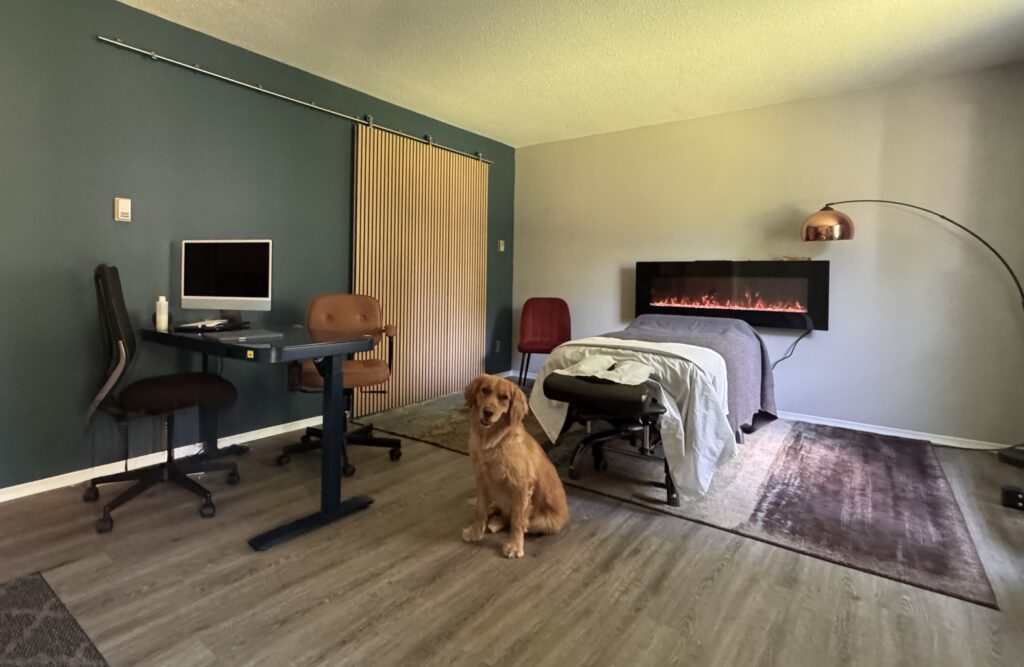
A student massage session is a regular Registered Massage Therapy appointment, and knowing the shape of it removes the first-time nerves. It runs 60 minutes in the private treatment room at Bruno Panucci RMT’s Brantford in-home practice, draped to College of Massage Therapists of Ontario standards, with your consent for each area of work. Bruno usually opens with the neck, upper back, and shoulders, since that is where study tension concentrates, then works the jaw if you clench, and adjusts to wherever your term has landed hardest. Two friendly, calm dogs share the treatment room, and they can be kept out if you have allergies or would simply prefer it, so just say the word when you book. Anyone under 18 brings a parent or guardian, who stays in the room for the whole session. The table below sorts what massage realistically does for a student from what it does not.
| Student concern | What a massage may do | What it will not do |
|---|---|---|
| Exam and deadline stress | Ease the held muscle tension that stress builds, so the body settles | Cure anxiety or replace counselling and physician care |
| Study-posture neck and shoulders | Loosen the neck, upper traps, and base of the skull | Undo bad ergonomics if the study setup never changes |
| Broken term-time sleep | Lower physical bracing so falling asleep is easier | Fix insomnia or override caffeine and late screens |
| Jaw clenching under pressure | Release the jaw, face, and surrounding muscles within scope | Diagnose or treat a dental or TMJ disorder |
How do students afford massage, and do health plans cover it?
Cost is the real question for most students, and there are two honest answers. First, Registered Massage Therapy receipts are reimbursable under most extended health plans, and students are more likely to be covered than they think: many post-secondary student unions include RMT coverage in their health plan, and students still on a parent’s family plan can often claim there too. Bruno Panucci RMT provides a compliant receipt after every session, and the receipt is what you submit; check your plan for its annual massage limit. Second, the in-home practice keeps the price steady, $115 for 60 minutes, because working from his own space means lower overhead than a downtown clinic carries. Direct billing is available for most insurers. On the value of pairing hands-on care with the work you do yourself, a review of controlled trials found that exercise-based rehabilitation was the effective primary intervention across musculoskeletal conditions, while added modalities offered mainly short-term benefits (Rawat and colleagues, 2026). Read plainly for a student: massage gives real short-term relief, and movement, better posture, and sleep habits carry the long game, so the two together are the honest plan.
Frequently asked questions
Is massage actually worth it for a stressed-out student?
For the physical side of stress, yes. Registered Massage Therapy eases the held tension across the neck, shoulders, and jaw that a heavy term builds, and most students leave calmer than they arrived. It is not a treatment for anxiety itself, so pair it with your school’s health service if stress is affecting how you function.
Do student health plans cover massage therapy?
Often, yes. Many post-secondary student union plans include Registered Massage Therapy, and students on a parent’s family plan can frequently claim there. Bruno Panucci RMT gives a compliant receipt after every session; check your own plan for its annual limit before booking.
How much does a student massage cost with Bruno in Brantford?
A 60 minute session is $115 at Bruno’s Brantford in-home practice, a rate kept steady by low overhead. If your student or family plan covers Registered Massage Therapy, the receipt means your out-of-pocket cost is often much lower. Text Bruno if you want a shorter or longer session.
Can massage help me sleep before exams?
It may help you fall asleep more easily by lowering the physical tension that keeps a wound-up body awake. It will not fix insomnia or undo late caffeine and screen time, which do more to your sleep than anything. Many students notice the easier sleep first, but the habits still matter most.
Book a student massage with Bruno in Brantford
Bruno Panucci RMT treats study stress and tension at his in-home practice in Brantford, serving Brant County including Paris, St. George, Mt. Pleasant, and Burford, with occasional mobile visits on request. Sessions are $115 for 60 minutes, with receipts for most extended health plans and direct billing available for most insurers.
Text Bruno at 519-753-5544 (he prefers texts), call the same number, or book online. Need a time outside posted hours, or a shorter session or a 90 minute one before a heavy exam week? Text him directly. He can often rearrange to fit you in, sometimes the same day.
A note on scope: This page is general information, not medical advice. Registered Massage Therapy may ease the muscle tension that comes with student stress and support more restful sleep, but it does not cure anxiety, treat insomnia, or fix any underlying condition, and results vary. If stress is affecting your eating, mood, or daily functioning, speak with your physician or your school’s health service first. Bruno Panucci is a Registered Massage Therapist (RMT), and works within current RMT scope of practice.
Related reading
- how massage eases stress and anxiety tension
- massage and better sleep in Brantford
- the headache end of study tension
Sources
- Mathunjwa ML, Mahlangu S, Haddad M. Evaluating the Impact of Massage Therapy on Performance and Well-Being in Taekwondo Practitioners: A Systematic Review. International Journal of Environmental Research and Public Health, 2025; 22(5): 742. doi.org/10.3390/ijerph22050742
- Aavula M, Parvizi D, Kandikattu S, Agrawal DK. Integrating Mechanical Diagnosis and Therapy Within Multidisciplinary Biopsychosocial Care for Chronic Musculoskeletal Pain. Journal of Orthopaedics and Sports Medicine, 2026. doi.org/10.26502/josm.511500253
- Rawat B, Rajpoot YS, Saha S, Ciocan VC, Cristuta AM, Choudhary S, Choudhary PK, Gorgan CM, Sufaru C, Voinea NL. Is Exercise Enough? Evidence from Controlled Clinical Trials on Rehabilitation with and Without Adjunct Modalities for Musculoskeletal Disorders. Life, 2026; 16(4): 608. doi.org/10.3390/life16040608
- College of Massage Therapists of Ontario, Standards of Practice.
- Government of Ontario. Massage Therapy Act, 1991, S.O. 1991, c. 27. ontario.ca/laws/statute/91m27