Bruno Panucci RMT
Massage for Tradespeople in Brantford: The Working Body
Quick answer: Massage for tradespeople is Registered Massage Therapy aimed at the load pattern heavy manual work builds: worn shoulders, a tired low back, a grip that will not fully let go, and forearms that carry the tool all day. Bruno Panucci RMT treats that working body at his Brantford in-home practice, $115 for 60 minutes, at the pressure you choose from soft through medium to deep. Receipts work with most extended health plans. This page is general information, not medical advice.
Massage for tradespeople is Registered Massage Therapy built around the way physical work loads a body: overhead reaching that grinds the shoulders, lifting and twisting that the low back absorbs, and a hand that grips a drill, a wrench, or a trowel until the forearm stops switching off. Bruno Panucci RMT has treated that working body for 25 years, and it walks into his Brantford in-home practice attached to electricians, framers, welders, mechanics, and landscapers from across Brant County, Paris, St. George, Mt. Pleasant, and Burford. The complaint that opens the booking is usually the shoulder that catches on the reach overhead, but in a working body it almost never shows up on its own.
Bruno Panucci RMT, 25 years of practice: “I can usually tell a trade by the hands and the way a shoulder sits. A framer’s grip is different from a plumber’s, and a guy who runs a jackhammer holds his low back like it owes him money. The thing tradespeople get wrong is waiting until they cannot work. By then it is a repair job, not a tune-up. Come in while it is still just tight, and I can keep you on the tools instead of off them.”
In short: heavy manual work loads a body in a repeating pattern, not a single spot. The shoulders wear from reaching, the grip stays switched on, the forearms tire, and the low back carries the lift. A massage session built for tradespeople works that whole load pattern so the body keeps up with the job.
6 min read
Why does heavy manual work wear a body down in the same places?
Heavy manual work wears a body in the same places because the trade repeats the same loads until the tissue that takes them adapts and complains. Musculoskeletal disorders in physically demanding occupations are a recognized but under-researched occupational health burden, which is why a planned scoping review of farming work has set out to map the existing research on musculoskeletal hazards and its gaps (Kaur and colleagues, BMJ Public Health, 2026). In the trades, the everyday drivers are familiar enough: repeated motion, forceful exertion, and sustained awkward postures. Trades are the same story in a different uniform. The plumber under the sink, the drywaller overhead, and the mechanic reaching into an engine bay all hold awkward positions under load, over and over. Bruno Panucci RMT treats the pattern the trade builds, not just the spot that finally spoke up. A dedicated page for professional drivers covers the vibration and the low back.
Where does the load land, from shoulders to grip to low back?
The load from manual work lands in a predictable chain, and each link feeds the next. The shoulders and rotator-cuff muscles wear from overhead and repeated reaching. The upper back and neck brace to steady the arms. The forearms and grip stay switched on through every tool, so they tire and shorten. The low back takes the lifting, the twisting, and the hours on your feet. Two links earn their own detailed guides, firm work for the deep muscle layers and what lifting all day does to a low back, but the working body in one view looks like this:
| Region | What the work loads it with | What the session does there |
|---|---|---|
| Shoulders and rotator cuff | Overhead reaching and repeated lifting grind the shoulder | Patient work through the cuff, the upper traps, and the muscles that steady the arm |
| Neck and upper back | They brace constantly to hold the arms and the head steady | Slow release of the neck and the mid-back muscles that hold the tension |
| Forearms and grip | Every tool keeps the grip switched on; the forearm never fully rests | Releases the forearm and hand muscles from wrist to elbow |
| Low back and hips | Lifting, twisting, and standing all day land here | Broad, unhurried work through the low back and the hips that feed it |
What does a massage session for a tradesperson actually do?
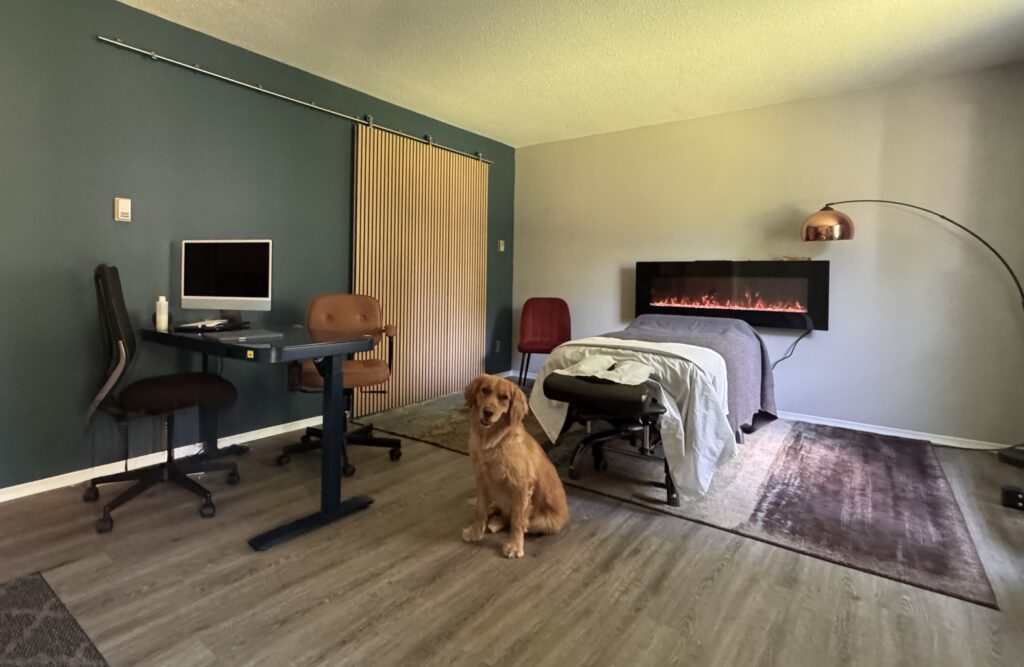
A massage session for a tradesperson works the load pattern in an order that lets each region settle before the next. You set the pressure. You can adjust it, or stop, at any time. The scale runs from soft through medium to deep, and deep work is available on request, never the default. Trades often want the deepest end, and Bruno Panucci RMT can deliver it, but a genuinely worn body frequently responds better to firm and patient than to force. Bruno usually opens the shoulders and upper back where the reaching lives, works the forearms and grip, then finishes at the low back and hips once the chain above has let go. Treatment happens in the private treatment room at his Brantford in-home practice, draped to College of Massage Therapists of Ontario standards, with your consent for each area of work.
Does massage help the aches that manual work causes?
Massage and hands-on manual therapy can ease the everyday aches manual work causes, and the honest version of the evidence is worth having. In a randomized controlled trial for non-specific chronic neck pain, the sort of neck load a bracing, reaching job builds, manual therapy improved pain and neck disability, and the improvements held at four months (Tatsios and colleagues, Journal of Clinical Medicine, 2026). Hands-on soft-tissue work also reduced neck pain severity in a controlled comparison, though that study was in children rather than working adults (Mihcioglu and colleagues, Work, 2026), so it is a supporting signal, not proof for a trades context. Registered Massage Therapy supports comfort and function; it does not cure a condition or repair a structural problem, and a shoulder or back that is getting worse deserves a physician’s look first.
What keeps you on the tools between sessions?
What keeps a tradesperson working between sessions is movement and load management, and Bruno would rather say that plainly than oversell a massage. Massage eases the pattern; the job rebuilds it, so the work you do off the clock matters. A network meta-analysis of exercise therapies for chronic nonspecific neck pain found exercise is a first-line approach but that no single type stood out clearly, and the overall evidence was only moderate (Huang and colleagues, Frontiers in Neurology, 2026). The trades translation is unfussy: a bit of mobility for the shoulders and hips, a real lift-with-your-legs habit, and short rests for the grip do more than any one perfect routine. Book massage as maintenance during the busy stretch, not only as a rescue when you cannot turn a wrench.
What does it cost, and will a benefits plan cover it?
A 60-minute session with Bruno Panucci RMT is $115 at his Brantford in-home practice, a rate kept steady by low overhead, and it covers the working-body pattern with honest triage: the whole chain gets attention, the loudest regions get the most minutes. A 90-minute session gives every region unhurried time, which many tradespeople prefer after a heavy run; text Bruno to arrange one. Registered Massage Therapy receipts are accepted by most extended health plans, including many union and trade-benefit plans, so the coverage is often there for the very body the work wears down. Direct billing is available for most insurers.
Frequently asked questions
Should I get a massage on a work day or a day off?
Either works, but many tradespeople prefer the end of a work day or a day off, because deeper work can leave a body pleasantly tender for a day. If you book before a heavy shift, ask Bruno to keep the pressure lighter so you stay ready for the tools.
Can massage fix a shoulder or back injury from work?
No. Massage may ease muscle tension and support comfort and movement, but it does not fix a structural injury, and it is not a substitute for medical care. If a shoulder or back is getting worse, or you have numbness or weakness, see your physician first.
Is deep pressure the right choice for a worn-out body?
Not always. Deep work is available on request, and Bruno can deliver it, but a genuinely worn body often responds better to firm and patient pressure than to force. You set the pressure and can change it at any point in the session.
Do trade and union benefit plans cover massage therapy?
Usually, yes. Treatment by a Registered Massage Therapist is reimbursable under most extended health plans, including many union and trade plans. Bruno provides a compliant receipt after every session; check your own plan for its annual limit.
Book a massage for the working body in Brantford
Bruno Panucci RMT treats trade and manual-work tension at his in-home practice in Brantford, serving Brant County including Paris, St. George, Mt. Pleasant, and Burford, with occasional mobile visits on request. Sessions are $115 for 60 minutes, with receipts for most extended health plans and direct billing available for most insurers. Two friendly, calm dogs share the treatment room, and can be kept out if you have allergies or a preference; just ask.
Text Bruno at 519-753-5544 (he prefers texts), call the same number, or book online. Need a time outside the posted hours, or a 90-minute or two-hour session after a hard run? Text him directly. He can often rearrange to fit you in, sometimes the same day.
A note on scope: This page is general information, not medical advice. Massage may ease work-related muscle tension in the short term, but it does not diagnose, cure, or repair injuries, and results vary. Persistent pain, numbness, tingling, or weakness in an arm, hand, or leg deserves a physician conversation first. Bruno Panucci is a Registered Massage Therapist (RMT), and works within current RMT scope of practice.
Related reading
- massage for a low back that lifts all day
- the shoulder that catches on the reach overhead
- firm, therapeutic work for the deep muscle layers
Sources
- Kaur G, Qureshi I, Bagde A. Agriculture-related musculoskeletal disorders among farming populations in rural India: focus on vulnerable communities, protocol for a scoping review. BMJ Public Health, 2026. doi.org/10.1136/bmjph-2025-004555
- Tatsios PI, Grammatopoulou E, Dimitriadis Z, Koumantakis GA. The Effectiveness of Cervical Spine and Diaphragm Manual Therapy Combined with Breathing Re-Education Exercises in Patients with Non-Specific Chronic Neck Pain: A Randomized Controlled Trial. Journal of Clinical Medicine, 2026; 15(11): 4266. doi.org/10.3390/jcm15114266
- Huang M, Liu H, Chen J, Pan R. Comparison of clinical efficacy of different exercise therapies in the treatment of chronic nonspecific neck pain: a network meta-analysis. Frontiers in Neurology, 2026. doi.org/10.3389/fneur.2026.1781903
- Mihcioglu EK, Guchan Topcu Z, Tunali AN, Mihcioglu S, Tomac H. Instrument-assisted soft tissue mobilization as a promising approach for children with chronic neck pain: A single-blind, randomized study. Work, 2026. doi.org/10.1177/10538127251401084
- College of Massage Therapists of Ontario, Standards of Practice.
- Government of Ontario. Massage Therapy Act, 1991, S.O. 1991, c. 27. ontario.ca/laws/statute/91m27