Bruno Panucci RMT
Massage for Pickleball Players in Brantford: The Fastest-Growing Ache
Quick answer: Massage for pickleball players focuses on the muscle groups the sport loads hardest: the calves and Achilles region, the paddle-side forearm and elbow, the shoulder, and the hips and low back that power every lunge. Bruno Panucci RMT treats that pattern at his Brantford in-home practice, $115 for 60 minutes, at the pressure you choose from soft through medium to deep. Massage supports recovery and eases tension; it does not speed healing or treat an injury. This page is general information, not medical advice.
Massage for pickleball players is Registered Massage Therapy aimed at the specific load pattern of North America’s fastest-growing sport: explosive lunges to the kitchen line, quick pivots, thousands of paddle swings, and a playing population that skews well past 50. Bruno Panucci RMT has spent 25 years working on sport-stressed soft tissue, and pickleball bodies now arrive at his Brantford in-home practice from across Brant County, including Paris, St. George, Mt. Pleasant, and Burford. The lower legs lead the complaint list, which is why so many of these sessions start with focused calf and Achilles-area work. The research backs the pattern: a systematic review of lower extremity injuries in adult pickleball players found sprains, strains, and fractures the most common injury types, with Achilles tendon rupture notably represented and age 50 or older a consistent risk factor (Okhovat and colleagues, 2026).
Bruno Panucci RMT, 25 years of practice: “Pickleball snuck up on my table. Five years ago I never heard the word at intake; now I hear it weekly, usually from someone in their fifties or sixties who took up the game fast and loves it. The pattern is consistent: tight calves, a cranky paddle-side elbow, and hips that were not warned about the lunging. My job is not to talk anyone out of playing. It is to keep the tissue that plays supple enough to keep showing up.”
In short: pickleball concentrates its demands in the calves and Achilles region, the paddle-side elbow and forearm, the shoulder, and the hips. Players over 50 carry the highest documented injury risk. Regular massage may ease the tightness and soreness the game builds, but a sudden pop, swelling, or inability to push off is a physician visit first, not a massage.
6 min read
Where does pickleball make players sore?
Pickleball soreness clusters in a handful of predictable regions, and a five-year clinic study mapped them: of 164 pickleball-related injury cases at one academic centre, the knee, foot and ankle, wrist and hand, and shoulder led the counts, with lateral epicondylitis, the classic tennis-elbow pattern, accounting for 75 percent of the elbow presentations and Achilles tendon tears for half of the foot and ankle group (Meng and colleagues, 2026). The game explains the map. The court is small, so the movements are short and sharp: sudden forward lunges for dinks, quick backpedals for lobs, and a compact swing repeated hundreds of times a session. Bruno Panucci RMT sees the softer end of that same map in Brantford, the tightness and overuse ache that shows up before, and hopefully instead of, the injuries in the studies. To be clear about the boundary: massage supports sore, tight, overworked muscle. It does not treat a tear, a fracture, or a rupture, and it does not speed healing of one. Those belong to your physician first.
Why do pickleball players get tight calves and Achilles trouble?
Pickleball loads the calf and Achilles region harder than the sport’s gentle reputation suggests, because every lunge and push-off fires the calf complex at speed. The demographic makes it matter more. A retrospective study of over 1,000 surgical Achilles tendon ruptures found the pickleball cases were markedly older, a median age of 60 versus 45 for tennis, with 82.5 percent of pickleball ruptures occurring in players over 50, and the share of repairs attributed to pickleball rising sharply after 2020 (Padley and colleagues, 2026). Massage cannot prevent a rupture and no honest RMT will claim it can. What regular calf work may do is ease the chronic tightness and heaviness that players feel between games, keep the tissue more comfortable through a full session of play, and give you a clearer sense of how your lower legs are actually coping. Bruno covers this region in depth on his calf and Achilles massage page, including the red flags that mean physician first: a sudden pop, sharp pain like being kicked in the back of the leg, swelling, or trouble pushing off. Those are never massage territory.
What about pickleball elbow and shoulder soreness?
Pickleball elbow is, in most documented cases, the same lateral epicondylitis that tennis players know, driven by gripping the paddle and repeating a compact swing; in the clinic study above it was the dominant elbow diagnosis among pickleball players (Meng and colleagues, 2026). The forearm muscles that stabilize the wrist through contact take thousands of small doses per session, and they tighten the way any overworked muscle does. Massage through the forearm, upper arm, and shoulder may ease that gripping tension and the general ache around the elbow, though it does not repair an irritated tendon, and a painful elbow that is not settling deserves a physician’s assessment. The same clinic data flagged rotator cuff problems as the leading shoulder presentation, a reminder that overhead smashes and serves ask real work of a shoulder in its sixth or seventh decade. Bruno Panucci RMT covers the forearm pattern fully on his tennis elbow massage page, and everything there applies to a paddle as much as a racquet.
Is massage useful for pickleball players over 50?
Massage for players over 50 fits the sport’s actual demographic, because pickleball’s boom is concentrated in exactly that age group and so is its injury burden; older age was a consistent risk factor across nearly all studies in the systematic review of lower extremity pickleball injuries (Okhovat and colleagues, 2026). An older body is not a fragile body, but it does recover more slowly and tends to carry more baseline stiffness into each game. Regular Registered Massage Therapy may help with that in-between recovery, easing the soreness that follows a tournament weekend and the stiffness that builds across a league season. Bruno Panucci RMT works with older active bodies constantly, and his approach for older players, more warm-up in the tissue, patient pacing, pressure adjusted to comfort, is laid out on his massage for seniors page. Two honest limits: massage does not restore tendon strength, and it is not a substitute for the warm-up habit the prevention literature keeps recommending. It is a recovery support, and for many players over 50, a genuinely useful one.
What does a pickleball recovery session with Bruno look like?
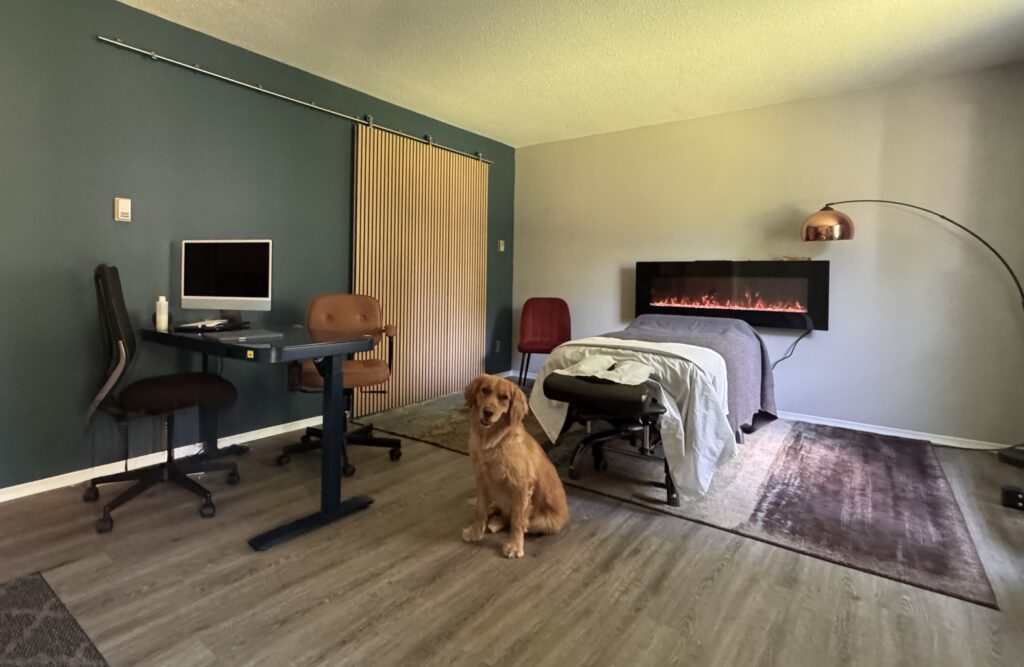
A pickleball recovery session at Bruno Panucci RMT’s Brantford in-home practice starts with a short intake about your game: how many days a week you play, singles or doubles, which side holds the paddle, and where the soreness actually lives. You set the pressure. You can adjust it, or stop, at any time. The scale runs from soft through medium to deep, and deep work is on request, never the default; overworked calves often respond better to patient, moderate pressure than to force. A typical session gives real time to the calves and the tissue around the Achilles, the paddle-side forearm and shoulder, the hip flexors and glutes that drive the lunging, and the low back. Treatment happens in a private treatment room, draped to College of Massage Therapists of Ontario standards, with consent for each area of work. Sessions are $115 for 60 minutes, with an official Registered Massage Therapy receipt with everything your insurer needs, and direct billing available for most insurers. Two friendly, calm dogs share the treatment room; if you have allergies or would rather they sit this one out, just ask and Bruno will keep them out for your visit.
Frequently asked questions
How soon after playing pickleball should I book a massage?
Whenever it suits you. Some players like a session a day or two after a tournament weekend, when the soreness peaks; others book on a steady rhythm, every few weeks through the season. If a specific spot is newly painful, swollen, or followed a pop or fall, see your physician before booking massage.
Can massage prevent an Achilles rupture from pickleball?
No, and you should be wary of anyone who claims it can. Research shows pickleball Achilles ruptures cluster in players over 50, and prevention evidence points to warm-up and training habits. Massage may ease chronic calf tightness and help you notice how your lower legs are coping, which is useful, but it is not injury prevention.
Does massage help pickleball elbow?
It may help the muscle side of the problem. The forearm muscles that grip the paddle tighten with heavy play, and massage can ease that tension and the ache around the elbow. It does not repair an irritated tendon, so an elbow that stays painful for weeks deserves a physician or physiotherapy assessment alongside any massage.
Is massage for pickleball recovery covered by insurance?
Usually, yes, if you have extended health benefits. Treatment by a Registered Massage Therapist is reimbursable under most extended health plans, and Bruno provides an official Registered Massage Therapy receipt with everything your insurer needs after every session. Check your own plan for its annual limit.
Book a pickleball recovery massage with Bruno in Brantford
Bruno Panucci RMT treats pickleball soreness at his in-home practice in Brantford, serving Brant County including Paris, St. George, Mt. Pleasant, and Burford, with occasional mobile visits on request. Sessions are $115 for 60 minutes, with receipts for most extended health plans and direct billing available for most insurers.
Text Bruno at 519-753-5544 (he prefers texts), call the same number, or book online. Playing a tournament and need a time the calendar does not show, or want a longer session? Text him about a 90 minute or two hour appointment. He can often rearrange to fit you in, sometimes the same day.
A note on scope: This page is general information, not medical advice. Massage may ease the muscle tightness and soreness that pickleball builds, but it does not treat injuries, speed healing, or prevent ruptures. A sudden pop, sharp pain, swelling, numbness, or an inability to bear weight or push off means see your physician first. Bruno Panucci is a Registered Massage Therapist (RMT), and works within current RMT scope of practice.
Related reading
- calf and Achilles-area massage in detail
- the paddle-side elbow and forearm
- how Bruno works with older active bodies
Sources
- Okhovat A, Ferkel E, Richards SA. Lower Extremity Injuries in Adult Pickleball Players: A Systematic Review of Injury Types, Mechanisms, and Risk Factors. Cureus, 2026. doi.org/10.7759/cureus.108841
- Padley JH, Averkamp B, Rieker M, et al. Pickleball-Associated Achilles Tendon Ruptures: Shifting Achilles Repair Demographics. Foot & Ankle Orthopaedics, 2026. doi.org/10.1177/24730114261425665
- Meng Y, Chen A, Nguyen C, et al. Pickleball-related injuries treated at a tertiary academic center over five years: a cross-sectional study. Injury Epidemiology, 2026. doi.org/10.1186/s40621-026-00673-6
- College of Massage Therapists of Ontario, Standards of Practice.
- Government of Ontario. Massage Therapy Act, 1991, S.O. 1991, c. 27. ontario.ca/laws/statute/91m27