Bruno Panucci RMT
Tennis Elbow Massage in Brantford: Forearm Work That Helps
Quick answer: Tennis elbow massage in Brantford, with Bruno Panucci RMT, is focused forearm and grip work that aims to ease the pain of lateral epicondylitis and help the arm move more comfortably. Research points to manual therapy and soft-tissue work as part of a wider plan, with exercise doing much of the heavy lifting and recovery measured in weeks to months. Massage supports the elbow alongside your physician’s care and does not cure the tendon on its own. This page is general information, not medical advice.
Tennis elbow, known medically as lateral epicondylitis, is pain and tenderness on the outer side of the elbow where the wrist-extensor tendons attach, usually brought on by gripping, lifting, or repetitive wrist use rather than tennis alone. Bruno Panucci RMT has spent 25 years as a Registered Massage Therapist in Brantford, and he treats a lot of forearms belonging to people who never pick up a racquet: trades workers, gardeners, painters, and desk users across Brantford and Brant County towns like Paris, St. George, Mt. Pleasant, and Burford. Registered Massage Therapy for tennis elbow is soft-tissue work on the forearm, wrist extensors, and the muscles above and below the elbow, and it often pairs well with the everyday strain many keyboard and mouse users carry. It is symptom support offered alongside your doctor’s care, not a stand-alone fix for the tendon.
Bruno Panucci RMT, 25 years of practice: “Most people point to the sore spot on the outside of the elbow and expect me to spend the hour right there. Nine times out of ten the trouble is upstream, in the forearm muscles and the grip. I work the whole chain, gently at first, because a cranky tendon does not want to be attacked. My honest job is to take the edge off, get the arm moving easier, and send you home with a couple of things to do between visits. The tendon heals on its own time. I just make the road less bumpy.”
In short: tennis elbow massage is targeted forearm and grip work meant to ease pain and improve how the arm moves, not to force a tendon to heal faster. It works best as one part of a plan that includes rest from the aggravating activity, gentle loading exercise, and your physician’s guidance. Progress is usually gradual, measured across weeks and months, and it belongs alongside medical care rather than in place of it.
6 min read
What is tennis elbow, and why does it happen?
Tennis elbow is a gradual-onset pain over the outer elbow that flares with wrist extension and gripping, and it comes from overloading the wrist-extensor tendons rather than from any single injury. The name is misleading: it shows up in homemakers, tradespeople, and office workers far more often than in tennis players. Clinicians describe it as a common overuse problem of the wrist-extensor tendons that causes pain, weakness, and a weaker, more painful grip (Tayyab and colleagues, 2025). The usual culprits are repetitive grasping, sustained gripping, and the small awkward loads of daily work, which is why a painter, a mechanic, or someone who spends the day on a mouse can all end up with the same sore spot. Because the pain sits at the tendon origin but the strain runs down the whole forearm, treating only the tender point misses most of the problem. That is the same principle behind Bruno’s approach to overuse strain from repetitive movement: work the chain that produced the load, not just the spot that hurts. The inner-elbow version, golfer’s elbow on the inner side, is covered separately. The broader picture, tendonitis as an umbrella term, has its own honest unpacking. The broader picture, hand and forearm massage, is covered separately.
Can massage help tennis elbow?
Massage can be a useful part of tennis elbow care, though it is one tool among several rather than the whole answer. In a review of physiotherapy techniques for lateral epicondylitis, soft-tissue massage, myofascial release, and joint mobilizations are listed among the manual therapies used to reduce pain and improve joint function, sitting alongside tailored exercise as a core part of treatment (Pathan and Sharath, 2023). Case reports describe manual methods that combine deep friction massage over the tendon with mobilization producing meaningful drops in pain and gains in function over a few weeks (Nagore and colleagues, 2024), and a separate case combining mobilization with movement and Cyriax physiotherapy reported pain falling from eight out of ten to two out of ten over a two-week course (S S and colleagues, 2025). Those are single cases, not proof for everyone, and the wider evidence keeps returning to the same point: loading exercise for the extensor tendon does much of the real work, and hands-on therapy supports it. That honest framing matters. Massage may ease the pain and free up the forearm so exercise is more tolerable, but it does not replace the graded loading that rebuilds the tendon, and it does not treat or cure the condition on its own.
A note on scope: This page is general information, not medical advice. Registered Massage Therapy can support comfort and function for tennis elbow, but it is not a cure for the condition, and stubborn or worsening elbow pain, numbness, tingling, or a sudden loss of grip strength should be checked by your physician to rule out other causes. If you have a health concern, speak with your physician or a Registered Massage Therapist. Bruno Panucci is a Registered Massage Therapist (RMT), and works within current RMT scope of practice.
What does a tennis elbow massage session involve?
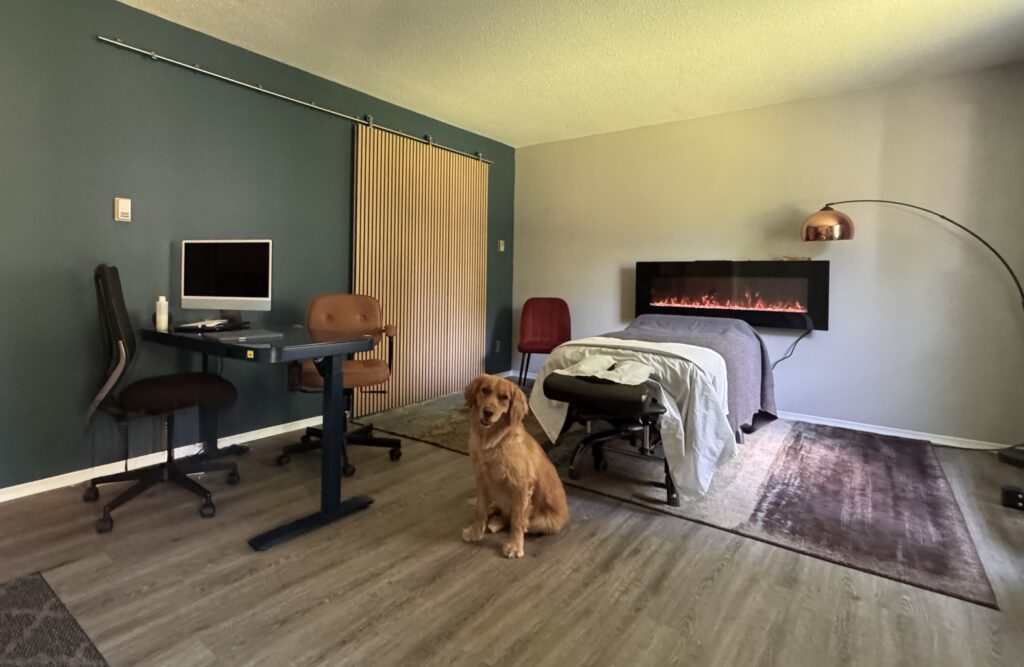
A tennis elbow massage session focuses on the forearm and the muscles that control the wrist and grip, and it starts with one promise: you set the pressure, and you can adjust it, or stop, at any time. Bruno begins gently, because an irritated tendon does not respond well to being dug into on the first pass, and he works soft-to-medium along the wrist extensors, easing tight bands in the forearm before doing any firmer, more focused work near the elbow. Deeper, friction-style work over the tendon is available on request within the soft-through-medium-to-deep scale, but it is offered, never imposed, and it is used sparingly. He often checks how the elbow, forearm, and grip move, works the neck and shoulder if they are feeding into the arm, and finishes by showing you a simple stretch or two to carry between visits. Treatment is in the private treatment room at his Brantford in-home practice, draped to College of Massage Therapists of Ontario standards. Two friendly, calm dogs share the treatment room and can be kept out on request. The table below shows what the work targets and why.
| Area worked | Why it matters |
|---|---|
| Wrist extensor muscles in the forearm | These carry the load that stresses the tendon, so easing them can reduce the pull at the elbow. |
| The tendon origin at the outer elbow | Worked gently and only on request, to calm the tender area without aggravating it. |
| Grip and hand muscles | A painful grip is a hallmark of tennis elbow, so loosening the hand and forearm supports daily use. |
| Neck, shoulder, and upper arm | Tension higher up the chain can feed elbow symptoms, so the whole arm is assessed, not just the elbow. |
| Home stretches and pacing advice | What you do between visits often matters more than the hour on the table. |
How long does tennis elbow take to recover?
Tennis elbow recovery is usually measured in weeks to months, not days, because tendon problems settle slowly and reward patience over force. Conservative care for lateral epicondylitis is built around pain control, functional recovery, and preventing recurrence, and the manual-therapy plus exercise approaches described in the research typically run over several weeks of regular sessions rather than a single fix (Pathan and Sharath, 2023; Nagore and colleagues, 2024). The single biggest lever is graded loading of the extensor tendon, and adjuncts such as taping alongside exercise have been shown to improve pain, function, and grip strength in the short term (Tayyab and colleagues, 2025), while some people also use acupuncture as part of a multimodal plan for elbow pain (Zhu and colleagues, 2025). Bruno does not offer taping or acupuncture, but he works in step with the exercise and rest your physician or physiotherapist prescribes. Honestly, the arm that recovers fastest is usually the one that gets some rest from the aggravating activity, does its loading exercises, and treats massage as support rather than a shortcut. If the pain is stubborn, worsening, or comes with numbness or weakness, that is a reason to see your physician, not to push harder.
Booking, price, and how it fits your care
Tennis elbow massage fits best as one part of a plan you and your physician or physiotherapist lead, with Registered Massage Therapy handling the hands-on side while exercise and rest do the rebuilding. Bruno Panucci RMT is glad to work in step with what your healthcare team recommends, and he will tell you plainly when he thinks something is outside what massage can help. A 60-minute session at his Brantford in-home practice is $115, receipts work with most extended health plans, and direct billing is available for most insurers. Because the practice runs from his own home, the lower overhead keeps the price fair, so your benefits stretch further across the handful of visits a stubborn elbow often needs. If a shorter, focused forearm session suits you better than a full hour, or you would rather build tennis elbow work into a broader treatment, that is easy to arrange, and firmer work is always the deeper, on-request end of the pressure scale rather than the default.
Frequently asked questions
Is massage good for tennis elbow?
Massage can help as part of a wider plan. Reviews of tennis elbow care list soft-tissue massage and myofascial release among the manual therapies used to ease pain and improve function, alongside exercise. Bruno works the forearm and grip gently, with firmer work on request, to take the edge off and make the arm move easier. It supports recovery but does not replace the loading exercises that rebuild the tendon, and it does not cure the condition on its own.
Should the therapist massage right on the sore spot at my elbow?
Not usually to start. The tender point at the outer elbow is the tendon origin, and attacking it early tends to aggravate it. Bruno works the forearm and wrist-extensor muscles first, since that is where most of the load comes from, and does any firmer, focused work over the tendon gently and only if you ask for it. You set the pressure, and you can adjust it, or stop, at any time.
How many massage sessions will I need for tennis elbow?
There is no fixed number, since tennis elbow settles over weeks to months rather than in a single visit. Many people find a handful of sessions spaced out, combined with rest from the aggravating activity and their prescribed exercises, is a sensible way to start. Bruno would rather help you find a pace that works with your budget and your recovery than sell you a package, and his experience often helps shorten the number of treatments needed.
Can I still work or exercise while I have tennis elbow?
That is a question for your physician or physiotherapist, since it depends on your job and how the tendon is responding. In general, easing off the specific gripping or lifting that aggravates it, while keeping up any loading exercises you have been given, is the usual advice. Massage can make that period more comfortable, but if the pain is worsening or comes with numbness or weakness, see your physician rather than pushing through.
Book tennis elbow massage with Bruno in Brantford
Bruno Panucci RMT offers focused forearm and grip work for tennis elbow at his in-home practice in Brantford, serving Brant County including Paris, St. George, Mt. Pleasant, and Burford, with occasional mobile visits on request. Sessions are $115 for 60 minutes, and a shorter, focused session is a valid choice. Receipts are provided for most extended health plans, with direct billing available for most insurers.
Text Bruno at 519-753-5544 (he prefers texts), call the same number, or book online. If you need a time the calendar does not show, a shorter session, or a 90-minute session, text him directly. He can often rearrange to fit you in, sometimes the same day.
A note on scope: This page is general information, not medical advice. Tennis elbow can have several causes, so its diagnosis and management belong with your physician; massage is symptom support, not a treatment or a cure. If your elbow pain is severe, worsening, or comes with numbness, tingling, or a loss of grip strength, stop and speak with your physician. Bruno Panucci is a Registered Massage Therapist (RMT), and works within current RMT scope of practice.
Related reading
- strain from long hours at a keyboard and mouse
- recovery work for repetitive and overuse strain
- firmer, on-request pressure explained
Sources
- Pathan AF, Sharath HV. A Review of Physiotherapy Techniques Used in the Treatment of Tennis Elbow. Cureus, 2023; 15(11): e47706. doi.org/10.7759/cureus.47706
- Nagore A, Samal S, Kolhe PD. Effectiveness of the Cyriax Technique With Conventional Therapy in the Management of Lateral Epicondylitis: A Case Report. Cureus, 2024; 16(6): e61813. doi.org/10.7759/cureus.61813
- Tayyab M, Ahmad Z, Akbar R, et al. Kinesio Taping Plus Exercise Versus Sham Taping Plus Exercise and Exercise Alone for Lateral Epicondylitis: A Systematic Review and Meta-Analysis of Randomized Controlled Trials. Cureus, 2025; e100228. doi.org/10.7759/cureus.100228
- Zhu F, Chen Y, Zhu Y, Bai Z, Yan H. Acupuncture Therapy for Extremity Musculoskeletal Pain: A Clinically Focused Evidence Synthesis with Therapeutic Implications. Journal of Pain Research, 2025. doi.org/10.2147/jpr.s551446
- S S, Reddy C R, Jayabalan P. Combining the Effects of Mobilization With Movement and Cyriax Physiotherapy in Lateral Epicondylitis: A Case Report. Cureus, 2025; e87093. doi.org/10.7759/cureus.87093
- College of Massage Therapists of Ontario, Standards of Practice.
- Government of Ontario. Massage Therapy Act, 1991, S.O. 1991, c. 27. ontario.ca/laws/statute/91m27