Bruno Panucci RMT
Massage for Desk Workers in Brantford: The Whole Pattern
Quick answer: Massage for desk workers treats the whole sitting pattern, neck, shoulders, forearms, hips, and low back, as one connected problem rather than five separate complaints. Bruno Panucci RMT works the full chain in a single session at his Brantford in-home practice, $115 for 60 minutes, at the pressure you choose from soft through medium to deep. Receipts work with most extended health plans, the kind most desk jobs carry. This page is general information, not medical advice.
Massage for desk workers is Registered Massage Therapy aimed at the specific pattern a workstation builds in a body: a head drifting toward the screen, tight upper trapezius muscles holding it there, rounded shoulders, forearms that grip a mouse all day, shortened hip flexors, and a low back that quietly absorbs the total. Bruno Panucci RMT has treated that pattern for 25 years, and it arrives at his Brantford in-home practice daily, attached to office workers from across Brant County, Paris, St. George, Mt. Pleasant, and Burford. The booking usually starts with the neck-and-shoulder core of the pattern, but in a desk body it rarely travels alone.
Bruno Panucci RMT, 25 years of practice: “I can usually read a workstation off a body before anyone describes it. There is a one-hip lean I see in parents who spend their evenings half out of the chair, and a two-monitor neck that turns further one way than the other. The mouse side tells on itself at the forearm. I am not guessing; the body keeps a record of the desk. Tell me about your setup and the record starts to make sense.”
In short: eight hours of sitting produces one connected pattern, not five separate problems. The head drifts forward, the shoulders round, the forearms grip, the hip flexors shorten, and the low back carries the bill. A massage session built for desk workers treats that chain in sequence instead of chasing one sore spot.
6 min read
Why do desk workers hurt in five places at once?
Desk workers hurt in five places at once because sitting is one shape, held for most of the waking day, and the body adapts to the shape it is held in most. Clinical reviews describe musculoskeletal disorders as arising not only from sudden exertion but from repeated motions and sustained awkward postures, with a sedentary lifestyle among the recognized risk factors (El-Tallawy and colleagues, Pain and Therapy, 2021). That is a fair description of office work: the same small motions, the same held position, thousands of repetitions. It also explains why treating one piece at a time underwhelms. Rub the sore neck while the chest stays short and the shoulders are pulled forward again by Monday, because the rest of the pattern never stopped pulling. Bruno Panucci RMT treats the chain as a chain. The bigger picture, your overall posture, is treated as a whole pattern on its own page. That knot between the shoulder blades, mid-back and rhomboid tension, has a dedicated guide.
What does eight hours of sitting do, from neck to low back?
The sitting pattern runs top to bottom, and every region of it feeds the next. The head drifts forward and the upper traps work overtime to hold it. The shoulders round as the chest shortens. The forearms stay switched on through thousands of keystrokes. The hips fold and stay folded, so the hip flexors shorten while the glutes, parked on all day, go quiet. The low back sits between all of it, loaded from above and below. Two regions of the chain earn their own detailed guides, wrists that type all day and what sitting does to hips, but the map in one view looks like this:
| Region | What sitting does to it | What the session does there |
|---|---|---|
| Neck and upper traps | The head drifts toward the screen; the upper traps hold it there | Slow work through the neck, upper traps, and the base of the skull |
| Shoulders and chest | The chest shortens and pulls the shoulders into a round | Releases the chest, then the mid-back muscles that resist the rounding |
| Forearms and wrists | Typing and mouse grip keep the forearms switched on all day | Releases the working muscles from wrist to elbow, mouse side especially |
| Hips and glutes | Hip flexors shorten in the folded position; the glutes go quiet | Lengthens the front of the hip and works the glutes back into the conversation |
| Low back | Carries the load of everything above and below it | Broad, unhurried work at the end of the chain, so the relief holds |
How does a whole-pattern massage session sequence the chain?
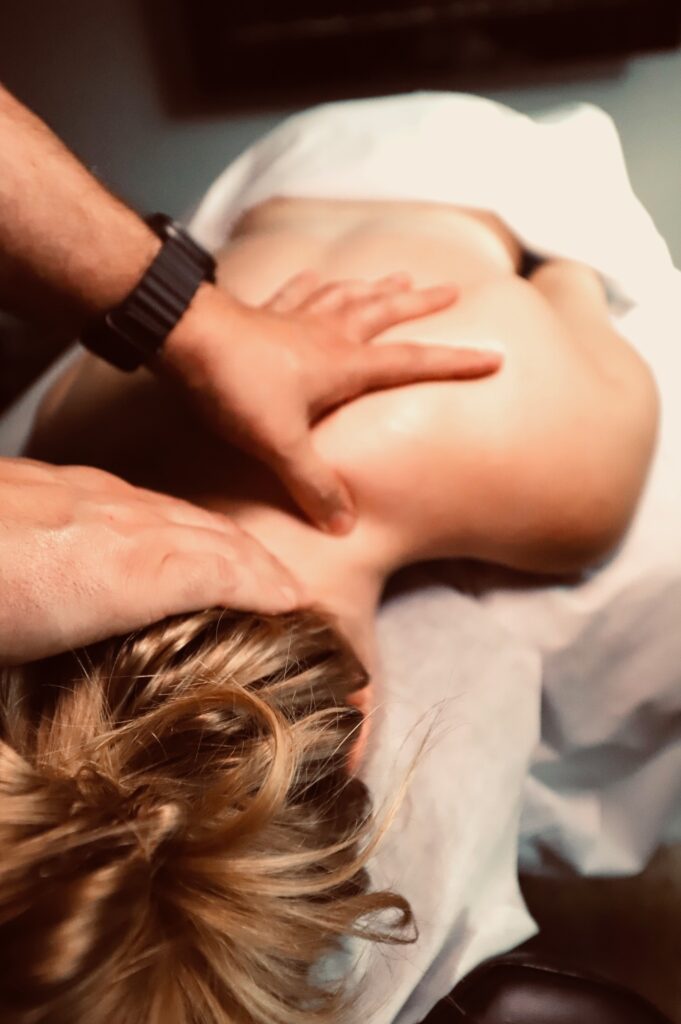
A whole-pattern session with Bruno Panucci RMT treats the sitting chain in an order that makes each region easier to work than the last. You set the pressure. You can adjust it, or stop, at any time. The scale runs from soft through medium to deep, and deep work is available on request, never the default; a desk body often responds better to patient, moderate pressure than to force. Bruno typically opens the chest and the front of the shoulders first, because the rounding is anchored there, then works the neck and the base of the skull, the mouse-side forearm, the hip flexors and glutes, and finishes with the low back once its neighbours have let go. Treatment happens in the private treatment room at his Brantford in-home practice, draped to College of Massage Therapists of Ontario standards, with your consent for each area of work.
What should you tell Bruno at intake?
The intake conversation for a desk worker is a workstation interview, and detail pays. Tell Bruno your actual hours, including the evening laptop stretch that officially does not exist. Describe the setup: laptop or monitors, how many screens and where they sit, chair or standing desk, and how much of the day you genuinely stand. Name your side of mouse, which hand drives it, and whether it is a mouse or a trackpad, because that forearm and shoulder work harder than their twins. Mention the commute and the phone habit too; both add sitting the desk never gets blamed for. Each answer changes where the session spends its minutes. The gaming version of long hours at the screen for play, not work gets its own guide.
What makes the relief last between sessions?
Between-session habits decide how long desk-massage relief lasts, and honesty about that beats overselling. Massage relieves the pattern; the workstation rebuilds it, so ergonomics and movement do the preventing. An overview of treatment evidence for the five most common musculoskeletal pain presentations, back, neck, shoulder, knee, and multi-site, found moderate to strong evidence for exercise, with mostly short-term benefits and no single type clearly superior (Babatunde and colleagues, PLoS ONE, 2017). The translation for an office body: movement snacks, a minute of standing or walking every hour, often do more than one perfect routine, because the problem is the unbroken holding, not fitness. Add one setup change per visit, screen raised or mouse brought closer, and each massage starts from a better baseline.
Sixty or ninety minutes, and will workplace benefits cover it?
Sixty minutes covers the whole desk pattern with honest triage: Bruno Panucci RMT works the full chain but gives the most time to the loudest regions, and the session costs $115 at his Brantford in-home practice, a rate kept steady by low overhead. Ninety minutes is the unhurried version, every region treated properly without the clock deciding, and desk bodies are the clients who most often choose it; text Bruno to arrange one. Registered Massage Therapy receipts are accepted by most extended health plans, and full-time desk jobs are precisely the jobs that tend to carry those plans, so the benefit often sits unused over the very chair that built the problem. Direct billing is available for most insurers.
Frequently asked questions
How often should a desk worker book a massage?
There is no prescription. Many desk workers settle into every four to six weeks once the worst of the pattern eases, and tighten the gap during heavy deadline stretches. Bruno suggests a rhythm based on how long relief actually holds for you, not a package.
Can one session really cover neck, wrists, hips, and low back?
Yes, with honest priorities. In 60 minutes Bruno works the whole chain but spends the most time where your pattern is loudest. A 90 minute session gives every region unhurried attention, which is why desk workers often move to it.
Is massage for desk workers covered by workplace benefits?
Usually, yes. Treatment by a Registered Massage Therapist is reimbursable under most extended health plans, the kind most full-time office jobs include. Bruno provides a compliant receipt after every session; check your own plan for its annual limit.
Will massage undo years of sitting?
No single session will, and it would be dishonest to promise it. Massage may ease the pattern meaningfully for days to weeks, while your setup and movement habits between sessions decide the long game. The combination is what works.
Book a whole-pattern massage with Bruno in Brantford
Bruno Panucci RMT treats desk-work tension at his in-home practice in Brantford, serving Brant County including Paris, St. George, Mt. Pleasant, and Burford, with occasional mobile visits on request. Sessions are $115 for 60 minutes, with receipts for most extended health plans and direct billing available for most insurers.
Text Bruno at 519-753-5544 (he prefers texts), call the same number, or book online. Want the whole chain done without the clock, or a time outside posted hours? Text him about a 90 minute or two hour session. He can often rearrange to fit you in, sometimes the same day.
A note on scope: This page is general information, not medical advice. Massage may ease desk-related muscle tension in the short term, but it does not diagnose or treat underlying conditions, and results vary. Persistent numbness, tingling, or weakness in a hand or arm deserves a physician conversation first. Bruno Panucci is a Registered Massage Therapist and works within current RMT scope of practice.
Related reading
Sources
- El-Tallawy SN, Nalamasu R, Salem GI, LeQuang JAK, Pergolizzi JV, Christo PJ. Management of Musculoskeletal Pain: An Update with Emphasis on Chronic Musculoskeletal Pain. Pain and Therapy, 2021; 10: 181-209. doi.org/10.1007/s40122-021-00235-2
- Babatunde OO, Jordan JL, van der Windt DA, Hill JC, Foster NE, Protheroe J. Effective treatment options for musculoskeletal pain in primary care: A systematic overview of current evidence. PLoS ONE, 2017; 12(6): e0178621. doi.org/10.1371/journal.pone.0178621
- College of Massage Therapists of Ontario, Standards of Practice.