Bruno Panucci RMT
Massage for Posture in Brantford: The Whole Standing Pattern
Quick answer: Massage for posture in Brantford, with Bruno Panucci RMT, eases the muscle tightness that pulls you into rounded shoulders and a forward head, so it is more comfortable to sit and stand tall. Registered Massage Therapy can loosen a tight chest and overworked upper trapezius and calm the strain that builds through a desk day. It does not permanently straighten posture on its own. Lasting change also needs the movement and strengthening your body has to train. This page is general information, not medical advice.
Posture is a whole standing pattern, not a single bad muscle, and that is the first thing to understand before you book a massage for it. Bruno Panucci RMT has spent 25 years as a Registered Massage Therapist in Brantford, and clients across Brant County towns like Paris, St. George, Mt. Pleasant, and Burford arrive believing one knot is dragging them forward. It is rarely that simple. Rounded shoulders, a forward head, and a tight chest usually travel together as a linked pattern, tight in the front and weak in the back, which is exactly why massage that only chases the sore upper back gives short relief. Massage for posture works best when it is paired with the deliberate movement your body needs, and it sits naturally alongside the work Bruno does for the desk day that built the pattern.
Bruno Panucci RMT, 25 years of practice: “People come in and point at the top of the shoulders and say, fix this, that is where it hurts. And that spot is real, it is genuinely tight. But it is tight because it is doing the job the front of the body handed it. In 25 years I have never fixed posture by only working the part that hurts. I loosen what is pulling you forward, I give the sore muscles a real break, and then I am honest with people: my hands buy you room, but you keep the change by moving. That is the deal.”
In short: massage for posture is Registered Massage Therapy that releases the tight, overworked muscles holding you in a slumped pattern, so upright feels less like a fight. It eases tension and improves how you feel and move in the short term. It does not remould your skeleton or replace the strengthening and movement that make an upright posture stick.
6 min read
Why is bad posture a whole pattern, not one muscle?
Bad posture is a pattern of muscle imbalance, which is why it stubbornly returns after a single massage. The most common desk-and-screen version has a name: upper crossed syndrome. Russin and colleagues (2026) describe it as tightness in the upper trapezius and levator scapulae at the top, tightness in the chest muscles, the pectoralis major and minor, at the front, and weakness in the deep neck flexors and the middle and lower trapezius that should be holding you back and up. The visible result is forward head, rounded shoulders, and shoulder blades that drift out of place. In that same review, upper crossed syndrome is named a significant contributor to neck pain, rated at 55 to 69 percent among computer users, and to shoulder pain, rated at 15 to 52 percent. So when the top of your shoulders aches, it is often the overworked front and top compensating for a weak, switched-off back. That understanding shapes everything Bruno Panucci RMT does for posture, and it is closely tied to the neck and shoulder tension that so often rides along with it. A related nerve-and-posture problem, the thoracic outlet pattern, is covered separately.
Can massage actually fix your posture?
Massage can genuinely help with the muscle side of posture, but the honest answer is that it does not fix posture by itself. Here is the useful distinction. Massage is very good at the tight, short, overworked half of the pattern: the chest, the upper trapezius, the muscles that have been pulling you forward for years. Easing them makes upright feel less like effort. What massage cannot do is switch on the weak, lengthened muscles in your mid-back, and that half of the job is trained, not rubbed. This is why the research on lasting postural change centres on active work. Fadaei Forghan and Sedaghati (2025) found that eight weeks of comprehensive corrective exercises combined with concurrent Kinesio taping produced clear, measurable improvements in forward head posture, rounded shoulders, and thoracic curve, compared with a group given no intervention. The lesson is not that massage is pointless. It is that massage clears the way and reduces the discomfort, so the movement that actually retrains the pattern becomes easier to keep up. Treat the two as partners. Speak with your physician first if posture change comes with numbness, tingling, or arm symptoms rather than plain tightness.
What does a posture-focused massage session work on?
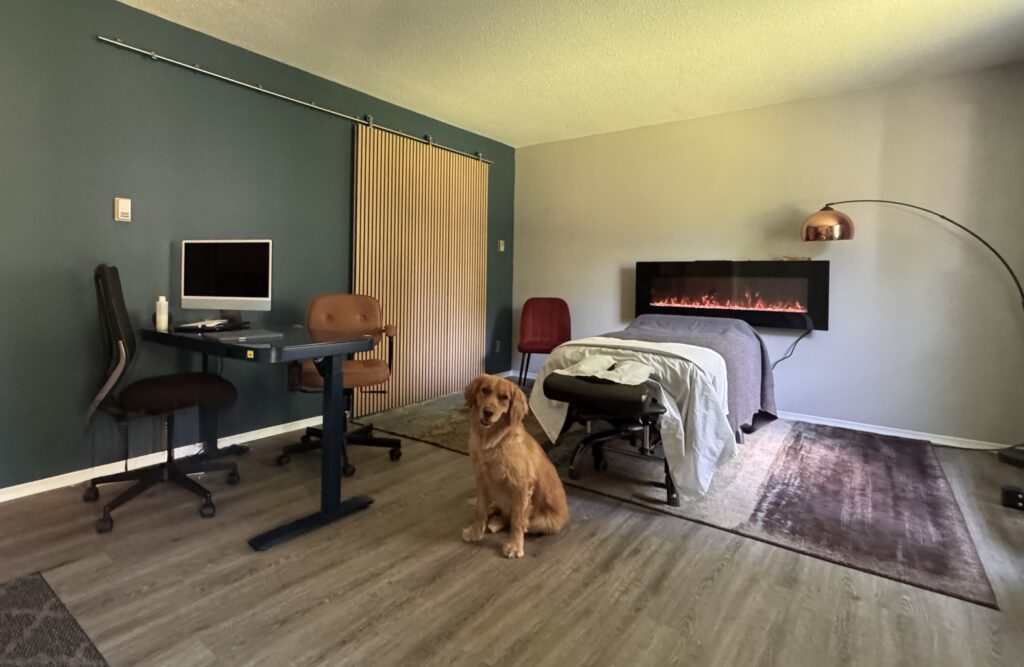
A posture-focused massage session works the tight front and top of the pattern first, then the sore back that has been overworking to hold you up. In practice, that means attention to the chest and pectoralis muscles, the upper trapezius, the levator scapulae up the side of the neck, and the front of the shoulder, all of which shorten with hours of reaching for a keyboard. This lines up with the wider literature: O’Sullivan and colleagues (2026), reviewing rehabilitation for a related shoulder-girdle problem, found the pectoralis and scalene muscles were the main targets for stretching, while manual therapy and posture work appeared repeatedly as supporting components alongside exercise. You set the pressure, and you can adjust it, or stop, at any time. Bruno works the soft-through-medium-to-deep scale from the lighter end, and firmer, deep-tissue work on a bound-up chest or upper back is on request, never the default. Treatment is in the private treatment room at his Brantford in-home practice, draped to College of Massage Therapists of Ontario standards, and this pairs well with broader relief across the upper back when the whole region has locked up.
| Part of the pattern | What is happening | What it needs |
|---|---|---|
| Chest and front of shoulder | Short and tight from hours of reaching forward | Massage and stretching to lengthen and release |
| Upper trapezius and neck | Overworked and sore, holding the head forward | Massage to ease the strain and calm the tension |
| Mid and lower back, shoulder blades | Weak and lengthened, not doing their share | Strengthening you train, not something massage can switch on |
| Deep neck flexors | Weak, so the head drifts forward | Gentle strengthening and awareness, over time |
What you have to train between sessions
The part massage cannot do for you is the strengthening and movement that retrain the pattern, and this is where posture change actually sticks. The evidence points the same way every time: the front comes loose with release work, and the back comes online with strengthening. O’Sullivan and colleagues (2026) noted that the scapula, trapezius, and serratus anterior, the muscles that pull your shoulder blades back and down, were the main targets for strengthening in shoulder-girdle rehabilitation. Fadaei Forghan and Sedaghati (2025) showed that a structured programme of release plus strengthening, applied over eight weeks alongside concurrent Kinesio taping, measurably improved forward head and rounded shoulders against a no-intervention group. Small changes in your desk day matter too. Russin and colleagues (2026) point to workstation ergonomics, with the keyboard and monitor at the right heights, and regular hourly breaks as sensible prevention. On self-care, the evidence for any single method is modest: for heat, Wilfling and colleagues (2026) found the research base thin, yet concluded a warm wrap is a reasonable low-risk option for everyday neck tension. Consistency, not intensity, is what changes a standing pattern.
Cost, care, and how massage fits your day
Massage for posture fits best as a steady, affordable part of a plan you can keep up, not a one-off rescue. A 60-minute session at Bruno Panucci RMT’s Brantford in-home practice is $115, and because the practice runs from his own home, the lower overhead keeps the price fair, so your benefits stretch across a longer series of visits. Receipts are provided for most extended health plans, with direct billing available for most insurers. A regular rhythm of sessions, spaced to match how your body responds, tends to serve posture far better than a single deep treatment when the ache peaks. Two friendly, calm dogs share the treatment room, and they can be kept out on request if you have allergies or simply prefer. A limited number of mobile visits is available on request. Bruno is glad to work in step with a physiotherapist, chiropractor, or your physician when posture is part of a larger plan they are guiding.
Frequently asked questions
Can massage alone correct rounded shoulders?
Not on its own. Massage releases the tight chest and overworked upper back that pull your shoulders forward, which makes upright feel easier and less sore. But rounded shoulders also come from weak muscles in your mid-back that massage cannot switch on. Lasting change needs strengthening and movement that you train between sessions. Think of massage as clearing the way, and the exercise as keeping the change.
How many massages will it take to improve my posture?
There is no set number, because posture is a pattern built over years and it changes gradually. Many people notice they feel looser and sit taller after the first session or two, but that comfort fades if nothing else changes. A regular rhythm of sessions, paired with the strengthening you do on your own, serves posture far better than a single treatment. Bruno would rather help you find a sustainable pace than sell you a package.
Is deep pressure needed to work on posture?
No. Deep pressure is on request, never the default, and a lot of good posture work is done at the soft to medium end of the scale, especially on a chest and neck that are already strained. You set the pressure, and you can adjust it, or stop, at any time. Bruno starts lighter than most people expect and adds firmness only if you ask for it and your tissues welcome it.
Should I see a doctor about my posture instead of getting a massage?
See your physician first if poor posture comes with numbness, tingling, weakness, or pain radiating down an arm, since those can signal a nerve issue that needs assessment. For plain muscle tightness and the ache of a long desk day, Registered Massage Therapy is a reasonable support, and Bruno is happy to work alongside your doctor, physiotherapist, or chiropractor when they are guiding a larger plan.
Book a posture-focused massage with Bruno in Brantford
Bruno Panucci RMT offers Registered Massage Therapy for posture-related tightness at his in-home practice in Brantford, serving Brant County including Paris, St. George, Mt. Pleasant, and Burford, with a limited number of mobile visits on request. Sessions are $115 for 60 minutes, and the pressure is always yours to choose, from soft through medium to deep. Receipts are provided for most extended health plans, with direct billing available for most insurers.
Text Bruno at 519-753-5544 (he prefers texts), call the same number, or book online. If you need a time the calendar does not show, a shorter session, or a 90-minute session for a fuller upper-body treatment, text him directly. He can often rearrange to fit you in, sometimes the same day.
A note on scope: This page is general information, not medical advice. Registered Massage Therapy can ease the muscle tension behind poor posture, but it does not straighten posture on its own and is not a treatment or cure for any structural condition. If poor posture comes with numbness, tingling, weakness, or pain radiating into an arm, see your physician, as those can point to a nerve issue that needs assessment. Bruno Panucci is a Registered Massage Therapist (RMT), and works within current RMT scope of practice.
Related reading
Sources
- Russin NH, Robertson C, Montalvo A. Upper Crossed Syndrome in the Workplace: A Narrative Review with Clinical Recommendations for Non-Pharmacologic Management. International Journal of Environmental Research and Public Health, 2026; 23(1): 120. doi.org/10.3390/ijerph23010120
- Fadaei Forghan Z, Sedaghati P. Modern Methods for Postural Correction: The Impact of Kinesio Taping and Corrective Exercises on Dentists, A Quasi-Experimental Study. Health Science Reports, 2025; 8: e71242. doi.org/10.1002/hsr2.71242
- O’Sullivan J, Rushton C, Bateman M, Miller C, Stapleton C, Hill J. Physical assessment and rehabilitation for neurogenic thoracic outlet syndrome (NTOS): A scoping review. Hand Therapy, 2026. doi.org/10.1177/17589983251411877
- Wilfling D, El-Allawy A, Muche-Borowski C, Kötter T. Use of Heat for the Self-Management of Non-Specific Neck Pain: A Systematic Review. Journal of Pain Research, 2026. doi.org/10.2147/jpr.s605284
- College of Massage Therapists of Ontario, Standards of Practice.
- Government of Ontario. Massage Therapy Act, 1991, S.O. 1991, c. 27. ontario.ca/laws/statute/91m27