Bruno Panucci RMT
Golfer’s Elbow Massage in Brantford: The Inner-Arm Version
Quick answer: Golfer’s elbow, or medial epicondylitis, is an overuse strain of the tendons on the inner side of the elbow. Massage for golfer’s elbow in Brantford, with Bruno Panucci RMT, is soft-tissue work on the forearm flexor muscles and the tendons at the inner elbow, meant to ease tightness and soreness while your arm settles down. It supports comfort alongside rest and your physician’s advice, and it does not treat or cure the tendon problem on its own. This page is general information, not medical advice.
Golfer’s elbow gets its name from the swing, but you do not need a golf club to end up with it. Bruno Panucci RMT has spent 25 years as a Registered Massage Therapist in Brantford, and the inner-elbow strain he sees turns up in gardeners, tradespeople, climbers, and anyone who grips and twists a wrist all day, across Brantford and Brant County towns like Paris, St. George, Mt. Pleasant, and Burford. Medial epicondylitis is an overuse syndrome marked by degeneration of the flexor-pronator tendons at the elbow, brought on by repetitive forced wrist flexion and forearm pronation (Ryskalin and colleagues, 2026). Massage cannot make a strained tendon young again, but it can ease the tight forearm muscles pulling on it, and it pairs naturally with the firmer forearm work some people ask for once the sharp phase has passed.
Bruno Panucci RMT, 25 years of practice: “People come in pointing at the bony bump on the inside of the elbow, sure that is where the problem lives. Most of the time the real trouble is the forearm above it, a whole rope of flexor muscle that has been gripping and twisting all week and never let go. I spend more time there than on the elbow itself. And I always say the same thing: massage buys you comfort and a bit of room to move, but the tendon heals on rest and load, not on my thumbs. If we work it every day and you never change the thing that caused it, we are just chasing our tails.”
In short: golfer’s elbow massage is soft-tissue work on the inner-forearm flexor muscles and the tendon at the inside of the elbow. It aims to ease muscle tightness and soreness, not to fix the tendon by force. It works best beside rest, load management, and your physician’s or physiotherapist’s guidance, never in place of them.
6 min read
What is golfer’s elbow, and how is it different from tennis elbow?
Golfer’s elbow, known medically as medial epicondylitis, is pain and tenderness on the inner side of the elbow, where the tendons of the wrist and finger flexors attach to the bone. Tennis elbow is the outer-arm version, lateral epicondylitis, where the wrist extensor tendons attach on the outside. Both are overuse conditions of the same family, just on opposite sides of the joint, and the tell is simple: golfer’s elbow flares when you grip, flex the wrist, or turn the palm down, while tennis elbow flares when you extend the wrist or straighten the fingers. Non-traumatic inner-elbow pain has several possible causes beyond the tendons, including the ulnar nerve and the ligaments, and their symptoms overlap enough that a clear diagnosis matters (Adani and colleagues, 2025). That is why massage is never the first stop for a swollen, hot, or numb elbow. If you have already been told the problem is on the outer arm, the more relevant page is the outer-elbow guide, because the muscles Bruno works are different for each. Beyond the elbow, golfers and the rotation the swing demands have a full page on back, hips, and shoulders.
Can massage help golfer’s elbow?
Massage can help golfer’s elbow feel and move better, though it is honest to say what it does and does not do. It does not repair a degenerated tendon, and no set of hands can rush that. What it can do is release the tight forearm flexor muscles that keep loading the sore tendon, ease the guarding that builds up around a painful joint, and give the arm a bit more comfortable range. In one case series of javelin throwers with medial elbow injuries, a multimodal approach that included soft-tissue therapy and cross-friction massage was part of a program that returned athletes to sport, though that is a small case series rather than proof from a controlled trial (McEntyre and colleagues, 2025). Other conservative options exist too, from bracing to needling techniques, and a single case report found one session of dry needling eased a long-standing golfer’s elbow (Shariat and colleagues, 2018). The sensible reading of all this: for medial epicondylitis, conservative care is the mainstay, and massage is one supportive piece of it (Adani and colleagues, 2025). If you want the firmer end of that work once the arm can tolerate it, that is the deeper therapeutic pressure offered on request.
A note on pressure: You set the pressure. You can adjust it, or stop, at any time. On a sore inner elbow, harder is not better. Bruno starts at the soft-to-medium end of the soft-through-medium-to-deep scale, works the forearm more than the elbow, and only deepens the work if you ask and the arm welcomes it. Deep tissue is on request, never the default, and it is rarely the right first tool for an angry tendon.
What does a golfer’s elbow massage session look like?
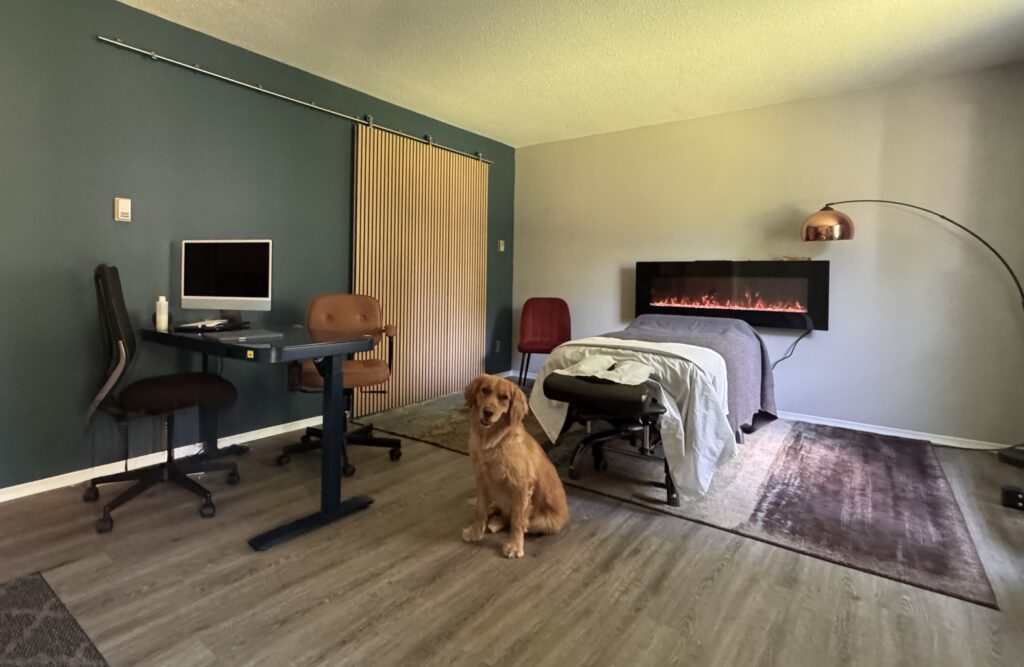
A golfer’s elbow massage session spends most of its time on the forearm, not on the bony point everyone wants to poke. Bruno Panucci RMT works the wrist and finger flexor muscles that run from the inner elbow down toward the hand, using slower, warming strokes to settle tone before any focused work near the tendon itself. Because the muscle group he is treating is the same one used in sport and heavy hand work, this overlaps with the forearm attention inside a recovery-focused session for grip-heavy activities. Expect check-ins throughout, since the inner elbow can be sharp, and expect him to look up the chain as well, at the shoulder and neck, because a guarded arm rarely stays a local problem. Treatment is in the private treatment room at his Brantford in-home practice, draped to College of Massage Therapists of Ontario standards. Two friendly, calm dogs share the treatment room, and they can be kept out on request. A 60-minute session is $115, and a shorter focused session is a reasonable choice for a single stubborn area.
When should you rest, and when should you see a doctor?
Rest and load management do the real healing in golfer’s elbow, and massage sits beside them rather than replacing them. Because medial epicondylitis is an overuse strain of the flexor-pronator tendons from repetitive wrist flexion and pronation, the single most useful thing is usually to reduce the gripping and twisting that set it off, then reintroduce load gradually (Ryskalin and colleagues, 2026). Massage can make that rest more comfortable, but working the arm hard every day is not the same as helping it. Some signs call for a physician rather than a massage table. See your doctor if you have numbness, tingling, or weakness in the ring and little fingers, which can point to ulnar nerve involvement, if the elbow is hot, swollen, or intensely painful, if pain follows a fall or a sudden pop, or if steady conservative care brings no improvement over several weeks. Conservative treatment manages most non-traumatic inner-elbow pain, but a proper diagnosis, and sometimes further care, matters when the nerve is involved or when nothing is helping (Adani and colleagues, 2025).
- Numbness, tingling, or weakness in the ring and little fingers, which can suggest ulnar nerve involvement, is a reason to see your physician, not to book a massage.
- A hot, swollen, or intensely painful elbow, or pain after a fall or a sudden pop, needs medical assessment first.
- Massage is avoided directly over an acutely inflamed, broken, or infected area; the work stays on the surrounding muscle instead.
- If conservative care brings no change over several weeks, ask your doctor or physiotherapist to reassess the diagnosis.
How massage fits with the rest of your recovery
Massage for golfer’s elbow works best as one part of a plan, not the whole of it. A typical recovery leans on relative rest, activity changes, and the graded loading and stretching a physiotherapist or physician can guide, with soft-tissue work supporting comfort and movement along the way. Bruno Panucci RMT is happy to work in step with whatever your healthcare team recommends, and he will say plainly when he thinks the arm needs a rest week more than another appointment. Because his practice runs from his own Brantford home, the lower overhead keeps the 60-minute price at $115, receipts work with most extended health plans, and direct billing is available for most insurers, so your benefits stretch further across a sensible series rather than a rushed one. The goal is a comfortable, capable arm you can load again, reached at a pace the tendon can actually keep.
| Aspect | Golfer’s elbow (medial epicondylitis) | Tennis elbow (lateral epicondylitis) |
|---|---|---|
| Where it hurts | Inner side of the elbow | Outer side of the elbow |
| Tendons involved | Wrist and finger flexors | Wrist and finger extensors |
| What provokes it | Gripping, wrist flexion, turning the palm down | Wrist extension, straightening the fingers |
| Where massage focuses | Inner forearm flexor muscles | Outer forearm extensor muscles |
| What actually heals it | Rest and graded load, in both cases | Rest and graded load, in both cases |
Frequently asked questions
Is golfer’s elbow the same as tennis elbow?
No, they are opposite sides of the same problem. Golfer’s elbow, or medial epicondylitis, affects the flexor tendons on the inner side of the elbow and flares with gripping and wrist flexion. Tennis elbow, or lateral epicondylitis, affects the extensor tendons on the outer side and flares with wrist extension. Because different muscles are involved, Bruno works the inner forearm for golfer’s elbow and the outer forearm for tennis elbow.
Can massage cure my golfer’s elbow?
No. Massage does not repair a strained tendon, and it is honest to say so. What it can do is ease the tight forearm flexor muscles pulling on the sore tendon, reduce guarding, and give the arm more comfortable movement. The tendon itself heals on rest and gradual loading, so massage is a supportive piece of recovery, not a cure, and it works best alongside your physician’s or physiotherapist’s advice.
Should the massage be deep to work on golfer’s elbow?
Not usually, especially early on. You set the pressure and can change it at any time, and on a sore inner elbow harder is not better. Bruno starts at the soft-to-medium end of the scale and spends most of the time on the forearm rather than the tender bony point. Deeper work is available on request once the arm tolerates it, but it is never the default and rarely the right first tool.
When should I see a doctor instead of booking a massage?
See your physician if you have numbness, tingling, or weakness in the ring and little fingers, which can point to nerve involvement, if the elbow is hot, swollen, or intensely painful, if pain followed a fall or a sudden pop, or if steady conservative care brings no improvement over several weeks. Massage is symptom support, not a diagnosis, and a nerve or ligament issue needs medical assessment first.
Book a golfer’s elbow massage with Bruno in Brantford
Bruno Panucci RMT offers focused forearm and elbow soft-tissue work as Registered Massage Therapy at his in-home practice in Brantford, serving Brant County including Paris, St. George, Mt. Pleasant, and Burford, with occasional mobile visits on request. Sessions are $115 for 60 minutes, a shorter focused session is a reasonable option for a single stubborn area, and the pressure is always yours to set. Receipts are provided for most extended health plans, with direct billing available for most insurers.
Text Bruno at 519-753-5544 (he prefers texts), call the same number, or book online. If you need a time the calendar does not show, a shorter session, or a 90-minute session, text him directly. He can often rearrange to fit you in, sometimes the same day.
A note on scope: This page is general information, not medical advice. Golfer’s elbow is a real overuse condition, and its diagnosis and management belong with your physician or physiotherapist; massage is symptom support, not a treatment or a cure. If you have numbness, weakness, a hot or swollen elbow, or pain after an injury, see your physician before booking. Bruno Panucci is a Registered Massage Therapist (RMT), and works within current RMT scope of practice.
Related reading
- the outer-elbow version and why it differs
- firmer forearm work, on request
- recovery work for grip-heavy activity
- session lengths and rates
Sources
- Ryskalin L, Fulceri F, Busoni F, Colomo E, Soldani P, Gesi M. Application of extracorporeal shockwave therapy in medial epicondylitis with concomitant ulnar nerve instability: a case series with long-term follow-up. Frontiers in Rehabilitation Sciences, 2026. doi.org/10.3389/fresc.2026.1677404
- Adani N, Azalia X, Gani KS, Mitchel M, Kholinne E. Non-traumatic medial-sided elbow pain: a comprehensive review of etiologies, diagnostic strategies, and treatment approaches. Cureus, 2025. doi.org/10.7759/cureus.94701
- McEntyre AS, Clohesy NC, Steven DJ. A multimodal chiropractic approach to the treatment and management of medial elbow injuries in elite javelin throwers: a case series. International Journal of Sports Physical Therapy, 2025. doi.org/10.26603/001c.129970
- Shariat A, Noormohammadpour P, Memari AH, Ansari NN, Cleland JA, Kordi R. Acute effects of one session dry needling on a chronic golfer’s elbow disability. Journal of Exercise Rehabilitation, 2018; 14(1): 138-142. doi.org/10.12965/jer.1836008.004
- College of Massage Therapists of Ontario, Standards of Practice.
- Government of Ontario. Massage Therapy Act, 1991, S.O. 1991, c. 27. ontario.ca/laws/statute/91m27