Bruno Panucci RMT
Massage for Golfers in Brantford: Back, Hips, and Shoulders
Quick answer: Massage for golfers is Registered Massage Therapy aimed at the muscles the swing loads hardest: the low back, the hips, and the shoulders that drive rotation. Bruno Panucci RMT works those areas at his Brantford in-home practice, $115 for 60 minutes, at the pressure you choose from soft through medium to deep. It may ease muscle tension and support recovery between rounds; it does not cure injury or fix a swing. This page is general information, not medical advice.
Massage for golfers is Registered Massage Therapy focused on the rotation the game demands and the toll it takes on the low back, hips, and shoulders. Bruno Panucci RMT has spent 25 years working those muscles, and golfers arrive at his Brantford in-home practice from across Brant County, Paris, St. George, Mt. Pleasant, and Burford, usually deep in a season that has left one side of the body tighter than the other. The swing is a whole-body rotation, so the soreness rarely stays in one place, though the booking often starts with a request for focused work on the low back.
Bruno Panucci RMT, 25 years of practice: “A golfer’s body tells me which way they play before they say a word. The lead hip and the trail shoulder do most of the work in a swing, and after a full season they show it. I am not here to fix your handicap, and I will not pretend I can. I am here to give the muscles that rotate you a chance to let go, so the next round feels like your own body and not a stiff version of it.”
In short: the golf swing is a fast, repeated rotation, and the low back, hips, and shoulders absorb most of it. Surveys of golfers put the mid back and lower back among the most common injury sites. Massage eases the muscle tension a season builds; it does not prevent injury or repair a swing fault.
6 min read
Why do golfers get sore in the back, hips, and shoulders?
Golfers get sore in the back, hips, and shoulders because the golf swing loads exactly those regions, over and over, at speed. The pattern shows up in the research on golfing populations. In a nationwide cross-sectional study of professional golfers, about one in three reported a spinal injury, split between the neck and the thoracolumbar spine, and a fair grade of shoulder-reach flexibility was associated with a lower risk of lower-spine injury (Kim and colleagues, 2025). A separate survey of young elite golfers found the most common injury sites were the mid back, ankle, and lower back (Lee and colleagues, 2026). Those are injury studies rather than massage studies, but they map the same geography a massage session works: the muscles around the spine, the hips that turn the swing, and the shoulders that carry it. Bruno Panucci RMT treats that muscular tension, not the joints or a diagnosis, and shoulder-driven tightness has its own guide to shoulder tension.
What does the golf swing demand from the body?
The golf swing demands a coordinated chain of rotation that runs from the hips through the spine and shoulders and out to the wrists, all in a fraction of a second. When that chain is smooth, the load spreads across the big rotators. When it is not, individual joints take more than their share. A biomechanical study using statistical parametric mapping compared low and high handicap golfers and found the higher handicap group engaged the wrist earlier in the downswing and showed a more pronounced tendency toward opposing motion between neighbouring joints (Xiao and colleagues, 2026). In plainer terms, a less grooved swing tends to ask the small joints to do work the large rotators should share. For the muscles, that means the forearms and the tissue around the elbow can end up overworked alongside the back and shoulders, which is why the elbow and forearm side of the game has its own page on golfer’s elbow.
What does a massage session for golfers involve?
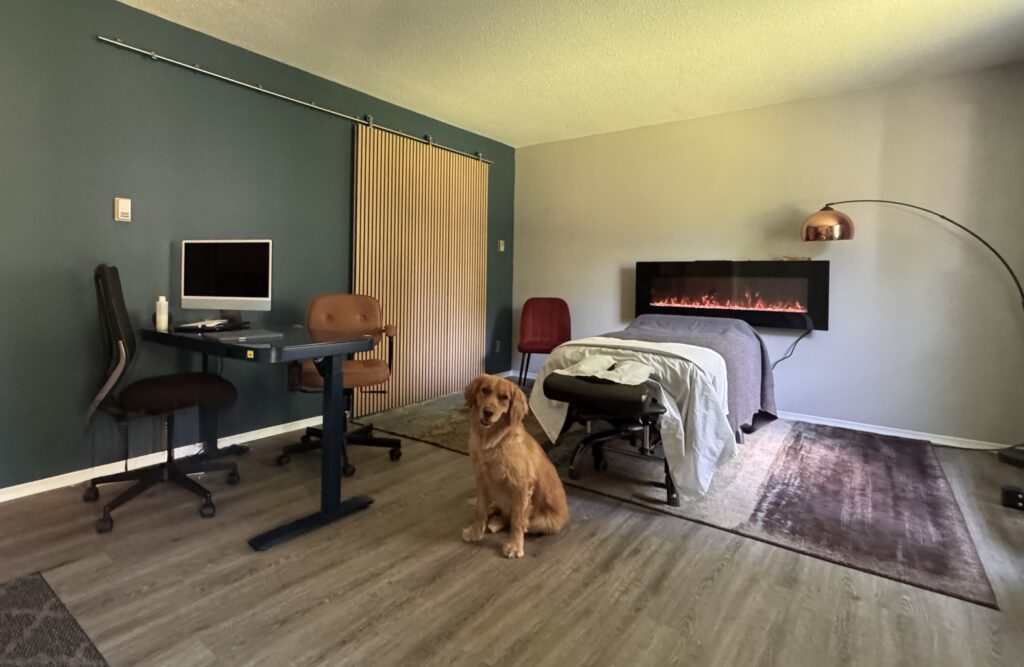
A massage session for golfers with Bruno Panucci RMT is built around where the swing has loaded you, and it starts with your consent and your control. You set the pressure. You can adjust it, or stop, at any time. The scale runs from soft through medium to deep, and deep work is on request, never the default; a body mid-season often responds better to steady, moderate pressure than to force. Bruno typically works the low back and the muscles alongside the spine, the hips and glutes that drive the turn, and the shoulders and upper back that carry the follow-through, giving the most time to the side your swing loads hardest. The work happens in the private treatment room at his Brantford in-home practice, draped to College of Massage Therapists of Ontario standards, $115 for 60 minutes.
| Region | What the swing does to it | What the session does there |
|---|---|---|
| Low back and spinal muscles | Absorbs the rotation and the finish of every swing | Broad, unhurried work along the spine and low back |
| Hips and glutes | Drive the turn and the weight shift, then stay tight | Releases the hip rotators and works the glutes back into play |
| Shoulders and upper back | Carry the backswing and the follow-through | Eases the trail-shoulder and upper-back tension the swing builds |
| Forearms and elbow | Grip and control the club through impact | Releases the forearm muscles that overwork on a less grooved swing |
| Neck | Turns to track the ball and hold the head steady | Gentle work through the neck and the base of the skull |
Can massage prevent golf injuries or speed recovery?
Massage can support recovery and ease the muscle tension a season builds, but it is honest to be clear about what it does not do: it does not prevent golf injuries, repair a swing fault, or speed the healing of a damaged joint. The prevention evidence in golf points elsewhere. In a double-blind, randomized controlled trial, a twelve-week warm-up program lowered the number of low back pain incidents among adolescent golfers compared with a sham routine (Hamada and colleagues, 2025), and the professional-golfer study above linked better shoulder flexibility to a lower risk of lower-spine injury (Kim and colleagues, 2025). Those are exercise and flexibility findings, not massage findings. Where massage fits is alongside them, easing the tight rotators so a warm-up and a stretching habit have a looser body to work with. If you have sharp or persistent back, hip, or shoulder pain, numbness, or a loss of strength, see your physician before booking massage.
What does massage for golfers cost in Brantford, and is it covered?
Massage for golfers at Bruno Panucci RMT’s Brantford in-home practice is $115 for 60 minutes, a rate kept steady by low overhead. Sixty minutes covers the back, hips, and shoulders with honest triage, giving the most time to the side your swing loads hardest. A 90-minute session treats the whole chain unhurried, which golfers in season often prefer, and you can text Bruno to confirm its price. Registered Massage Therapy receipts are accepted by most extended health plans, so the benefit many people already carry can offset the cost. Direct billing is available for most insurers. Text Bruno to arrange a longer session or a time outside the posted hours; he can often rearrange to fit you in, sometimes the same day.
Frequently asked questions
Can massage improve my golf swing?
No, and it would be dishonest to claim it. Massage can ease the muscle tension that makes a body feel stiff, so you move more comfortably, but it does not correct swing mechanics. A coach and practice do that. What massage offers is a looser starting point for the work you and your coach put in.
Should a golfer book a massage before or after a round?
Either works, and the goal differs. After a round, massage helps you recover from the tension the day built. Before a round, Bruno keeps the work lighter, since deep pressure can leave muscles feeling loose or a little sleepy for a swing. Tell him your plan and he tailors the session to it.
Is massage for golfers covered by insurance?
Usually, yes. Treatment by a Registered Massage Therapist is reimbursable under most extended health plans. Bruno provides a compliant receipt after every session, with the details your insurer needs to process the claim. Check your own plan for its annual massage limit.
How much pressure should a golfer choose?
You choose it, and you can change it any time. The scale runs from soft through medium to deep, and deep work is on request, never automatic. Mid-season, a steady moderate pressure often does more for a tired rotating body than force does. Nothing goes deeper than you ask for.
Book a massage for golfers with Bruno in Brantford
Bruno Panucci RMT treats golf-related back, hip, and shoulder tension at his in-home practice in Brantford, serving Brant County including Paris, St. George, Mt. Pleasant, and Burford, with occasional mobile visits on request. Sessions are $115 for 60 minutes, with receipts for most extended health plans and direct billing available for most insurers.
Text Bruno at 519-753-5544 (he prefers texts), call the same number, or book online. Want the whole chain done without the clock, or a time the calendar does not show? Text him about a 90-minute or two-hour session. He can often rearrange to fit you in, sometimes the same day.
A note on scope: This page is general information, not medical advice. Registered Massage Therapy may ease golf-related muscle tension and support recovery, but it does not diagnose or treat injuries, and results vary. Sharp or persistent back, hip, or shoulder pain, numbness, tingling, or weakness deserves a physician conversation first. Bruno Panucci is a Registered Massage Therapist (RMT), and works within current RMT scope of practice.
Related reading
Sources
- Kim HJ, Lee HR, Suh SW, Chang DG, Yang JH. Associations between flexibility, stretching habits, and spine injuries in professional golfers: a nationwide, cross-sectional study. Journal of Orthopaedic Surgery and Research, 2025. doi.org/10.1186/s13018-025-06268-z
- Lee S, Lastella M, Vitiello A, Pollard H. Golf-Related Injuries in Young Elite Golfers: A Cross-Sectional Survey Study. Health Science Reports, 2026. doi.org/10.1002/hsr2.72333
- Hamada Y, Akasaka K, Okubo Y, Hattori H, Mizoguchi Y, Kikuchi Y, Nakagawa H, Hall T. Warm-Up Program for Adolescent Golfers Reduces Low Back Pain: A Double-Blind, Randomized Controlled Trial. Translational Sports Medicine, 2025. doi.org/10.1155/tsm2/6993582
- Xiao Y, Zhang T, Huang R, Ma Y, Zheng W. Statistical parametric mapping analysis of upper limb joint coordination and variability differences during the downswing phase of the golf swing. Frontiers in Sports and Active Living, 2026. doi.org/10.3389/fspor.2026.1820927
- College of Massage Therapists of Ontario, Standards of Practice.
- Government of Ontario. Massage Therapy Act, 1991, S.O. 1991, c. 27. ontario.ca/laws/statute/91m27