Bruno Panucci RMT
Massage for Tendonitis in Brantford: The Umbrella Term, Unpacked
Quick answer: Massage for tendonitis in Brantford, with Bruno Panucci RMT, supports the muscles around an irritated tendon and eases the guarding and tension that build up while it settles. Modern tendon care centres on progressive loading, meaning graded exercise, and massage works alongside that plan rather than replacing it. Massage does not repair tendon tissue and does not speed healing. Sessions are $115 for 60 minutes at his in-home practice. This page is general information, not medical advice.
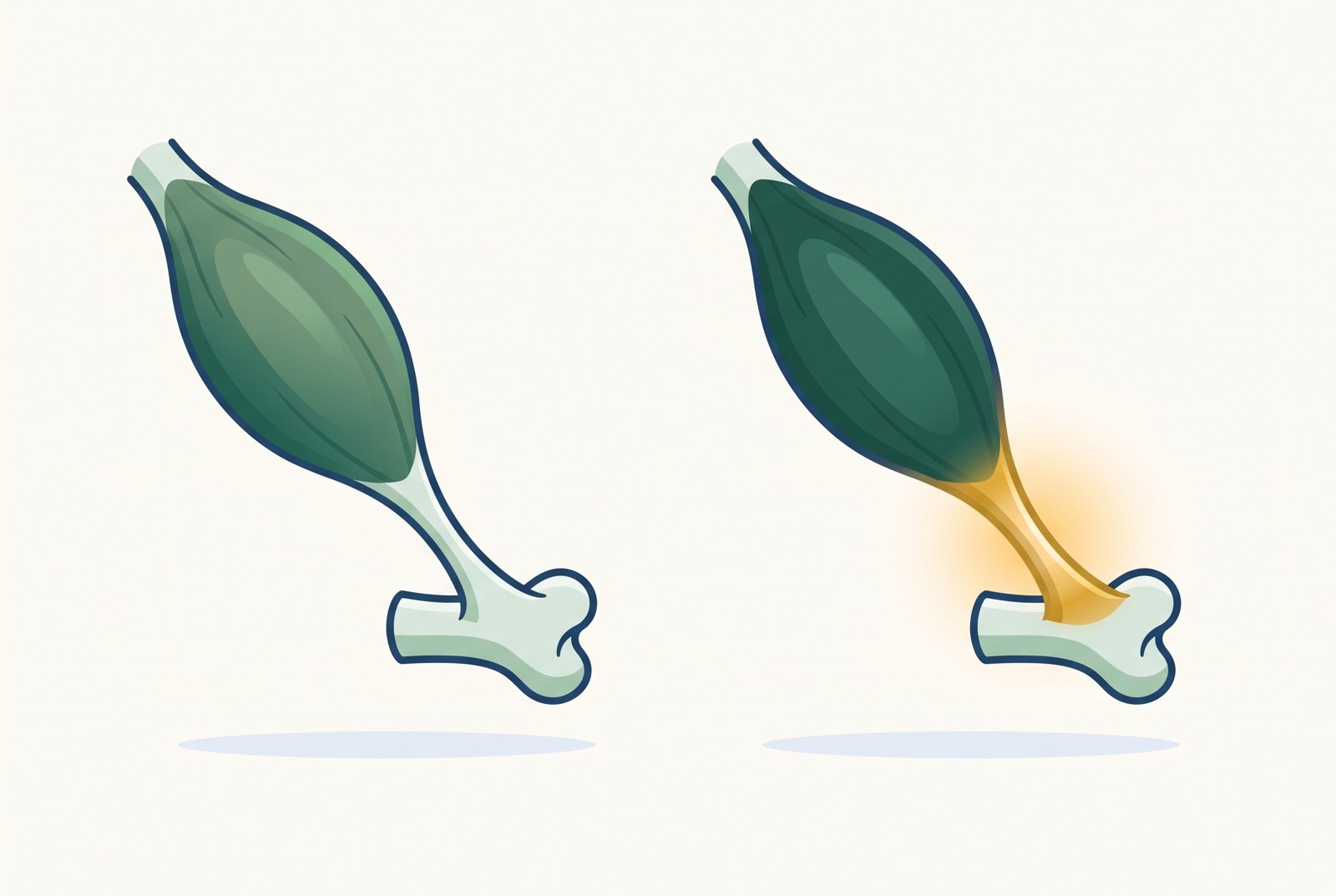
Tendonitis is an umbrella term for pain in a tendon, the strong cord that connects muscle to bone, and most cases people describe with the word are actually tendinopathy, an irritated and overloaded tendon rather than a raging inflammation. Bruno Panucci RMT is a Registered Massage Therapist with 25 years of hands-on experience, working from a private in-home practice in Brantford and serving Brant County, including Paris, St. George, Mt. Pleasant, and Burford. He treats the pattern constantly, in the elbow, the shoulder, the Achilles, and the knee, and he is direct about what Registered Massage Therapy adds: relief for the overworked muscle around the tendon, not a repair of the tendon itself. If your pain is on the outside of the elbow, the more specific page on massage for tennis elbow will serve you better than this general one.
Bruno Panucci RMT, 25 years of practice: “Tendonitis is the word people arrive with, and I never correct anyone at the door. What I do explain is that the tendon itself does not want an hour of rubbing. The muscle attached to it usually does, because it has been bracing for weeks. I work the muscle, the tendon gets its graded exercise from your physio plan, and the two together tend to go better than either alone. I would rather tell you that plainly than sell you a fix.”
In short: tendonitis is an umbrella term for a painful, irritated tendon, most often from doing more than the tendon was prepared for. The core of modern care is progressive loading, graded exercise that rebuilds the tendon’s capacity. Massage supports the surrounding muscle, comfort, and tension; it does not repair tendon tissue or speed healing.
6 min read
What does the word tendonitis actually cover?
Tendonitis, as most people use it, covers almost any persistent tendon pain: tennis elbow and golfer’s elbow at the arm, rotator cuff and biceps trouble at the shoulder, Achilles pain at the heel, patellar pain below the kneecap. The suffix “itis” implies inflammation, but researchers now describe most long-running cases as tendinopathy, a tendon that has been loaded beyond its current capacity and has become irritated and disorganized rather than acutely inflamed. That distinction matters for care. An angry, hot, swollen tendon after a sudden injury is a reason to see your physician first. The far more common slow-burn version, sore in the morning, cranky at the start of activity, worse after a big week, responds best to a managed return to load. The name on the label matters less than the pattern: a tendon asked to do more than it was prepared for, and a body compensating around it.
Why is exercise, not massage, the centre of tendon care?
Exercise sits at the centre of tendon care because tendons adapt to load, and graded loading is what rebuilds their capacity. A 2026 UK Defence Rehabilitation consensus on Achilles and patellar tendinopathy strongly advocated exercise rehabilitation as the primary management, with education advised and other adjuncts considered only case by case (Judd and colleagues, 2026). The delivery format seems to matter less than the loading itself: a 2026 systematic review found remotely supervised rehabilitation produced outcomes comparable to in-person physical therapy for nonoperative tendinopathy, though the authors rated the certainty of that evidence as low and urged caution (Fan and colleagues, 2026). The practical takeaway for someone in Brantford is simple. If a tendon has hurt for more than a couple of weeks, the backbone of your plan is a progressive exercise program, usually from a physician or physiotherapist. Registered Massage Therapy with Bruno Panucci RMT is a supporting player in that plan, and he will say so himself, because pretending otherwise would not survive contact with the evidence.
What can massage honestly do for tendonitis?
Massage for tendonitis works mostly on everything around the tendon rather than the tendon itself. When a tendon hurts, the attached muscle tends to tighten and guard, nearby muscles pick up compensation work, and the whole region can feel short, stiff, and protective. Massage can ease that guarding, reduce the felt tension in the muscle bellies, and make the graded exercise that actually rehabilitates the tendon more comfortable to do. There is some support for manual therapy in that supporting role: a 2026 case report on biceps tendinopathy described a six-week physiotherapy program that combined manual therapy with strengthening, range of motion work, and education, with large improvements in pain and function, though a single case cannot prove what any one ingredient did (Ummul and colleagues, 2026). What massage does not do also needs saying plainly. It does not repair or remodel tendon tissue, it does not speed healing, and it is not a substitute for loading. If someone promises to rub a tendinopathy away, that promise is not honest. Bruno works the forearm for an elbow tendon, the calf for an irritated Achilles, the shoulder girdle for a cuff problem, and he keeps direct pressure on a freshly irritated tendon light or off entirely.
Which tendon is it? Finding your specific page
Tendonitis behaves differently depending on which tendon is involved, so this site covers the common ones on their own pages, each individually researched. The table below routes you to the right one. Whichever tendon it is, the same honest frame applies: loading is the treatment, massage is the support, and new, severe, or unexplained pain belongs with your physician first.
| Where it hurts | Common name | Where massage focuses |
|---|---|---|
| Outside of the elbow | Tennis elbow (golfer’s elbow is its inner-elbow cousin, covered on the same page) | The forearm extensor muscles, not the sore bony point. See the tennis elbow page. |
| Back of the heel or lower calf | Achilles tendonitis | The calf complex above the tendon. See calf and Achilles massage. |
| Top or side of the shoulder | Rotator cuff tendonitis | The cuff muscles, chest, and upper back around the joint. See rotator cuff massage. |
| Just below the kneecap | Patellar tendonitis, jumper’s knee | The quadriceps and hip muscles that load the tendon. |
What a tendonitis-focused session looks like in Brantford
A tendonitis-focused massage session with Bruno Panucci RMT starts with questions: which tendon, how long, what makes it worse, and what your physician or physiotherapist has already said. The hands-on work then targets the muscles that feed and guard the tendon, at the pressure you choose, from soft through medium to deep, with deep work on request and never the default. You set the pressure, and you can adjust it, or stop, at any time. Sessions run in the private treatment room at his Brantford in-home practice, draped to College of Massage Therapists of Ontario standards, with two friendly, calm dogs sharing the room unless you ask for them to be kept out. A 60-minute session is $115, you receive an official Registered Massage Therapy receipt with everything your insurer needs, and direct billing is available for most insurers. Because the practice runs from his own home, the overhead stays low and the price stays fair, which matters when tendon recovery takes a series of visits rather than one.
Frequently asked questions
Can massage cure tendonitis?
No. Massage does not repair tendon tissue and does not cure tendonitis. What it can do is ease the tension and guarding in the muscles around the tendon and make you more comfortable while a progressive loading program, the actual core of tendon care, does its work. Bruno is upfront about that division of labour.
Should I get massage directly on the sore tendon?
Usually not, and especially not on a freshly irritated one. The useful work is in the muscle attached to the tendon and the muscles compensating around it, not grinding on the sore spot itself. Bruno keeps direct tendon pressure light or off entirely and focuses where the tension actually lives.
Do I need to see a doctor before booking massage for tendon pain?
If the pain is severe, followed a sudden injury or a pop, comes with marked swelling, or has no clear cause, see your physician first. For a familiar, slow-building tendon ache, massage can be booked alongside your exercise plan. Bruno will refer you out if what he finds does not fit a massage-appropriate picture.
How many massage sessions does tendonitis take?
There is no honest fixed number, because the tendon’s recovery is driven by your loading program and time, not by the massage count. Many people space supportive sessions a few weeks apart while the rehab progresses. Bruno would rather help you find a sensible rhythm than book you more often than you need.
Book supportive massage for tendon pain with Bruno in Brantford
Bruno Panucci RMT offers Registered Massage Therapy that supports tendon recovery at his in-home practice in Brantford, serving Brant County including Paris, St. George, Mt. Pleasant, and Burford, with a limited number of mobile visits available on request. Sessions are $115 for 60 minutes, with receipts for most extended health plans and direct billing available for most insurers.
Text Bruno at 519-753-5544 (he prefers texts), call the same number, or book online. If the calendar does not show a time that works, or you want a shorter or 90-minute session, text him directly. He can often rearrange to fit you in, sometimes the same day.
A note on scope: This page is general information, not medical advice. Massage supports comfort and the muscles around an irritated tendon; it does not repair tendon tissue, speed healing, or replace a loading program. If your tendon pain is severe, followed a sudden injury, or comes with significant swelling or weakness, see your physician first. Bruno Panucci is a Registered Massage Therapist (RMT), and works within current RMT scope of practice.
Related reading
- when the outside of the elbow will not settle
- calf work for a cranky Achilles
- shoulder and cuff support
- session rates and what is bookable
Sources
- Judd A, Wild K, Puxley L, Barker-Davies R. UK Defence Rehabilitation consensus agreement for the conservative management of Achilles and patellar tendinopathy: a modified Delphi approach. BMJ Military Health, 2026. doi.org/10.1136/military-2024-002893
- Fan S, Noor S, Arunkumar Y, Bi Z, Guo Y, Zhang L. Effectiveness of telerehabilitation versus home exercise and in-person therapy for nonoperatively managed tendinopathy: A systematic review and meta-analysis. Journal of International Medical Research, 2026. doi.org/10.1177/03000605261456510
- Ummul SS, Hossain KMA, Alam F, Fazal S, Sharmin F, Sattar MM, Ali ME. Clinical Reasoning-Led Physiotherapy Intervention for Biceps Tendinopathy: A Case Report. Clinical Case Reports, 2026. doi.org/10.1002/ccr3.72189
- College of Massage Therapists of Ontario, Standards of Practice.
- Government of Ontario. Massage Therapy Act, 1991, S.O. 1991, c. 27. ontario.ca/laws/statute/91m27