Bruno Panucci RMT
Massage vs Acupuncture: An Honest Ontario Comparison
Quick answer: Massage therapy and acupuncture are both regulated in Ontario, and both have research behind them for common pain problems. Massage works soft tissue hands-on with pressure and movement; acupuncture stimulates specific points, usually with fine needles. Neither is universally better, and the honest answer is fit: the problem, the evidence for it, and your own comfort. Bruno Panucci RMT offers Registered Massage Therapy only, in Brantford, at $115 for 60 minutes. This page is general information, not medical advice.
People compare massage vs acupuncture because both show up in the same conversations: sore necks, stubborn backs, stress, and benefits booklets that cover each one. Massage therapy is the hands-on assessment and treatment of muscle and soft tissue, regulated in Ontario under the Massage Therapy Act, 1991 and overseen by the College of Massage Therapists of Ontario. Acupuncture is the stimulation of specific body points, most often with fine needles, and in Ontario it is regulated too: traditional Chinese medicine practitioners and acupuncturists have their own college, and some physiotherapists and RMTs hold additional acupuncture training. Bruno Panucci RMT has practised massage therapy for 25 years and serves Brantford and Brant County, including Paris, St. George, Mt. Pleasant, and Burford, from his private in-home practice. He offers massage only, and this page says so plainly rather than dressing a comparison up as a pitch. If you want the mechanics first, how massage therapy actually works covers them honestly.
Bruno Panucci RMT, 25 years of practice: “I built my practice on massage, and I do not offer needling. I will still say this straight: acupuncture helps some people, massage helps some people, and plenty of people do well with either. If a comparison page tells you one of them wins every time, it was written to sell you something, not to inform you.”
In short: massage therapy treats muscle and soft tissue hands-on with graded pressure, while acupuncture stimulates specific points, usually with fine needles. Both are regulated health practices in Ontario, both carry research support for certain pain problems, and neither is proven superior across the board. Choice usually comes down to the problem and personal comfort.
6 min read
What is the difference between massage therapy and acupuncture?
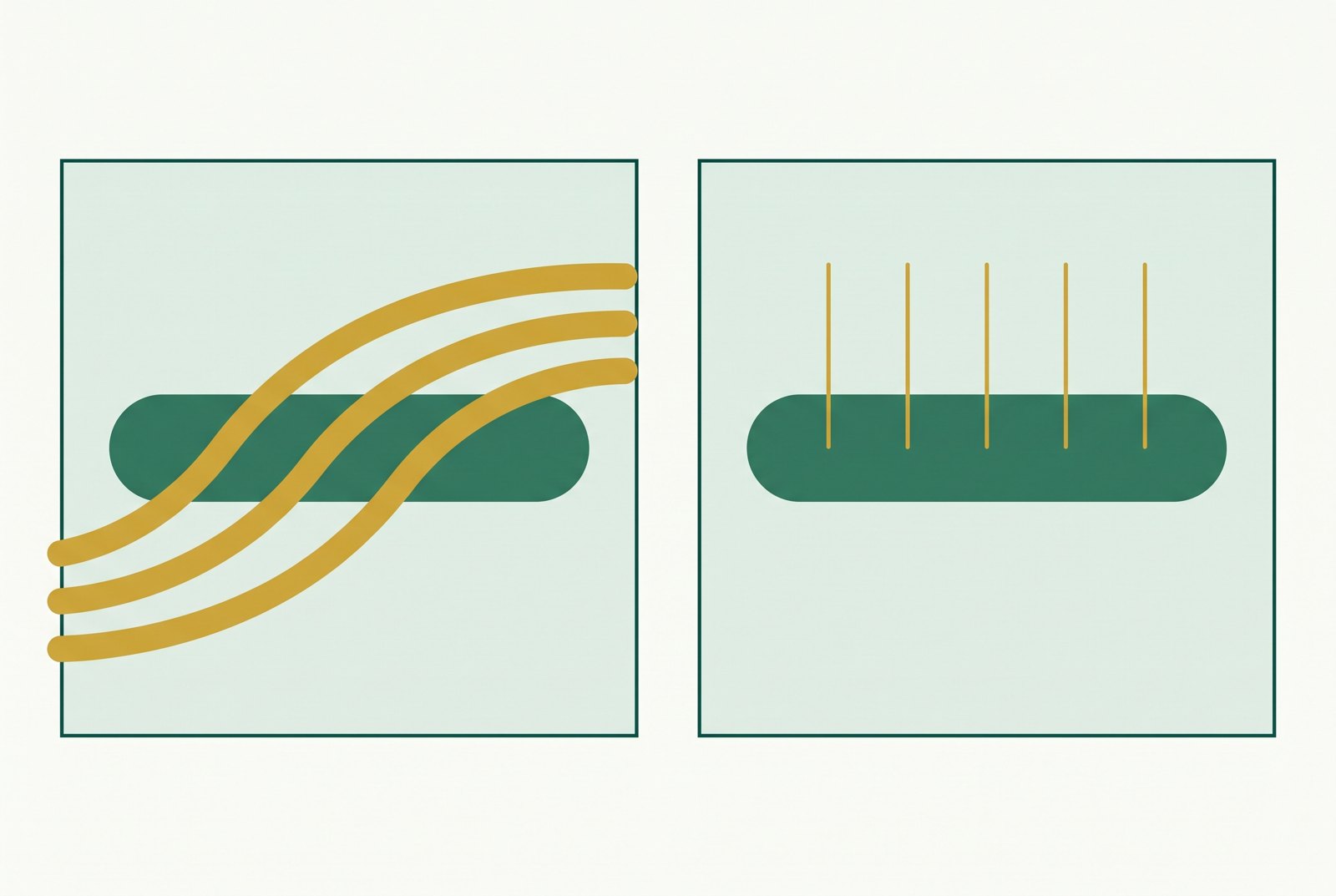
Massage therapy and acupuncture differ in tool, target, and feel. Massage therapy uses the therapist’s hands to work muscle, fascia, and other soft tissue: kneading, gliding, sustained pressure, and joint movement, with the pressure you choose, from soft through medium to deep. Acupuncture inserts fine, sterile needles at specific points and leaves them in place, sometimes with gentle stimulation; most people describe the sensation as a brief prick followed by a dull ache or nothing at all. Massage is continuous contact for the whole session, which is part of why many people find it calming; acupuncture is mostly stillness once the needles are placed. At Bruno Panucci RMT’s Brantford practice, a session is Registered Massage Therapy only, hands-on for the full hour, with draping to College of Massage Therapists of Ontario standards throughout. If you are also weighing physiotherapy or chiropractic, the three-profession comparison maps those doors the same even-handed way.
| Aspect | Massage therapy (RMT) | Acupuncture |
|---|---|---|
| Main tool | Hands: pressure, kneading, movement | Fine sterile needles at specific points |
| What a session feels like | Continuous hands-on work, pressure you control | Brief needle sensation, then mostly stillness |
| Ontario regulation | College of Massage Therapists of Ontario | College of Traditional Chinese Medicine Practitioners and Acupuncturists of Ontario; some physios and RMTs hold added training |
| Common uses | Muscle tension, stress, general soreness | Various pain conditions, often alongside other care |
| Benefits coverage | Usually its own massage line in extended health plans | Often covered, under its own line; plans vary |
What does the evidence say about massage vs acupuncture?
The evidence for massage and acupuncture is genuinely mixed, and the honest summary is that both show benefit for some pain problems, usually with modest effects and low-certainty studies. Recent research often studies them side by side rather than head to head. A network meta-analysis of 66 randomized trials in cervicogenic vertigo found that both acupuncture-based and manual-therapy interventions may improve outcomes, and that combinations tended to rank best, while cautioning that most of the evidence was low or very low certainty (Yang and colleagues, 2026). In endometriosis-related pain, a systematic review found acupuncture ranked highest for pelvic pain while physical therapies ranked highest for overall pain and menstrual pain, with both improving quality of life compared with conventional care alone (Zheng and colleagues, 2026). A review of manual therapy for post-stroke shoulder-hand syndrome reported consistent benefit across 13 trials but concluded the variability in techniques made results hard to generalize (Kim and colleagues, 2026). The pattern repeats across conditions: each approach helps some problems, neither dominates, and researchers keep calling for better trials. Any page claiming a clear winner is ahead of the science. And to be plain about scope: massage supports comfort and eases symptoms; it does not cure conditions, remove toxins, or speed tissue healing, and neither claim should be made for acupuncture either.
How does Ontario regulate massage therapy and acupuncture?
Ontario regulates both practices, which matters more than most comparison pages admit. Registered Massage Therapists are regulated under the Massage Therapy Act, 1991 and are accountable to the College of Massage Therapists of Ontario, with binding standards for consent, draping, privacy, and record keeping, and a formal complaints process. Acupuncture in Ontario sits with the College of Traditional Chinese Medicine Practitioners and Acupuncturists of Ontario, which regulates traditional Chinese medicine practitioners and acupuncturists; in addition, some regulated professionals such as physiotherapists and RMTs complete recognized training that permits them to perform acupuncture within their own scope. Practically, that means a properly credentialed provider of either practice is a regulated professional, accountable to a College and its complaints process, and issues receipts most extended health plans accept. Bruno Panucci RMT holds the protected RMT title, provides an official Registered Massage Therapy receipt with everything your insurer needs, and offers massage therapy only; he does not provide acupuncture.
How do you choose between massage and acupuncture for your problem?
Choosing between massage and acupuncture usually comes down to three practical questions rather than a verdict. First, where does the problem live? If it feels muscular, tight shoulders from desk work, a jaw that clenches, soreness after training, hands-on soft-tissue work is a natural fit, and research suggests massage may help ease that kind of tension. If your problem is one where acupuncture has specific research support, or your physician or physiotherapist has suggested needling, that is a reasonable door too. Second, what does your body tolerate? Some people cannot relax with needles in place; others dislike sustained pressure. Comfort is not a trivial factor, because tension fights treatment. Third, what does your plan cover? Most Ontario extended health plans carry separate lines for massage therapy and acupuncture, so trying one does not usually drain the other’s coverage; confirm your own booklet. If massage is your fit and you are comparing local options, how to choose an RMT in Brantford walks through it practically. One anchor holds for both: new, severe, or unexplained symptoms, numbness, weakness, or pain after real trauma belong with your physician first.
Can you use massage and acupuncture together?
Massage and acupuncture are commonly used together, and nothing in Ontario’s rules prevents it. Some research points the same way: in the cervicogenic vertigo analysis, combined regimens, such as electroacupuncture plus Tuina manual therapy, tended to rank ahead of either approach alone, though the authors flagged the low certainty of the underlying trials (Yang and colleagues, 2026). In practice, people often book acupuncture for a specific condition and massage therapy for the muscle tension around it, or alternate depending on how a flare behaves. If you combine care, tell each provider what the other is doing, including timing, so nobody works the same irritated tissue twice in a day. Bruno Panucci RMT has spent 25 years in Brantford working alongside other providers this way, and he will tell you plainly when a question is better put to an acupuncturist than to him.
Frequently asked questions
Is massage or acupuncture better for back pain?
Neither is proven better across the board. Research supports each for some pain problems, usually with modest effects and low-certainty evidence, and studies that compare approaches often find combinations rank well. Fit, comfort, and your physician’s advice matter more than a universal winner.
Is acupuncture regulated in Ontario like massage therapy is?
Yes. Traditional Chinese medicine practitioners and acupuncturists are regulated by their own Ontario college, and some physiotherapists and RMTs hold recognized acupuncture training within their scope. Massage therapy is separately regulated by the College of Massage Therapists of Ontario.
Does Bruno Panucci RMT offer acupuncture?
No. His Brantford in-home practice provides Registered Massage Therapy only, at $115 for 60 minutes, and he does not offer needling. If acupuncture interests you, look for a provider regulated to deliver it in Ontario.
Will my benefits cover both massage and acupuncture?
Often yes, under separate lines. Most Ontario extended health plans carry their own annual amount for massage therapy, and many also cover acupuncture from an appropriately regulated provider. Plans vary, so confirm your own benefits booklet before booking either.
Book a massage with Bruno in Brantford
If hands-on soft-tissue work is the fit, Bruno Panucci RMT provides Registered Massage Therapy at his private in-home practice in Brantford, serving Brant County including Paris, St. George, Mt. Pleasant, and Burford, with occasional mobile visits on request. Sessions are $115 for 60 minutes, receipts work with most extended health plans, and direct billing is available for most insurers. Two friendly, calm dogs share the treatment room, and Bruno can keep them out on request.
Text Bruno at 519-753-5544 (he prefers texts), call the same number, or book online. Need a time the calendar does not show, or a 90 minute or two hour session? Text him directly. He can often rearrange to fit you in, sometimes the same day.
A note on scope: This page is general information, not medical advice. It compares two regulated practices; it does not diagnose or rank one above the other, and neither massage nor acupuncture cures any condition. For new, severe, or unexplained symptoms, numbness, weakness, or pain after an injury, see your physician first. Bruno Panucci is a Registered Massage Therapist (RMT), and works within current RMT scope of practice.
Related reading
- massage, physio, or chiro, mapped honestly
- what massage actually does in the body
- picking a local RMT, practically
Sources
- Yang Z, Li P, Jiang L, et al. Comparative effectiveness of acupuncture and Tuina for cervical vertigo: a systematic review and network meta-analysis of randomized controlled trials. Frontiers in Neurology, 2026. doi.org/10.3389/fneur.2026.1691312
- Zheng X, Wang Y, Li H, et al. Comparative Effectiveness of Non-Pharmacological Interventions for Pain and Quality of Life in Women with Endometriosis: A Systematic Review and Network Meta-Analysis. Journal of Pain Research, 2026. doi.org/10.2147/jpr.s577080
- Kim GY, Sung WS, Kim EJ. The clinical effect of manual therapy including Tuina (or Chuna) on post-stroke shoulder hand syndrome, a literature review. Frontiers in Neurology, 2026. doi.org/10.3389/fneur.2026.1820005
- Government of Ontario. Massage Therapy Act, 1991, S.O. 1991, c. 27. ontario.ca/laws/statute/91m27
- College of Massage Therapists of Ontario, Standards of Practice.