Bruno Panucci RMT
Massage for Flexibility in Brantford: Range of Motion, Honestly
Quick answer: Massage for flexibility can loosen tight muscle and soft tissue so a joint moves more freely, and research suggests the gain is real but short-lived, measured in minutes to hours rather than weeks. Registered Massage Therapy eases the tension that limits range of motion; it does not permanently lengthen muscle or replace stretching and strength work. Bruno Panucci RMT offers therapeutic massage in Brantford at $115 per 60 minutes, at the pressure you choose, from soft through medium to deep. This page is general information, not medical advice.
People look for massage for flexibility when a stiff neck, tight hips, or unyielding hamstrings start getting in the way, and they want to know whether hands-on work actually helps range of motion or just feels good in the moment. Massage for flexibility is soft-tissue work meant to reduce the muscle tension and guarding that hold a joint short of its full travel. Bruno Panucci RMT has practised Registered Massage Therapy for 25 years, is registered with the College of Massage Therapists of Ontario (CMTO), and works from his in-home practice in Brantford, serving Brant County towns including Paris, St. George, Mt. Pleasant, and Burford. If you want the honest version of how massage and stretching compare, the guide to how stretching and massage differ sits alongside this one.
Bruno Panucci RMT, 25 years of practice: “I am careful with the word flexibility, because people hear it and picture a muscle getting permanently longer under my hands. That is not what happens. What I can do is settle down the muscle that is guarding and holding a joint tight, so you move more freely right after, and often for a while. That window is your chance to do the stretching and the strengthening that actually keeps the range. I would rather tell you that plainly than sell you a session and let you think the massage did all the work.”
In short: massage can temporarily improve range of motion by easing muscle tension and guarding, but the effect is short-term, usually minutes to hours. The lasting gains in flexibility come from regular stretching and movement, with massage as a helpful, comfortable way to make that work easier.
6 min read
Does massage actually improve flexibility and range of motion?
Massage can improve flexibility, and the honest framing is that it does so by changing how a muscle behaves, not by stretching the tissue permanently. When a muscle is tight or guarding, it resists movement and holds the joint short of its usable range. Hands-on soft-tissue work reduces that guarding, so range of motion increases in the minutes after treatment. Percussion massage, the massage-gun style of work, has been studied directly for this: Bartik and colleagues (2025) found that percussion massage produced an immediate improvement in hamstring flexibility that was greater than foam rolling or no treatment. That is a real, measurable effect. It is also an acute one, meaning it shows up right after the work rather than building a lasting structural change. At Bruno Panucci RMT’s in-home practice in Brantford, that is exactly how a flexibility-focused session is framed: therapeutic massage to quiet the tension limiting your movement, so the range is there for you to use and to build on. For work that leans into athletic range of motion, sports-focused massage covers the same ground for training bodies.
| Question | What the evidence supports |
|---|---|
| Can massage increase range of motion? | Yes, acutely. Percussion massage improved hamstring flexibility immediately (Bartik and colleagues, 2025). |
| Does it lengthen muscle permanently? | No. The change is in tension and sensation, not permanent tissue length. |
| Do self-tools always work? | Not reliably. Foam rolling up to two minutes did not improve knee flexibility in one study (Couture and colleagues, 2015). |
| What holds the gain? | Regular stretching and movement, with massage as support. |
How long does the flexibility gain from massage last?
The flexibility gain from massage is short-lived, and being straight about that is part of using it well. The studies that measure range of motion after soft-tissue work generally capture an effect in the minutes and hours after treatment, not one that persists for weeks on its own. Bartik and colleagues (2025) described the percussion-massage flexibility improvement as an acute effect and cautioned that it should not be relied on as a standing performance enhancer. The practical reading is that a session opens a window: your tissue is more comfortable and your joint moves more freely, and that is the moment to move through the new range and reinforce it. Massage does not cure stiffness, speed healing, or flush anything out of the muscle. What it does is make the range available and the follow-up work more comfortable. Bruno Panucci RMT frames a Brantford session around that window rather than around a promise that one appointment fixes long-standing tightness, because 25 years of hands-on work has made the pattern clear: the people who keep their range are the ones who keep moving between visits.
How much pressure does flexibility work actually need?
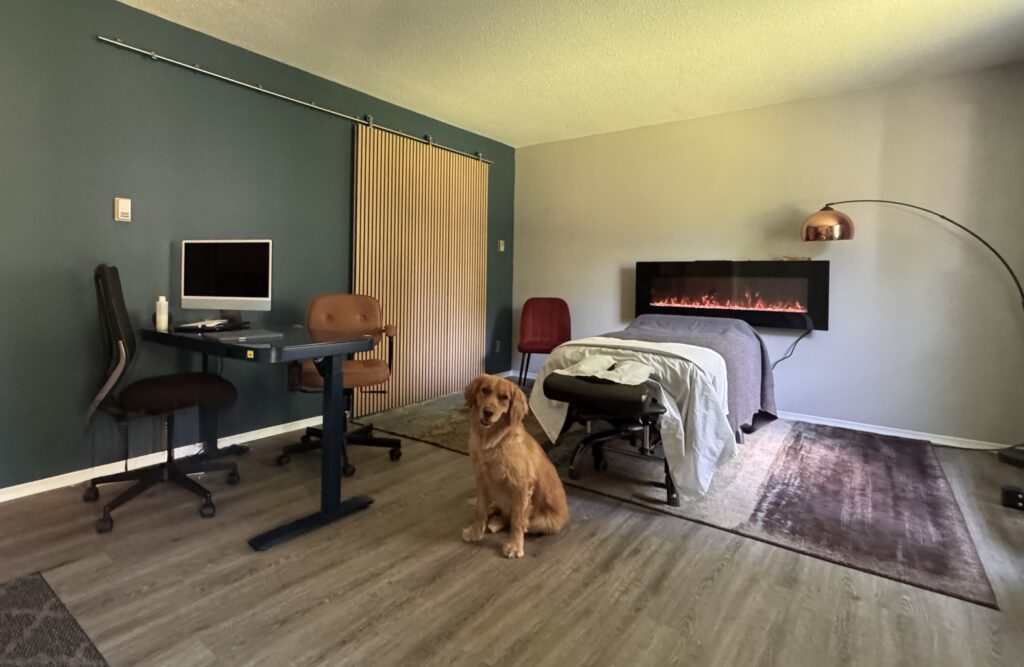
Flexibility work does not require the deepest pressure, and more force is not automatically more result. You set the pressure. You can adjust it, or stop, at any time. That control matters here because tissue responds to being met, not overpowered. The foam-rolling research is a useful caution: Couture and colleagues (2015) found that self-administered foam rolling for up to two minutes did not produce a significant improvement in knee flexibility, and they pointed to the amount of pressure the roller actually delivered as a likely reason. Pressure has to reach the tissue in a way it can accept. In a hands-on session that is a conversation, not a fixed setting. Bruno Panucci RMT works on a gradient from soft through medium to deep, and deep pressure is on request, never the default. For flexibility, a medium, well-directed touch that lets the muscle release usually does more than a punishing one that makes it brace. If deeper, sustained work is genuinely what a stubborn area needs, that is available too, chosen by you. The related overview of how myofascial and connective-tissue work is described gives more context on where soft-tissue techniques fit.
Why you still stretch and move, even with regular massage
Stretching and movement remain the foundation of flexibility, and massage supports them rather than replacing them. Stretching has long been used by therapists and coaches to increase joint range of motion, and a systematic review by Apostolopoulos and colleagues (2015) noted that moderate-intensity stretching, in the range of roughly 30 to 60 percent of a person’s maximum, appears to gain range without provoking the inflammation that harder, painful stretching can cause. That is the same soft-first logic that guides good massage: enough to work, not so much that the body defends against it. Broader movement matters too. A Cochrane overview by Geneen and colleagues (2017), pooling 21 reviews, found that physical activity including flexibility and range-of-motion training may improve physical function and pain severity, with few adverse events, though the authors rated the overall evidence quality as low. Read together, the honest picture is a partnership: massage eases the tension limiting your range, and stretching plus regular movement is what holds and extends it over time. If you have a specific injury or a diagnosed condition, speak with your physician or a Registered Massage Therapist about what belongs in your own plan.
Booking flexibility-focused massage in Brantford and Brant County
Flexibility-focused massage in Brantford is straightforward to arrange with Bruno Panucci RMT. A session is Registered Massage Therapy at his in-home practice, $115 for 60 minutes, with the pressure you choose and the flexibility angle built into how the time is spent. He serves Brantford and Brant County, including Paris, St. George, Mt. Pleasant, and Burford, with occasional mobile visits on request. Receipts are provided for most extended health plans, so many clients use their massage benefits for this, and direct billing is available for most insurers. Because his practice runs from his own home with low overhead, the price stays fair, which matters when flexibility work is something you return to rather than do once. If your goal is athletic range of motion, everyday desk-and-driving stiffness, or simply moving more comfortably, the session is shaped around what your body is actually asking for.
Frequently asked questions
Can one massage make me more flexible?
One session can improve your range of motion right after it, because massage eases the muscle tension and guarding that hold a joint short. Research on percussion massage shows this immediate gain. It is short-lived, though, so the way to keep flexibility is to stretch and move through that new range while it is available.
Does massage lengthen my muscles?
No. Massage changes how tight and guarded a muscle feels, which lets a joint move more freely, but it does not permanently lengthen the tissue. Lasting flexibility comes from regular stretching and movement. Bruno Panucci RMT in Brantford is upfront about this rather than promising a permanent change from hands-on work alone.
Do I need deep pressure for flexibility work?
Usually not. A medium, well-directed pressure that lets the muscle release tends to help range of motion more than force that makes it brace. You set the pressure, from soft through medium to deep, and deep work is on request. If a stubborn area genuinely needs it, deeper work is available and chosen by you.
Is massage or stretching better for flexibility?
They do different jobs and work best together. Massage eases the tension limiting your range in the short term, while stretching and regular movement are what build and hold flexibility over time. For a diagnosed condition or an injury, speak with your physician or a Registered Massage Therapist about the right plan for you.
Book a massage with Bruno in Brantford
If you want flexibility-focused massage, Bruno Panucci RMT provides Registered Massage Therapy at his in-home practice in Brantford, serving Brant County including Paris, St. George, Mt. Pleasant, and Burford, with occasional mobile visits on request. Sessions are $115 for 60 minutes, receipts work with most extended health plans, and direct billing is available for most insurers.
Text Bruno at 519-753-5544 (he prefers texts), call the same number, or book online. Need a time the calendar does not show, or a 90 minute or two hour session? Text him directly. He can often rearrange to fit you in, sometimes the same day.
A note on scope: This page is general information, not medical advice. Registered Massage Therapy can support comfort and movement, but it does not cure stiffness, lengthen muscle permanently, or speed healing. For new, severe, or unexplained symptoms, or pain after an injury, speak with your physician first. Bruno Panucci is a Registered Massage Therapist (RMT), and works within current RMT scope of practice.
Related reading
- how stretching and massage each earn their place
- range of motion for training bodies
- what soft-tissue and myofascial work involves
Sources
- Bartik P, Pacholek M. Acute effect of percussion and foam roller massage on flexibility, reactive and explosive strength, and muscular endurance in young adult males: a crossover pilot study. PeerJ, 2025; 13: e20304. doi.org/10.7717/peerj.20304
- Couture G, Karlik D, Glass SC, Hatzel BM. The Effect of Foam Rolling Duration on Hamstring Range of Motion. The Open Orthopaedics Journal, 2015; 9: 450-455. doi.org/10.2174/1874325001509010450
- Apostolopoulos N, Metsios GS, Flouris AD, Koutedakis Y, Wyon MA. The relevance of stretch intensity and position: a systematic review. Frontiers in Psychology, 2015; 6: 1128. doi.org/10.3389/fpsyg.2015.01128
- Geneen LJ, Moore RA, Clarke C, Martin D, Colvin LA, Smith BH. Physical activity and exercise for chronic pain in adults: an overview of Cochrane Reviews. Cochrane Database of Systematic Reviews, 2017; 4: CD011279. doi.org/10.1002/14651858.CD011279.pub3
- College of Massage Therapists of Ontario, Standards of Practice.
- Government of Ontario. Massage Therapy Act, 1991, S.O. 1991, c. 27. ontario.ca/laws/statute/91m27