Bruno Panucci RMT
Piriformis Syndrome Massage in Brantford: Is It Really Sciatica?
Quick answer: Piriformis syndrome massage in Brantford, with Bruno Panucci RMT, is focused Registered Massage Therapy for the deep gluteal muscles that can sit near the sciatic nerve. It often gets mistaken for sciatica because the buttock and leg pain feels similar, but the cause is different. Careful glute and hip work may ease the muscle tension and buttock pain that irritate the nerve, though it does not treat a spinal disc or cure the condition. This page is general information, not medical advice.
Piriformis syndrome is a pain pattern in the buttock and back of the leg that comes from the deep gluteal muscles rather than a problem in the spine. The piriformis is a small muscle deep in the buttock, and the sciatic nerve runs right beside it, so when that muscle and its neighbours get tight or irritated they can produce buttock pain and a leg ache that mimics true sciatica. Bruno Panucci RMT has spent 25 years as a Registered Massage Therapist in Brantford, and clients across Brantford and Brant County towns like Paris, St. George, Mt. Pleasant, and Burford often arrive convinced they have sciatica when the real trouble is in the glutes. Massage cannot diagnose the difference, and it is not a cure, but focused, client-controlled work on the deep gluteal muscles is one honest option worth understanding, which is why it helps to know how it relates to nerve-related leg pain before you book.
Bruno Panucci RMT, 25 years of practice: “Half the people who come in saying they have sciatica actually have a cranky buttock. The nerve is fine, but the muscles wrapped around it are not, and they have been protecting it in ways that made everything tighter. I cannot tell you which one you have, and I will not pretend to. What I can do is work the glutes and hip carefully, at the pressure you choose, and if it does not settle the way it should, I will tell you to get it looked at properly. Guessing is not a treatment.”
In short: piriformis syndrome massage is focused Registered Massage Therapy for the deep gluteal and hip muscles that surround the sciatic nerve. It may ease the muscle tension and buttock pain that irritate the nerve, and it can feel similar to relief from sciatica, but the underlying cause is muscular rather than spinal. It supports comfort and movement alongside medical care, and it does not diagnose or cure anything.
6 min read
What is piriformis syndrome?
Piriformis syndrome is a neuromuscular condition that causes hip and buttock pain, sometimes with pain referred toward the lower back and down the leg. The piriformis is one of several deep external rotator muscles in the buttock, and the sciatic nerve passes close to it, which is why a tight or irritated piriformis can send symptoms down the leg. In a systematic review protocol on the condition, Deshmukh and colleagues (2026) describe it as difficult to diagnose because its symptoms overlap so heavily with lumbar disc herniation, spinal stenosis, and radiculopathy, and they note the prevalence of low back pain in piriformis syndrome ranges from roughly 5 to 36 percent, with the pattern more common in women than men. Researchers now group this and related buttock-pain problems under the broader term deep gluteal syndrome, and Yoon and colleagues (2025) argue that muscle and tendon problems, not only nerve entrapment, can be the primary source of the pain. For massage, the useful takeaway is simple: this is a muscular and soft-tissue picture, and the deep gluteal muscles are the region Registered Massage Therapy can actually reach.
Is it piriformis syndrome or real sciatica?
Telling piriformis syndrome apart from true sciatica is genuinely hard, and it is not something a massage therapist should claim to settle. True sciatica means the sciatic nerve is being compressed or irritated, most often by a spinal disc or narrowing in the low back, while piriformis-type pain comes from the muscles of the deep buttock. Both can produce buttock pain and a leg ache, which is exactly why they get confused. Sciatic pain also has less common causes: Wu and colleagues (2026) documented a case where an unusual gluteal artery, not a muscle or a disc, was compressing the sciatic nerve, and they stress how much imaging matters for finding the real cause. That is the honest reason Bruno Panucci RMT does not diagnose which one you have. If you already know your pain is nerve-driven, it is worth reading how massage relates to true sciatica. If it seems to sit in the buttock and hip, the muscular picture, and the kind of work described on the hip and gluteal tension page, is more likely what applies. When in doubt, a physician sorts it out.
| Aspect | Piriformis-type pain | True sciatica |
|---|---|---|
| Where the problem starts | Deep gluteal muscles in the buttock | The sciatic nerve, often from the spine or disc |
| What it can feel like | Buttock ache, sometimes running down the leg | Buttock and leg pain, often with tingling or numbness |
| How it is confirmed | Physical exam and imaging by a physician | Physical exam and imaging by a physician |
| What massage can reach | The tight buttock and hip muscles | Surrounding muscle tension only, not the nerve itself |
| Who diagnoses it | Your doctor, not a massage therapist | Your doctor, not a massage therapist |
Can massage help piriformis syndrome?
Massage may help piriformis syndrome by easing the tightness in the deep gluteal muscles, but the honest framing matters more than the hopeful one. Because the pain generator in this region is often muscular and soft-tissue in nature, as Yoon and colleagues (2025) describe for deep gluteal syndrome, hands-on work on the glutes and hip is a reasonable, conservative option among several. Stretching the region appears to help too: in a comparative trial on sacroiliac joint pain that targeted the piriformis among other muscles, Patel and colleagues (2026) found that a sustained, low-load stretching protocol reduced pain more than conventional stretching. Gentle, sustained soft-tissue work follows the same idea. Registered Massage Therapy does not release a trapped nerve or fix a spinal disc, and it is not a cure. What it can do is loosen the buttock and hip muscles that may be irritating the nerve, which for some people takes the edge off the pain and makes movement easier. Other approaches exist, and some are outside massage. Dry needling, for instance, has been studied for piriformis syndrome, though Dunning and colleagues (2014) note the evidence for needling directly into muscle trigger points is limited; it is a separate technique from hands-on massage and not something Bruno offers. If tight buttock muscles are part of your picture, the same reasoning behind releasing stubborn muscle tension applies here.
What does a piriformis-focused session involve?
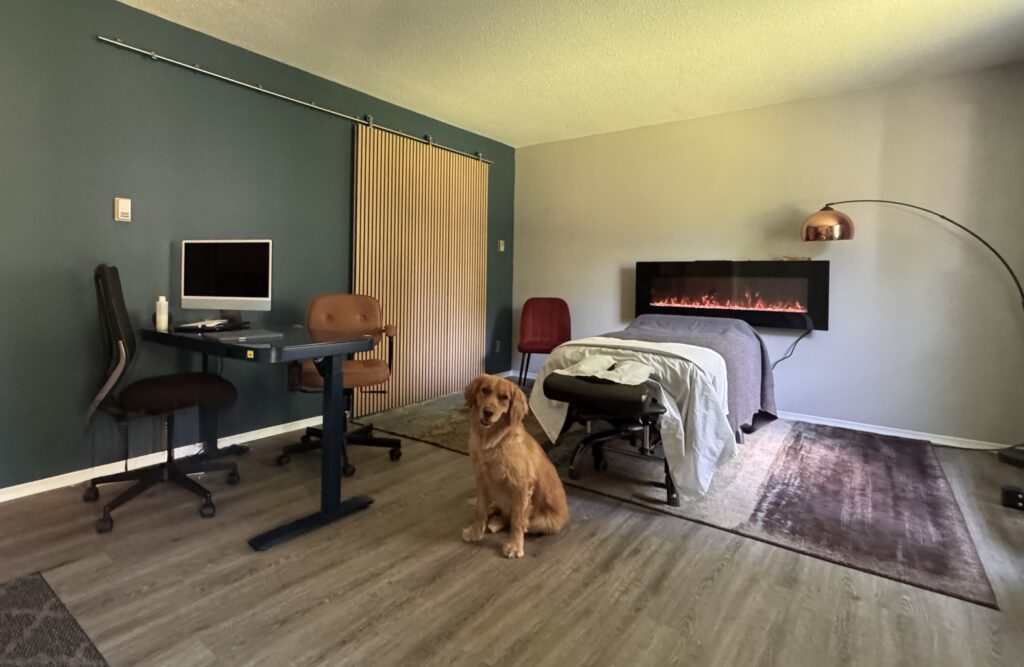
A piriformis-focused massage session is careful, gradual work on the deep gluteal and hip muscles, and it starts with one promise: you set the pressure, and you can adjust it, or stop, at any time. The glutes are strong muscles and the region is close to the sciatic nerve, so Bruno Panucci RMT works up the soft-through-medium-to-deep scale rather than starting hard. Deep pressure is on request, never the default, and pressure that reproduces a sharp, shooting, nerve-like pain is a signal to ease off, not push through. Expect work on the buttock, the hip, and often the lower back and hamstrings, since tension in the area rarely stays in one muscle. Treatment is in the private treatment room at his Brantford in-home practice, draped to College of Massage Therapists of Ontario standards, with two friendly, calm dogs that share the treatment room and can be kept out on request. A 60-minute session is $115, receipts work with most extended health plans, and because the practice runs from his own home the lower overhead keeps the price fair, so your benefits stretch further across a short series of visits if the work is helping.
When should you see a doctor instead?
You should see a doctor rather than book a massage when the signs point to a nerve or spinal problem instead of muscle tension. Buttock and leg pain has serious causes that massage cannot address, and imaging is often what tells them apart, as Wu and colleagues (2026) showed when an unexpected vascular cause explained pain that had resisted conservative care for over two years. See your physician promptly if you have numbness or weakness in the leg or foot, pain that shoots sharply down the leg, any loss of bladder or bowel control, numbness around the groin or saddle area, pain after a fall or injury, or symptoms that keep getting worse. Those are red flags, and they need a medical assessment first. Registered Massage Therapy can sit alongside your physician’s care as symptom support once serious causes have been ruled out, and Bruno Panucci RMT will tell you plainly when he thinks something belongs with your doctor rather than on the table.
Frequently asked questions
Can massage cure piriformis syndrome?
No. Massage does not cure piriformis syndrome, and it cannot release a trapped nerve or fix a spinal problem. What careful Registered Massage Therapy can do is ease the tightness in the deep gluteal and hip muscles that may be irritating the area, which for some people reduces buttock pain and makes movement easier. It is symptom support alongside your medical care, not a treatment for the condition itself.
How do I know if it is piriformis syndrome or sciatica?
You often cannot tell on your own, and a massage therapist should not claim to. The two overlap because both cause buttock and leg pain, but true sciatica involves the sciatic nerve, usually from the spine, while piriformis-type pain comes from the deep buttock muscles. Diagnosis needs a physician, sometimes with imaging. Bruno does not diagnose which one you have, and he will send you to your doctor if the picture looks nerve-driven.
Does the massage have to be deep and painful to work?
No. You set the pressure, and you can adjust it, or stop, at any time. Because the glutes sit close to the sciatic nerve, Bruno builds up from soft through medium to deep rather than starting hard, and deep pressure is always on request. Pressure that produces a sharp, shooting, nerve-like pain is a signal to ease off, not to push through.
How much is a session and are receipts provided?
A 60-minute session at Bruno’s Brantford in-home practice is $115. Receipts are provided for most extended health plans, and direct billing available for most insurers. If you want a shorter or a 90-minute session, or a time the online calendar does not show, text Bruno and he can often rearrange to fit you in, sometimes the same day.
Book a piriformis-focused massage with Bruno in Brantford
Bruno Panucci RMT offers focused, client-controlled Registered Massage Therapy for deep gluteal and hip tension at his in-home practice in Brantford, serving Brant County including Paris, St. George, Mt. Pleasant, and Burford, with occasional mobile visits on request. Sessions are $115 for 60 minutes, and pressure is always the one you choose, from soft through medium to deep. Receipts are provided for most extended health plans, with direct billing available for most insurers.
Text Bruno at 519-753-5544 (he prefers texts), call the same number, or book online. If you need a time the calendar does not show, a shorter session, or a 90-minute session, text him directly. He can often rearrange to fit you in, sometimes the same day.
A note on scope: This page is general information, not medical advice. Piriformis syndrome and sciatica can share symptoms, and only a physician can diagnose the cause; massage is symptom support, not a treatment or a cure. See your physician promptly if you have leg weakness or numbness, sharp shooting pain down the leg, any loss of bladder or bowel control, saddle-area numbness, or symptoms that keep getting worse. Bruno Panucci is a Registered Massage Therapist (RMT), and works within current RMT scope of practice.
Related reading
- when the pain is truly nerve-related
- easing hip and gluteal tension
- working out stubborn muscle knots
Sources
- Deshmukh N. Impact of Physiotherapy Intervention on Pain, Quality of Life, and Function in Low Back Pain Associated With Piriformis Syndrome: Protocol for Systematic Review. JMIR Research Protocols, 2026. doi.org/10.2196/72350
- Yoon YH, Hwang JH, Lee HW, Lee M, Park C, Lee J, Kim S, Lee J, de Castro JC, Lam KHS, Suryadi T, Youn KH. Beyond Nerve Entrapment: A Narrative Review of Muscle-Tendon Pathologies in Deep Gluteal Syndrome. Diagnostics, 2025. doi.org/10.3390/diagnostics15192531
- Wu WT, Hsu YC, Chang KV, Ozcakar L. Unusual Sciatic Nerve Entrapment by the Inferior Gluteal Artery. Diagnostics, 2026. doi.org/10.3390/diagnostics16111668
- Patel SJ, Shinde S, Thomas MS, Ambali MP, Kale HY. Effect of Low-Load, Long-Duration Stretching on Pain and Mobility in Sacroiliac Joint Dysfunction. Cureus, 2026. doi.org/10.7759/cureus.108987
- Dunning J, Butts R, Mourad F, Young I, Flannagan S, Perreault T. Dry needling: a literature review with implications for clinical practice guidelines. Physical Therapy Reviews, 2014; 19: 252-265. doi.org/10.1179/108331913×13844245102034
- College of Massage Therapists of Ontario, Standards of Practice.
- Government of Ontario. Massage Therapy Act, 1991, S.O. 1991, c. 27. ontario.ca/laws/statute/91m27