Bruno Panucci RMT
7 Signs Your Body Is Asking for a Massage
Quick answer: The most common signs you need a massage are shoulder and neck tension that builds through the day, headaches that start at the base of the neck, stiffness that limits easy movement, restless sleep, and stress you can feel in your muscles. Bruno Panucci RMT treats these at his in-home practice in Brantford, $115 for 60 minutes. Some signs, including numbness, fever, and unexplained pain, belong with a physician first, and this page says so plainly. This page is general information, not medical advice.
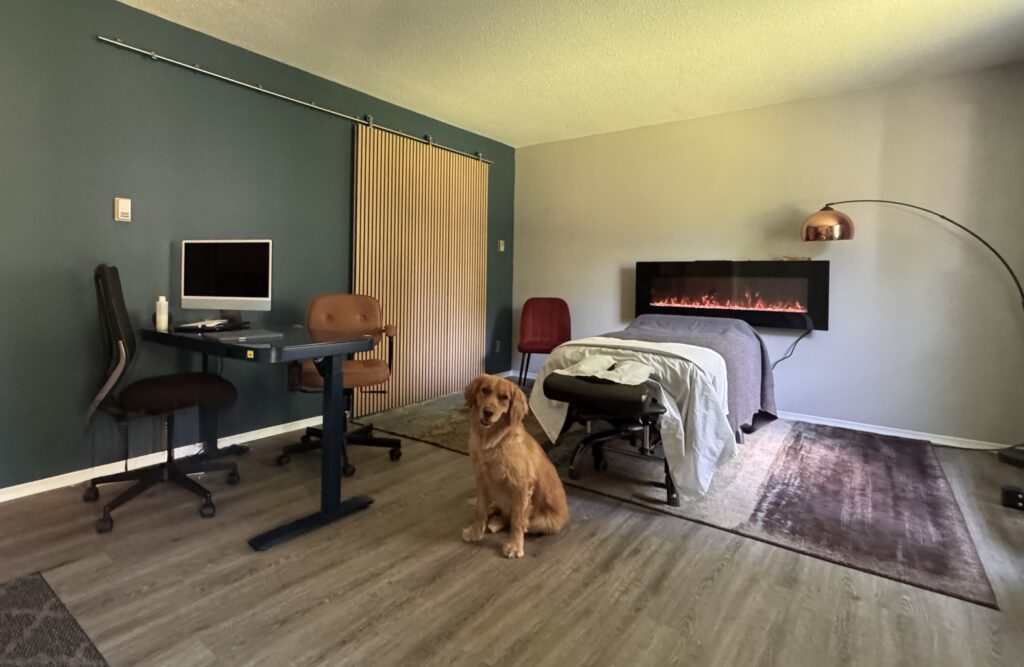
A body asks for help quietly before it asks loudly. Shoulders that sit an inch higher by Friday, a jaw that clenches in traffic, sleep that never quite settles: these are the everyday signals that muscle tension is accumulating faster than it is releasing. Bruno Panucci RMT has been reading those signals for 25 years as a Registered Massage Therapist, registered with the College of Massage Therapists of Ontario (CMTO), working from his in-home practice in Brantford and serving Brant County, including Paris, St. George, Mt. Pleasant, and Burford. If you already suspect you are overdue, how often a massage actually makes sense is covered honestly on its own page.
Bruno Panucci RMT, 25 years of practice: “Most people apologize on my table. They say sorry, I know it is bad back there, as if tension were a personal failing. It is not. It is a signal that arrived months ago and kept getting filed under later. I would rather see a shoulder when it starts complaining than after it has seized. And I will be just as straight the other way: if something has gone numb, or you have a fever, or a pain showed up out of nowhere, you do not need my table first. You need your doctor.”
In short: steady shoulder and neck tension, headaches that begin where the neck meets the skull, stiffness that limits ordinary movement, restless sleep, jaw clenching, tender knots, and a long gap since your last session are the usual signs a body is asking for massage. Numbness, fever, or unexplained pain call for a physician first.
6 min read
What are the signs you need a massage?
The signs you need a massage tend to build gradually rather than announce themselves, which is why so many people book only after the tension has become hard to ignore. Across 25 years of practice in Brantford, Bruno Panucci RMT sees the same seven signals more often than any others: A dedicated page for Mt. Pleasant and area residents covers the short drive north.
- Shoulder and neck tension that creeps up through the work day and sits higher by evening.
- Headaches that start at the base of the skull and wrap forward toward the temples.
- Stiffness that limits ordinary movement, like shoulder-checking in the car or reaching a high shelf.
- Restless sleep, or waking with the same tight spots you carried to bed.
- Stress you can feel physically: a clenched jaw, raised shoulders, shallow breathing.
- Tender, rope-like knots in the muscle that ache when you press them.
- A long gap since your last massage, with the familiar spots slowly reasserting themselves.
None of these is an emergency. They are maintenance signals, the body’s equivalent of a dashboard light, and Registered Massage Therapy is a reasonable, regulated response to them.
Shoulder and neck tension that builds through the day
Shoulder and neck tension is the sign Bruno Panucci RMT hears about most, and desk work is usually the author. Hours of keyboard posture hold the upper shoulders and neck in a low-grade contraction they were never designed to sustain, and by evening the muscles feel a size too small. Research supports treating a stubborn neck hands-on: in a randomized trial of 160 people with chronic neck pain, Gong and colleagues (2025) found that six sessions of manual therapy significantly improved active neck extension, and a general manual therapy approach performed as well as a specialized technique. In plain terms, careful hands-on work helped stiff necks move again, and no exotic method was required. When the tension gathers into distinct tender points that ache under a thumb, that is a subject of its own, and the guide to what muscle knots are and how massage addresses them covers it in depth.
Headaches that start at the base of the neck
Headaches that start at the base of the neck and wrap toward the temples are often tension-type headaches, and tight muscles where the neck meets the skull frequently sit underneath them. Massage therapy may help ease that muscular component. The honest word is “may”, because headaches have many causes and massage addresses only the soft-tissue share. In a session at his Brantford practice, Bruno works the neck, the shoulders, and the small muscles at the skull’s base. You set the pressure, and you can adjust it, or stop, at any time; the scale runs from soft through medium to deep, with the deepest work on request only. One caution belongs here plainly: a headache that is sudden and severe, unlike any you have had before, or paired with fever, vision changes, or confusion is not a massage booking. See your physician or emergency care first.
Restless sleep and stress you can feel in your muscles
Restless sleep and physical stress feed each other in a loop: tense muscle makes it harder to settle at night, and short sleep leaves muscle more reactive the next day. Excessive muscle stiffness is closely linked to chronic pain, as Sakato and Amitani (2025) note in their review of manual muscle-relaxation techniques, and their findings carry a reassuring detail for anyone dreading a heavy-handed session. Very gentle, low-load techniques produced immediate reductions in muscle stiffness and pain in the studies they reviewed, comparable to conventional manual therapies. You do not have to endure deep pressure for muscle to let go. That matches how Bruno Panucci RMT actually works: much of his 25 years has been spent on relaxation massage for stress relief, and the gentle end of the scale is as much his craft as the deep end. When stress is the main event rather than a side effect, how massage supports stress and anxiety is covered on its own page.
Low back ache that keeps coming back
Low back ache that eases for a while and then returns is one of the most familiar signs of all, and it is worth being honest about what the research does and does not say. Yuan and colleagues (2026) describe nonspecific low back pain as a significant global public health concern that limits daily activities and reduces quality of life, and their randomized trial protocol is part of an active research effort into massage-based treatment for it. The picture is similar around aching joints: Pan and colleagues (2026) note that the benefits of massage for knee osteoarthritis are documented, while evidence from objective biomechanical measures remains limited. That is the honest state of much massage research, encouraging and still maturing. So the claim Bruno Panucci RMT makes in Brantford is deliberately modest: Registered Massage Therapy can support comfort and ease the muscular side of a recurring ache. It does not cure the underlying condition, and anyone who promises otherwise is selling.
When the sign means a doctor first, not a massage
A doctor-first sign is any symptom that needs a diagnosis before hands-on work makes sense, and an honest page about the signs you need a massage has to include them. Numbness, tingling, or weakness can point to nerve involvement. Fever means the body is fighting something, and massage waits until you are well. Pain that appeared without any clear cause, wakes you at night, or followed a fall or collision needs assessment before anyone works on it. None of this is meant to alarm; most tension is exactly what it feels like, and a Registered Massage Therapist who sends you to a physician first is doing the job properly. That discipline is built into the profession: RMTs in Ontario work under the Massage Therapy Act, 1991 and the standards of the College of Massage Therapists of Ontario, and recognizing when a symptom belongs elsewhere is part of that scope. The flip side, when massage is the wrong call, is covered with equal honesty.
| What you notice | What it usually points to | Sensible first step |
|---|---|---|
| Gradual shoulder or neck tension after desk work | Overworked soft tissue | Massage therapy is a reasonable step |
| A familiar tension-type headache pattern | A muscular contribution from the neck | Massage may help; physician if the pattern changes |
| Numbness, tingling, or weakness | Possible nerve involvement | Physician first |
| Fever, chills, or feeling unwell | Illness, not muscle tension | Physician first; massage waits until you are well |
| Pain with no clear cause, or pain that wakes you at night | Needs a diagnosis before hands-on work | Physician first |
| Pain after a fall, collision, or other trauma | Possible injury that needs assessment | Physician first |
Frequently asked questions
How do I know if I need a massage or a doctor first?
A useful rule: gradual, familiar, activity-related tension is massage territory, while new, severe, or unexplained symptoms belong with your physician. Numbness, fever, unexplained pain, or pain after an injury should be assessed by a doctor before any hands-on work. Bruno Panucci RMT will tell you plainly if your situation calls for a physician first.
What happens if I ignore the signs and wait too long for a massage?
Nothing dangerous, in most cases. Tension is not damage, and waiting does not usually harm you. Muscles that have been tight for months simply tend to take more sessions to settle than muscles treated early, so booking sooner is a comfort decision, not a safety one.
I have not had a massage in years. Is there anything I should know?
Take a little less pressure your first time back. After a long gap, deep work can leave you sore the next day, the way any workout does after months off. Bruno Panucci RMT suggests starting soft to medium so you feel pleasant tenderness rather than soreness, then building from there.
How much does a massage cost in Brantford?
At Bruno Panucci RMT’s in-home practice in Brantford, a 60 minute session is $115. Receipts are provided for most extended health plans, and direct billing is available for most insurers. You can book online or text 519-753-5544.
Book a massage with Bruno in Brantford
If the signs on this page sound like your week, Bruno Panucci RMT provides Registered Massage Therapy at his in-home practice in Brantford, serving Brant County including Paris, St. George, Mt. Pleasant, and Burford, with occasional mobile visits on request. Sessions are $115 for 60 minutes, receipts work with most extended health plans, and direct billing is available for most insurers.
Text Bruno at 519-753-5544 (he prefers texts), call the same number, or book online. Need a time the calendar does not show, or a 90 minute or two hour session? Text him directly. He can often rearrange to fit you in, sometimes the same day.
A note on scope: This page is general information, not medical advice. Registered Massage Therapy can support comfort and ease muscle tension, but it does not treat or cure any condition. For numbness, fever, unexplained pain, pain after an injury, or any new or severe symptom, see your physician first. Bruno Panucci is a Registered Massage Therapist (RMT), and works within current RMT scope of practice.
Related reading
- a realistic massage schedule, honestly
- the truth about muscle knots
- when stress settles into the body
Sources
- Gong Z, Gao Y, Liu W, Li W, Wu X, Li J. Effectiveness of Jingjin Therapy for Non-Specific Chronic Neck Pain with Extension Dysfunction: A Randomised Controlled Trial. Journal of Pain Research, 2025. doi.org/10.2147/jpr.s515232
- Sakato T, Amitani H. The Muscle Relaxation Effects of Gentle, Focal Load (4.9-7.4 N) With a Narrow Contact Area: A Narrative Review of Kanshoho and Conventional Manual Therapies. Cureus, 2025. doi.org/10.7759/cureus.89646
- Yuan M, Guo G, Wang S, Yao F, Wang G, Xu H. Clinical Efficacy Evaluation of Tuina Combined Medicated Oil in the Treatment of Nonspecific Low Back Pain: Protocol for a Randomized Controlled Trial. JMIR Research Protocols, 2026. doi.org/10.2196/81887
- Pan F, Zhang M, Zhang G, Lu JH, Chen B, Wang G, Wang S, Zhan H. Effects of Massage on Pain, Muscle Co-Contraction, and Knee Loading in Medial Knee Osteoarthritis: A Randomized Controlled Trial Protocol. Journal of Pain Research, 2026. doi.org/10.2147/jpr.s584510
- College of Massage Therapists of Ontario, Standards of Practice.
- Government of Ontario. Massage Therapy Act, 1991, S.O. 1991, c. 27. ontario.ca/laws/statute/91m27