Bruno Panucci RMT
Upper Back Massage in Brantford: Between the Shoulder Blades
Quick answer: Upper back massage in Brantford, with Bruno Panucci RMT, is Registered Massage Therapy focused on the muscles between and around the shoulder blades, the rhomboids, the mid and lower trapezius, and the bands along the thoracic spine, that carry so much desk and posture tension. It can ease tightness, aching, and stiffness and help those muscles relax, at the pressure you choose from soft through medium to deep. It supports comfort alongside your physician’s care and does not cure any condition. This page is general information, not medical advice.
The upper back is the stretch of muscle between your shoulder blades and along the mid-spine, and it is where a surprising amount of everyday tension settles. Bruno Panucci RMT has spent 25 years as a Registered Massage Therapist in Brantford, and a large share of the people who reach him, across Brantford and Brant County towns like Paris, St. George, Mt. Pleasant, and Burford, point to the same place: the band between the shoulder blades that aches by mid-afternoon. Most upper back complaints are muscular rather than structural, which is exactly the tissue hands-on work addresses. This page explains what upper back massage does, who tends to benefit, and how a session runs, and it connects naturally to the wider work Bruno does across the back.
Bruno Panucci RMT, 25 years of practice: “People come in pointing right between the shoulder blades and say the knot is deep in there. Most of the time it is not one knot at all. It is the rhomboids and the middle of the trapezius holding a job they were never meant to do, keeping you upright over a keyboard for eight hours. So I do not go hunting for a single spot to crush. I warm the whole area, get those muscles to let go, and give the shoulder blades room to move again. That is usually what actually changes how your back feels the next day.”
In short: upper back massage is Registered Massage Therapy for the muscles between and around the shoulder blades and along the mid-spine. It aims to ease muscular tightness and aching and to restore easy movement, at a pressure the client controls. It supports comfort and function. It is not a cure, and lasting relief usually comes from combining it with movement and better daily posture.
6 min read
What is upper back massage, and what does it target?
Upper back massage is hands-on Registered Massage Therapy directed at the muscles of the mid and upper thoracic region, the area many people simply call between the shoulder blades. The main targets are the rhomboids, which sit between each shoulder blade and the spine, the middle and lower trapezius across the upper back, and the paraspinal bands that run alongside the thoracic spine. These are the muscles that hold your posture through a long day, and they are the ones that tend to tighten, ache, and feel knotted. Pain in this region is usually musculoskeletal rather than a sign of a spinal problem: in one survey of manual therapists across Belgium and the Netherlands, thoracic complaints seen in practice were reported as mostly muscular in origin, around 94 percent of cases (Sokolov and colleagues, 2026). That is why soft-tissue work suits the upper back so well. It also overlaps with the neck and shoulders, which is why upper back tension and neck and shoulder tightness so often travel together and are treated as one connected region. Undoing rounded-shoulder posture takes more than one muscle, as the posture page explains.
Can massage help upper back and between-the-shoulder-blade pain?
Massage can help ease upper back tension for many people, and the honest framing matters. Non-specific thoracic spine pain, meaning mid-back pain without a clear structural cause, is an under-recognised complaint linked to functional limitations and reduced quality of life, and conservative care such as manual therapy, exercise, and education is widely used to manage it (Kovanur Sampath and colleagues, 2026). Guideline evidence for the closely related neck region points the same way: European clinical practice guidelines give consistent, if modest, support to reassurance, advice and education, manual therapy, and exercise for neck pain, favouring hands-on and active approaches over medication or imaging for ordinary muscular pain (Corp and colleagues, 2021). What Bruno Panucci RMT sees in Brantford fits that picture. Regular, well-judged massage can loosen the rhomboids and trapezius, quiet the aching, and make the shoulder blades move more freely, and the relief lasts longer when it is paired with movement and small posture changes. Massage supports comfort and function. It does not cure any condition, and it is not a substitute for care your physician provides.
Why does the upper back ache from desk work?
Desk work aches in the upper back because the muscles between the shoulder blades spend hours holding you against gravity in one position. When the head drifts forward toward a screen and the shoulders round in toward a keyboard, the rhomboids and mid-trapezius work in a long, static stretch rather than moving freely, and static load is what leaves muscles tight and tender. This is why the ache builds through the afternoon and eases when you stand and move. It is also why the fix is rarely massage alone. Bruno pairs upper back work with plain advice: reset your posture often, roll the shoulders back, and get up to move on a timer, because guideline-backed care for this kind of pain leans on staying active as much as on hands-on treatment (Corp and colleagues, 2021). If your days are spent at a screen, the same tension pattern shows up in the neck and shoulders too, which is the focus of Bruno’s massage geared to desk-based workers.
| What you feel | How the session works with it |
|---|---|
| Aching band between the shoulder blades | Warming and broad strokes across the rhomboids and mid-trapezius before any focused work. |
| A spot that feels like a deep knot | Steady, held pressure at the level you choose, never a forceful dig, with the shoulder blade freed to move. |
| Tightness that spreads into the neck | The upper back, neck, and shoulders treated as one connected region rather than in isolation. |
| Stiffness worse by the end of a work day | Attention to posture muscles plus plain advice on movement breaks and screen setup. |
| Tenderness everywhere, easily overwhelmed | Pressure kept lighter, more check-ins, and a shorter session if that is what suits you. |
What does an upper back massage session look like?
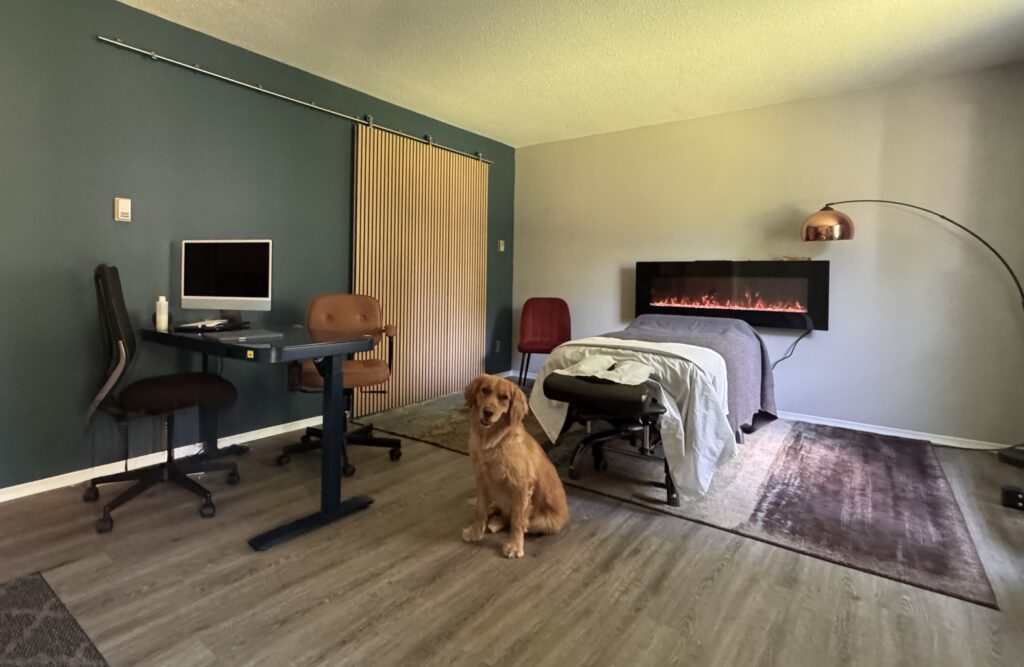
An upper back massage session starts with one promise: you set the pressure, and you can adjust it, or stop, at any time. Bruno Panucci RMT begins by warming the whole region with broader strokes before working into the rhomboids, trapezius, and the bands beside the spine, and he checks in as he goes rather than assuming more pressure is better. The scale runs from soft through medium to deep, and the deepest pressure is on request, never the default, because upper back tension usually releases with steady, patient work rather than force. Sessions run in the private treatment room at his in-home practice in Brantford, draped to College of Massage Therapists of Ontario standards, so only the area being worked on is uncovered. A 60-minute session is $115, and because the practice runs from Bruno’s own home the lower overhead keeps the price fair, so receipts stretch your extended health benefits further. Two friendly, calm dogs share the treatment room, and they can be kept out on request if you have allergies or would simply prefer it.
When upper back pain needs a doctor, not a massage
Upper back pain is usually muscular, but a few situations call for a physician rather than a massage. Because the mid-back sits over the chest and internal organs, pain that feels different from ordinary muscle ache deserves medical attention first. See your physician promptly if upper back or chest pain comes on suddenly and severely, arrives with shortness of breath, or spreads into the arm or jaw, and treat any pain with fever, unexplained weight loss, or a history of cancer as a reason to be checked before booking hands-on care. Manual therapists are taught to screen for these red flags before treating the thoracic region, with conditions such as fracture, metabolic bone disease, and metastatic disease recognised as reasons not to proceed with hands-on work (Sokolov and colleagues, 2026). Bruno Panucci RMT will always say plainly when something looks outside what massage should handle and point you toward the right care. Registered Massage Therapy is for the muscular aches, not for pain that might be coming from somewhere the hands cannot reach.
Frequently asked questions
Why does it always hurt right between my shoulder blades?
That spot is usually the rhomboids and the middle of the trapezius, the posture muscles that hold your shoulder blades in place through a long day at a screen. Held in one position for hours, they get tight and tender, so the ache feels deep and central. It is muscular far more often than it is a spine problem. Warming the whole area and freeing the shoulder blade to move tends to help more than digging at one point.
Do I need deep pressure to fix upper back tension?
No. You set the pressure, and you can adjust it, or stop, at any time. Upper back tension usually releases with steady, patient work rather than force, and the deepest pressure is on request, never the default. Bruno starts by warming the rhomboids and trapezius and works up only to the pressure that feels right to you. Deep work is available if you want it, but it is a choice, not a requirement.
Will one massage fix upper back pain from desk work?
One session can ease the aching, but lasting relief usually comes from pairing massage with movement and small posture changes. The upper back aches because the posture muscles are held static for hours, so resetting your posture, moving on a timer, and getting up regularly matter as much as the hands-on work. Bruno gives that plain advice alongside the massage rather than promising a single visit will solve it.
Could my upper back pain be something more serious?
Usually it is muscular, but some pain needs a doctor first. See your physician promptly if upper back or chest pain comes on suddenly and severely, arrives with shortness of breath, or spreads into the arm or jaw, or if pain comes with fever, unexplained weight loss, or a history of cancer. Massage is for muscular aches. Bruno will say plainly when something looks outside what massage should handle.
Book an upper back massage with Bruno in Brantford
Bruno Panucci RMT offers upper back and interscapular Registered Massage Therapy at his in-home practice in Brantford, serving Brant County including Paris, St. George, Mt. Pleasant, and Burford, with occasional mobile visits on request. Sessions are $115 for 60 minutes, at the pressure you choose from soft through medium to deep. Receipts are provided for most extended health plans, with direct billing available for most insurers.
Text Bruno at 519-753-5544 (he prefers texts), call the same number, or book online. If you need a time the calendar does not show, a shorter session, or a 90-minute session, text him directly. He can often rearrange to fit you in, sometimes the same day.
A note on scope: This page is general information, not medical advice. Registered Massage Therapy can support comfort and ease muscular tension, but it is not a cure for any condition. See your physician promptly for upper back or chest pain that is sudden and severe, comes with shortness of breath, spreads into the arm or jaw, or arrives with fever, unexplained weight loss, or a history of cancer. Bruno Panucci is a Registered Massage Therapist (RMT), and works within current RMT scope of practice.
Related reading
- where upper back and neck tension meet
- massage across the whole back
- easing the screen-and-keyboard ache
Sources
- Sokolov A, Beyer B, Van Trijffel E, Scafoglieri A. Knowledge and use of thoracic manipulations by manual therapists in Belgium and the Netherlands. Journal of Manual and Manipulative Therapy, 2026. doi.org/10.1080/10669817.2025.2559023
- Kovanur Sampath K, Fleischmann M, Vaughan B. Outcome measures used in the conservative management of people with non-specific thoracic spine pain (NTSP): a scoping review protocol. BMJ Open, 2026. doi.org/10.1136/bmjopen-2025-114437
- Corp N, Mansell G, Stynes S, Wynne-Jones G, Morso L, Hill JC, van der Windt DA. Evidence-based treatment recommendations for neck and low back pain across Europe: a systematic review of guidelines. European Journal of Pain, 2021; 25: 275-295. doi.org/10.1002/ejp.1679
- College of Massage Therapists of Ontario, Standards of Practice.
- Government of Ontario. Massage Therapy Act, 1991, S.O. 1991, c. 27. ontario.ca/laws/statute/91m27