Bruno Panucci RMT
Calf and Achilles Massage in Brantford: Tight Lower Legs
Quick answer: Calf and Achilles massage in Brantford, with Bruno Panucci RMT, is Registered Massage Therapy that eases tight, sore, or overworked lower-leg muscles using the pressure you choose, from soft through medium to deep. Hands-on soft-tissue work can settle calf tightness and muscle soreness, but it does not fix Achilles tendon problems and is never used on a hot, swollen calf. It supports comfort alongside your doctor’s care and does not cure any condition. This page is general information, not medical advice.
The calf is really two muscles, the gastrocnemius and the soleus, that join into the Achilles tendon at the heel, so tightness in the lower leg can come from the muscle, the tendon, or both. Bruno Panucci RMT has spent 25 years as a Registered Massage Therapist in Brantford, working on tight, overworked lower legs for runners, walkers, gardeners, and people on their feet all day, across Brantford and the Brant County towns of Paris, St. George, Mt. Pleasant, and Burford. He treats calf and Achilles complaints from his private in-home practice, and the work often overlaps with the sports-recovery massage active clients book after hard training.
Bruno Panucci RMT, 25 years of practice: “The calf is one of the few places where the first thing I do is decide whether to keep my hands off it. If a calf is hot, swollen, and tender for no clear reason, that is a doctor’s visit, not a massage. Once we have ruled that out, a tight calf usually loosens up nicely. But I will be straight with people: the massage buys you comfort, and the dull heel-drop exercises are what actually rebuild a cranky calf or Achilles. I would rather tell you that than sell you a standing weekly appointment.”
In short: calf and Achilles massage is Registered Massage Therapy that eases tight, tired, or sore lower-leg muscles and the tissue around the Achilles tendon. It can relieve muscle tension and post-exercise soreness, but it does not cure tendon injuries, and a painful, swollen calf should be seen by a doctor before any massage.
6 min read
What does calf and Achilles massage do for tight lower legs?
Calf and Achilles massage is hands-on soft-tissue work focused on the gastrocnemius and soleus muscles and the tissue around the Achilles tendon, meant to ease tightness, tension, and everyday soreness. You set the pressure, and you can adjust it, or stop, at any time. Bruno starts at the soft to medium end of the soft-through-medium-to-deep scale and works deeper only if you ask, since a guarding, overworked calf rarely responds well to force. The evidence on post-exercise soreness is encouraging here. In a small randomized pilot study, a single session of Active Release Technique, a hands-on soft-tissue technique, significantly lowered pain and raised the pressure pain threshold in the calf after exercise-induced soreness in amateur football players, though the authors rightly call it a pilot to read with caution (Dimoulias and colleagues, 2026). That matches what soft-tissue work tends to do in practice: it can settle the muscle, ease the ache, and help a tight lower leg move more comfortably. If you want to know what a session costs and how long it runs, the rates and lengths are listed on the services page. Massage eases symptoms. It does not cure a calf or Achilles condition. The sudden version, night cramps and charley horses, is a different problem with its own page.
Why the Achilles tendon needs a more careful approach
The Achilles tendon behaves differently from the calf muscles, which is exactly why it is treated with care rather than worked hard. When the lower leg is stretched, the Achilles tendon starts resisting from the very earliest part of the range and stiffens faster than the gastrocnemius, lateral gastrocnemius, and soleus, so the tendon, not the muscle, governs the first resistance you feel (Kunita and colleagues, 2026). A tendon is not a knot to be pressed out. When the Achilles itself is painful, the problem is usually managed with graded loading rather than deep pressure. In a randomized controlled trial in people with non-insertional Achilles tendinopathy, both eccentric and concentric exercise produced comparable improvements in pain and function over six weeks, with eccentric exercise a widely recognized treatment (Contreras-Hernandez and colleagues, 2025). So Bruno works the calf muscles and the surrounding tissue to ease the pull on the tendon and keep you comfortable, while the tendon problem itself is guided by your physician or an exercise program. Sharp, localized Achilles pain, or a sudden pop with trouble pushing off, is a reason to be assessed before any massage. For tendonitis in general, wherever it shows up, there is an umbrella guide.
What makes calves tight, and can massage help?
Tight calves usually come from load and overuse rather than anything sinister: long runs, new mileage, a day of ladders and gardening, standing shifts, or simply calves that never get stretched. A common calf muscle injury, medial gastrocnemius strain or “tennis leg,” is now understood to involve the connective tissue and fascia around the muscle, not only torn fibres, and the authors of one 2025 review describe manual therapy, aimed at restoring fascial continuity and posterior-chain function, as a complementary part of a rehabilitation program built on progressive loading and normal healing timelines (Colonna and colleagues, 2025). Because everything in the lower leg is connected, calf tightness rarely stays put. Tight calves and plantar-fasciitis heel pain often travel together, since the same posterior chain runs from the calf into the sole of the foot. And because the gastrocnemius crosses the back of the knee, a chronically tight calf can feed into knee discomfort as well. Massage can ease the muscle tension in all of this. It supports the tissue and your comfort, but it works best alongside stretching, movement, and medical guidance, not instead of them.
Massage supports your calves, it does not replace loading them
This is the honest limit worth stating plainly: massage can ease a tight or sore calf, but it does not build the strength that keeps the calf and Achilles healthy. Strength comes from loading the muscle. In a randomized controlled trial, an eight-week eccentric heel-drop program increased medial gastrocnemius thickness and fascicle length and improved jump performance in young athletes, changes that massage simply cannot produce (Gözener Canbülbül and Şakul, 2026), and graded loading is likewise the mainstay for a grumpy Achilles (Contreras-Hernandez and colleagues, 2025). Where massage earns its place is in comfort and continuity. Easing the ache and tension can make it easier to keep doing the heel-drop and calf-raise homework that actually rebuilds the tissue, so the two work together rather than compete. Bruno will tell you when a session is the right call and when your time is better spent on the exercises. That kind of straight talk is the point of seeing a Registered Massage Therapist rather than chasing a quick fix.
When tight calf or Achilles pain means see your doctor first
Most tight calves are harmless, but a few lower-leg problems are medical, not muscular, and massage is the wrong tool for them. See a doctor before booking a massage if any of these are true. A calf that is hot, swollen, red, and tender, especially on one side and without a clear injury, can signal a blood clot, or deep vein thrombosis, which is a medical emergency and must never be massaged. A sudden pop at the back of the ankle or calf with sharp pain and difficulty pushing off or standing on your toes can mean a torn Achilles tendon or calf muscle and needs prompt assessment. Numbness, tingling, coldness, or a change in the colour of the foot also belong with a physician first. As part of Registered Massage Therapy, Bruno screens for these before he treats, following College of Massage Therapists of Ontario standards, and he will send you to a doctor rather than work on a leg that needs medical care. When your calf is simply tight, tired, or sore, massage is a reasonable and comfortable choice.
Frequently asked questions
Can massage loosen a tight calf?
Often, yes. A tight calf from running, standing, or overuse tends to respond well to soft-tissue work, which can ease the tension and soreness and help the lower leg move more comfortably. Bruno starts light and adds pressure only if you ask, since a guarding calf rarely likes force. Massage eases the symptom, and stretching and calf exercises do the longer-term work.
Is it safe to massage the Achilles tendon?
The tendon itself is not something to press hard on, and a painful Achilles is not a knot to work out. Bruno focuses on the calf muscles and the tissue around the tendon to ease the pull on it, while an irritated Achilles is best managed with graded loading exercise and your physician’s guidance. Sharp Achilles pain, or a sudden pop with trouble pushing off, should be assessed before any massage.
Should I get a calf massage if my calf is swollen and painful?
No, not before seeing a doctor. A calf that is hot, swollen, red, and tender, especially on one side and without a clear injury, can be a sign of a blood clot, which is a medical emergency and must never be massaged. Bruno screens for this and will send you to a doctor rather than treat a leg that needs medical care.
How much is a calf and Achilles massage session in Brantford?
A 60-minute session at Bruno’s in-home practice in Brantford is $115, draped to College of Massage Therapists of Ontario standards, with the pressure your choice from soft through medium to deep. Receipts are provided for most extended health plans. To book, text Bruno at 519-753-5544, since he prefers texts, or book online.
Book a calf and Achilles massage with Bruno in Brantford
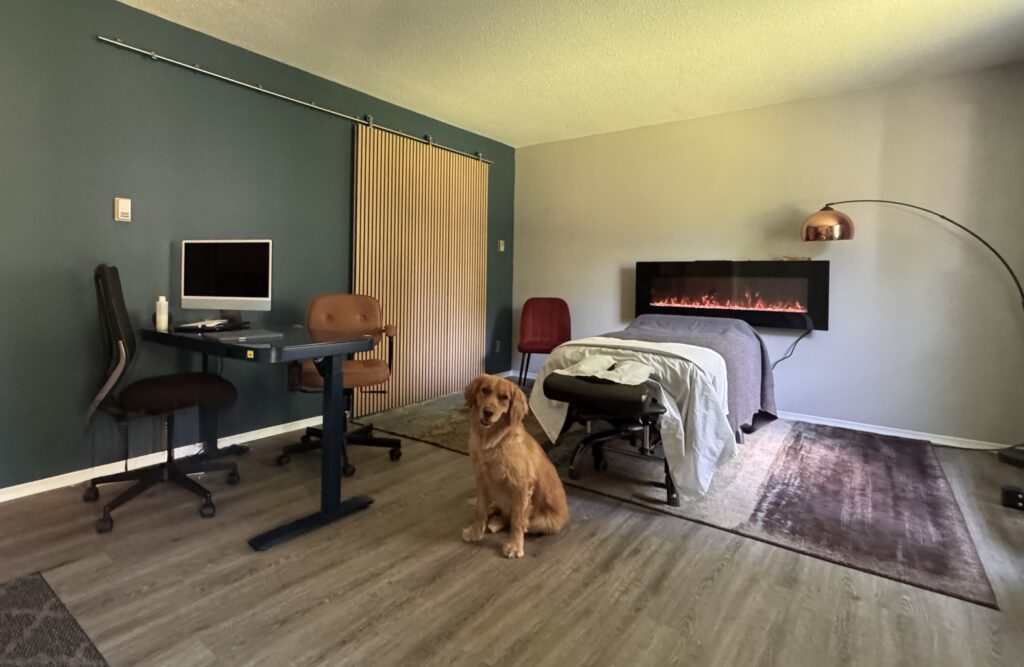
Bruno Panucci RMT offers Registered Massage Therapy for tight calves and lower-leg tension at his in-home practice in Brantford, serving Brant County including Paris, St. George, Mt. Pleasant, and Burford, with occasional mobile visits on request. A 60-minute session is $115, draped to College of Massage Therapists of Ontario standards, and the pressure stays your choice from soft through medium to deep. Two friendly, calm dogs share the treatment room and can be kept out on request. Receipts are provided for most extended health plans, with direct billing available for most insurers.
Text Bruno at 519-753-5544 (he prefers texts), call the same number, or book online. If the calendar does not show a suitable time, or you want a shorter visit or a 90-minute session, text him directly. He can often rearrange to fit you in, sometimes the same day.
A note on scope: This page is general information, not medical advice. Registered Massage Therapy can ease muscle tightness and soreness in the calf, but it does not cure tendon injuries or any other condition, and it is not appropriate for a suspected blood clot. If your calf is hot and swollen, if you felt a sudden pop, or if the pain persists, stop and see your physician. Bruno Panucci is a Registered Massage Therapist (RMT), and works within current RMT scope of practice.
Related reading
- Sports massage and recovery in Brantford
- Massage for plantar fasciitis and heel pain
- Massage for knee pain and stiffness
- What to expect on your first visit
Sources
- Colonna S, Casacci F, Minafra P, Basile N. Muscle or Fascial System Lesion (Part II): The Medial Gastrocnemius and the “Tennis Leg” Paradigm. Cureus, 2025. doi.org/10.7759/cureus.93994
- Kunita Y, Ikeda N, Nishioka T, Yamaguchi S, Yoshikawa A, Hajima D, Yabuno N, Harato K, Inami T. Angle-specific stiffness profiles of the Achilles tendon and triceps surae muscles: a continuous characterization. Frontiers in Sports and Active Living, 2026. doi.org/10.3389/fspor.2026.1728114
- Contreras-Hernandez I, Falla D, Arvanitidis M, Negro F, Jimenez-Grande D, Martinez-Valdes E. Eccentric and Concentric Torque Feedback Training Induce Similar Clinical Improvements but Distinct Triceps Surae Motor Unit Adaptations in Non-Insertional Achilles Tendinopathy: A Randomized Controlled Trial. medRxiv (preprint), 2025. doi.org/10.1101/2025.06.20.25330016
- Gözener Canbülbül S, Şakul BU. Architectural and Functional Adaptations to Eccentric Training in Adolescent Volleyball Players: A Randomized Controlled Trial. Sports, 2026. doi.org/10.3390/sports14030092
- Dimoulias T, Krekoukias G, Moutzouri M, Plakoutsis G, Paraskevopoulos E, Papandreou M. Effects of a Single Session of Active Release Technique on Gastrocnemius Delayed-Onset Muscle Soreness in Male Amateur Football Athletes: A Randomized Split-Body Pilot Study. Healthcare, 2026. doi.org/10.3390/healthcare14111581
- College of Massage Therapists of Ontario, Standards of Practice.
- Government of Ontario. Massage Therapy Act, 1991, S.O. 1991, c. 27. ontario.ca/laws/statute/91m27