Bruno Panucci RMT
Scar Tissue Massage in Brantford: Gentle Work After Healing
Quick answer: Scar tissue massage in Brantford, with Bruno Panucci RMT, is gentle, hands-on Registered Massage Therapy for a scar that has fully healed, meant to ease tightness and help the area move more comfortably. The evidence is limited and mostly modest, so it supports comfort and flexibility rather than erasing a scar or speeding healing. Always let a new scar close first, and check with your surgeon. This page is general information, not medical advice.
Scar tissue massage, sometimes called scar mobilization, is gentle work on and around a healed scar to keep the skin and the layers beneath it soft, mobile, and comfortable. Bruno Panucci RMT has spent 25 years as a Registered Massage Therapist in Brantford, working with scars from surgery, injury, and burns for clients across Brantford and Brant County towns like Paris, St. George, Mt. Pleasant, and Burford. At his in-home practice this is patient, low-pressure Registered Massage Therapy, and for many people it pairs naturally with gentle post-surgical swelling work as the body settles after an operation. It supports comfort and movement. It does not erase a scar or replace your surgeon’s care.
Bruno Panucci RMT, 25 years of practice: “A scar is not the enemy, and my job is not to break it up, no matter what you have read online. Once it has fully healed, I work slowly to keep the area soft and mobile, at a pressure you choose. If a scar is still new, still healing, or angry looking, the honest answer is that we wait and you check with your surgeon first. Patience does more for a scar than force ever will.”
In short: scar tissue massage is gentle, hands-on therapy for a fully healed scar, aimed at easing tightness and improving how the area feels and moves. The research is limited and the benefits are modest, so it manages comfort rather than curing anything. It always waits until a scar has closed.
6 min read
What is scar tissue massage?
Scar tissue massage is a gentle, hands-on technique that works on a healed scar and the tissue around it, using slow, light movements to encourage the skin, fascia, and underlying layers to glide more freely. When the body heals a wound, it lays down collagen quickly to close the gap, and that repair tissue can end up tighter, thicker, or more stuck to the layers beneath than the skin around it. Scar mobilization aims to ease that tightness and improve comfort and movement, and it overlaps with the slow fascial work Bruno uses elsewhere in the body. Mechanical load is one of the recognized factors in how scar tissue forms and remodels, and gentle tension-based approaches such as massage are among the strategies long used to influence it (Zhang and colleagues, 2022). What massage does not do is dissolve a scar, flush anything out, or make a scar disappear. It works with tissue that has already healed, at the surface and just below it.
Does scar tissue massage actually work?
Scar tissue massage can help some people feel less tightness and more ease around a scar, but the honest evidence is thin and worth stating plainly. A 2025 scoping review of physical therapies for scars found massage among the most commonly reported approaches, yet concluded that the research is highly variable, that many studies were small or lacked control groups, and that nearly half rested on expert opinion rather than strong trials (Di Serio and colleagues, 2025). A long-standing review of scar management similarly notes that after a wound has healed, massage is frequently used alongside pressure therapy and silicone, but that the benefits of many of these long-used treatments remain unclear (Aarabi and colleagues, 2007). At the smaller-scale end, a 2025 case report described scar massage started after a lip laceration had healed, with improved collagen remodelling and better flexibility, though a single case cannot prove a general rule (Abualadas, 2025). So the realistic promise is modest: massage may make a healed scar feel softer, less tight, and more comfortable to move, and it will not erase the scar or speed the body’s healing.
When can you start scar massage after surgery?
Scar massage after surgery starts only once the scar has fully closed and healed, not while a wound is still open, scabbed, or draining. The case report above began scar massage only after the wound had healed, which is the standard order of things (Abualadas, 2025). Most surgeons give a rough timeline, often several weeks, and that guidance comes first: if your surgeon has set a date or told you to wait, follow them, not a website. Some scars sit over sensitive areas. After a cesarean, for example, the surgical scar is one of the most common sites of localized pain in the immediate period right after surgery (Mazzoni and colleagues, 2026), which is exactly why gentle, later, cleared-by-your-doctor work matters more than rushing in. Bruno Panucci RMT would rather you wait an extra two weeks than start too soon. When you do begin, it is light and gradual, and it often pairs with easing any lingering post-surgical swelling once the area is ready.
What does a scar tissue massage session look like in Brantford?
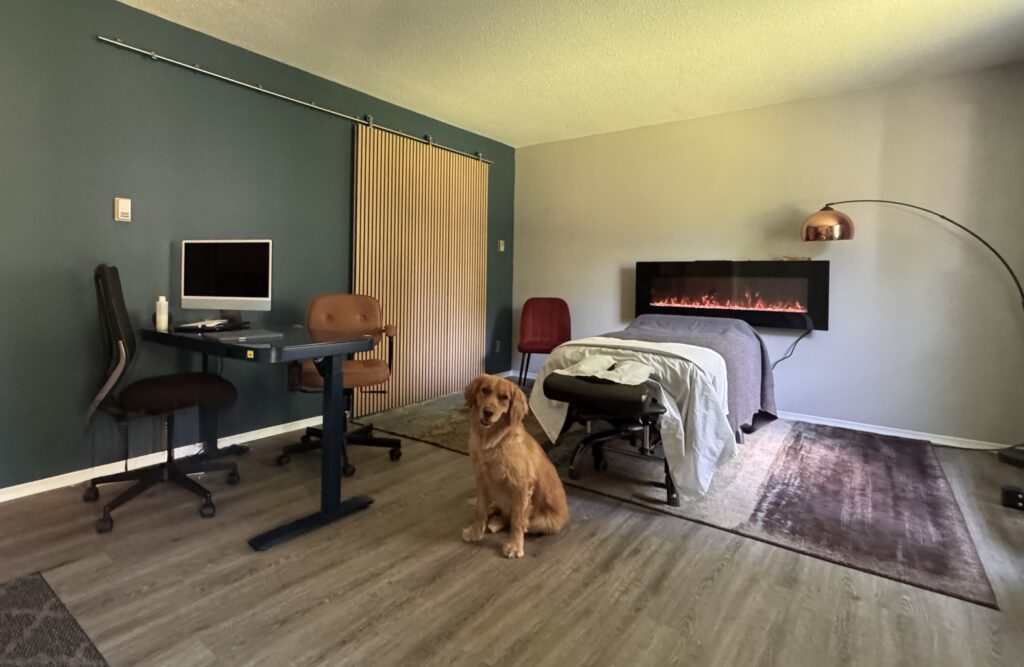
A scar tissue massage session at Bruno’s Brantford in-home practice is quiet, unhurried, and built around your comfort. You set the pressure, and you can adjust it, or stop, at any time. Scar work sits at the soft end of the soft-through-medium-to-deep scale, and deeper pressure is on request and rarely the right tool for a scar. Bruno starts by looking at how the scar and the surrounding tissue move, then uses slow, light strokes to encourage the area to soften and glide. Where a scar has left the nearby muscle guarded or tight, the session may also ease the surrounding muscle tension that builds up from protecting the area. Sessions run in a private treatment room, draped to College of Massage Therapists of Ontario standards, and two friendly, calm dogs share the room and can be kept out on request. A 60-minute session is $115, and receipts are provided for most extended health plans.
| May be ready for gentle scar massage | Wait and check with your doctor first |
|---|---|
| The scar is fully closed with no open areas | Any open wound, scab, or drainage |
| The scar is weeks to months old and healing well | The scar is new, or your surgeon set a later date |
| Skin is intact and the colour is settling | Spreading redness, heat, swelling, or pus, which can signal infection |
| Mild tightness or slightly restricted movement | Sharp or increasing pain, or a raised scar growing beyond the wound |
| Your surgeon has cleared hands-on work | You have not been cleared yet, or you are unsure |
When should you wait or talk to your doctor first?
Scar tissue massage is not right for every scar or every moment, and knowing when to wait is part of doing it safely. Stop and speak with your physician if a scar becomes hot, increasingly red, swollen, or starts to drain, since those can be signs of infection rather than simple tightness. Some scars also grow differently: a raised, thickened scar that stays within the original wound is called hypertrophic, while a keloid overgrows beyond the wound’s edges, and both are managed medically rather than massaged away (Aarabi and colleagues, 2007). Massage may still have a gentle, comfort-focused role for some of these once a doctor is involved, but that is a conversation to have with your surgeon or dermatologist first. If you have a diagnosed skin condition, reduced sensation, or a scar you are unsure about, start there. Registered Massage Therapy supports comfort and movement. It does not treat or cure any condition.
Frequently asked questions
How long after surgery can I have scar tissue massage?
Wait until the scar has fully closed and healed, with no open areas, scabs, or drainage, and follow any timeline your surgeon gave you. That is often several weeks, but it varies by procedure and by person. If you are unsure, ask your surgeon first, then Bruno will check the area before starting and keep the work gentle.
Does scar tissue massage hurt?
It should not. Scar work sits at the soft end of the pressure scale, and you set the pressure and can adjust it, or stop, at any time. You might feel mild tightness or tenderness as the area softens, but sharp or increasing pain is a signal to ease off, not to push through.
Can massage get rid of a scar completely?
No. Scar tissue massage may help a healed scar feel softer, less tight, and easier to move, but it does not erase a scar or speed up healing. The research behind it is limited and the benefits are modest, so it is best thought of as comfort and movement support, not a cure.
Is scar massage covered by insurance in Brantford?
Registered Massage Therapy with Bruno Panucci RMT comes with a receipt that works with most extended health plans, and receipts include his name and RMT designation. Direct billing is available for most insurers. Coverage depends on your specific plan, so it is worth checking your benefits before you book.
Book scar tissue massage with Bruno in Brantford
Bruno Panucci RMT offers gentle, patient scar tissue massage as Registered Massage Therapy at his in-home practice in Brantford, serving Brant County including Paris, St. George, Mt. Pleasant, and Burford, with occasional mobile visits on request. Sessions are $115 for 60 minutes, and the work stays light and led by you. Receipts are provided for most extended health plans, with direct billing available for most insurers.
Text Bruno at 519-753-5544 (he prefers texts), call the same number, or book online. If you need a time the calendar does not show, a shorter session, or a 90-minute session, text him directly. He can often rearrange to fit you in, sometimes the same day.
A note on scope: This page is general information, not medical advice. A scar and the surgery or injury behind it belong with your physician or surgeon; massage is comfort and movement support once the area has healed, not a treatment or a cure. See your physician before starting scar massage, and stop and seek care if a scar becomes hot, spreading-red, swollen, or begins to drain. Bruno Panucci is a Registered Massage Therapist (RMT), and works within current RMT scope of practice.
Related reading
- Easing swelling after an operation
- How slow fascial work is different
- Working out the tension around a scar
- Rates and session lengths
Sources
- Di Serio S, Congiu M, Minnucci S, Scalise V, Mourad F. Current physical therapy for skin scar management: a scoping review. Journal of Clinical Medicine, 2025; 14(17): 5920. doi.org/10.3390/jcm14175920
- Aarabi S, Longaker MT, Gurtner GC. Hypertrophic scar formation following burns and trauma: new approaches to treatment. PLoS Medicine, 2007; 4(9): e234. doi.org/10.1371/journal.pmed.0040234
- Abualadas HM. Beyond sutures: moist exposed burn ointment (MEBO) and scar massage for anatomical restoration of penetrating upper lip laceration at the vermilion-cutaneous junction in primary care, a case report. Clinical Medicine Insights: Case Reports, 2025. doi.org/10.1177/11795476251370546
- Zhang Q, Shi L, He H, et al. Down-regulating scar formation by microneedles directly via a mechanical communication pathway. ACS Nano, 2022; 16: 10163-10178. doi.org/10.1021/acsnano.1c11016
- Mazzoni CRR, Meirelles MCCC, de Araújo ACRP, Nicolussi AC, Ruiz MT. Physiotherapy protocol for pain in the immediate postcesarean postpartum: randomized clinical trial. Obstetrics and Gynecology International, 2026. doi.org/10.1155/ogi/5179249
- College of Massage Therapists of Ontario, Standards of Practice.
- Government of Ontario. Massage Therapy Act, 1991, S.O. 1991, c. 27. ontario.ca/laws/statute/91m27