Bruno Panucci RMT
Massage for Gamers in Brantford: Wrists, Neck, Sessions
Quick answer: Massage for gamers targets the specific load long sessions place on the wrists, thumbs, forearms, neck, and upper back. Research on esports players documents high rates of pain in exactly those regions. Bruno Panucci RMT treats gaming-related muscle tension at his Brantford in-home practice, $115 for 60 minutes, at the pressure you choose from soft through medium to deep. Massage may ease the tension; it does not treat nerve conditions, and numbness or tingling belongs with a physician first. This page is general information, not medical advice.
Massage for gamers is Registered Massage Therapy aimed at the pattern that hours of mouse, keyboard, or controller time build: forearms that never fully switch off, thumbs and wrists doing thousands of small repetitions, a neck held forward toward a monitor, and an upper back that quietly holds the whole posture together. Bruno Panucci RMT has spent 25 years working on soft-tissue tension, and the gaming version of it now shows up at his Brantford in-home practice the way desk-work tension always has, from players across Brant County, Paris, St. George, Mt. Pleasant, and Burford. The load is real and measurable: a systematic review of professional esports athletes found musculoskeletal disorders in 26.8% to 86.2% of players, with the lower back, shoulders, neck, and wrists the most commonly affected regions (Schlesiger and colleagues, 2026). The wrist and hand side of that picture overlaps heavily with the carpal tunnel and wrist-tension work Bruno already does for keyboard workers.
Bruno Panucci RMT, 25 years of practice: “A serious player’s forearm feels like a tradesperson’s, and I mean that literally. The grip muscles are dense and worked, just from a mouse instead of a tool. What surprises people is how much of their wrist complaint I find higher up, in the forearm and the shoulder that positions the arm all night. I treat the chain, not just the spot that aches, and I will tell you straight when a symptom needs a doctor before it needs me.”
In short: long gaming sessions load the wrists, thumbs, forearms, neck, and upper back through thousands of small repetitions held in one sustained posture. Studies of esports players report pain in most of them over a year, concentrated in the spine and upper limbs. Massage may ease that muscular tension; nerve symptoms like numbness or tingling need a physician first.
6 min read
What does long-session gaming actually do to the body?
Long-session gaming combines two mechanical problems at once: a sustained posture held for hours, and a very high count of small, repeated movements inside that posture. The research on esports players describes exactly this pairing. A systematic review and meta-analysis found a one-year pain prevalence of 73% among esports players, with a seven-day prevalence of 44%, and identified the spine and upper extremities as the most affected regions (Soffner and colleagues, 2026). That is not a niche complaint; it is most players over the course of a year. The same body of research points at the mechanisms a Registered Massage Therapist would expect: longer training durations and inadequate ergonomic setups, such as missing armrests, were significantly associated with musculoskeletal symptoms (Schlesiger and colleagues, 2026). None of this means gaming is dangerous. It means the body treats an eight-hour playing session the way it treats any other sustained occupational load, and it responds well to the same things: breaks, setup changes, and hands-on work on the tissue that is holding the position. The seated pattern itself, head forward and shoulders rounded, is the same one Bruno Panucci RMT maps on office workers who sit for a living.
Which regions take the load: wrists, thumbs, neck, or back?
The load lands in a predictable set of regions, and studies from several countries point to the same regions, though the reported rates vary widely between studies and appear to differ by platform and region. In the esports meta-analysis, neck pain reached 48% and wrist pain 37% among players (Soffner and colleagues, 2026). A large survey of 593 gamers in Saudi Arabia found musculoskeletal pain in 78.2%, led by the neck at 49.4% and the lower back at 40.0%, with professional players reporting more wrist and hand pain than casual players (Alqabbani and colleagues, 2026). A Brazilian study of 365 esports players found the upper limb was the most commonly injured region, with the wrist alone accounting for 28.49% of reported injuries, and both years of practice and weekly practice frequency associated with higher injury odds (Anselmo-E-Silva and colleagues, 2026). Read together, the pattern is clear: the neck and upper back hold the posture, and the wrists, thumbs, and forearms do the repetitions. Controller players concentrate the work in the thumbs and thumb-side forearm; mouse-and-keyboard players load the mouse-side wrist and shoulder harder than the other. The head-forward position itself is a whole-body pattern, and it is covered properly on the posture page.
How can massage help gamers, honestly?
Massage for gamers is muscle work, and it should be described honestly as muscle work. Registered Massage Therapy may ease the tension in the forearms, wrist flexors and extensors, thumbs, neck, and upper back that long sessions build, and many people find that relief lasts days to weeks. It does not cure anything, it does not repair a nerve, and it does not replace the two things the esports research keeps recommending: regular breaks during prolonged sitting and a better ergonomic setup (Soffner and colleagues, 2026). What a skilled session adds is direct, specific work the setup changes cannot do, releasing the grip muscles from wrist to elbow, the base of the thumb, the upper trapezius muscles holding the head forward, and the chest tissue anchoring the rounded shoulders. You set the pressure. You can adjust it, or stop, at any time. The scale runs from soft through medium to deep, and deep work is on request, never the default; overworked forearms usually respond better to patient, moderate pressure than to force. Bruno Panucci RMT treats the chain in one 60-minute session at his Brantford in-home practice, draped to College of Massage Therapists of Ontario standards, with consent for each area of work.
When is gaming pain a physician problem, not a massage problem?
Gaming pain crosses out of massage territory the moment it stops being muscular ache and starts being nerve symptoms. Numbness, tingling, pins and needles in the fingers, a hand that feels weak or clumsy, or symptoms that wake you at night deserve a physician conversation before a massage booking, because those are signs the problem may involve a nerve rather than tired muscle, and a nerve condition needs proper assessment. The same goes for a wrist or thumb that is swollen, hot, or painful to touch rather than simply tight, and for any pain following an actual injury. This is worth stating plainly because the research shows players tend not to seek help: the systematic review of professional esports athletes noted that only a small proportion sought medical consultation despite high symptom rates (Schlesiger and colleagues, 2026). Bruno Panucci RMT screens for these signs at intake and will tell you directly when something belongs with your doctor first. Massage can then support the muscular side alongside whatever your physician recommends. The nerve-versus-muscle distinction for the hand and wrist specifically is laid out in more detail in Bruno’s carpal tunnel guide.
What does a session for a gamer look like in Brantford?
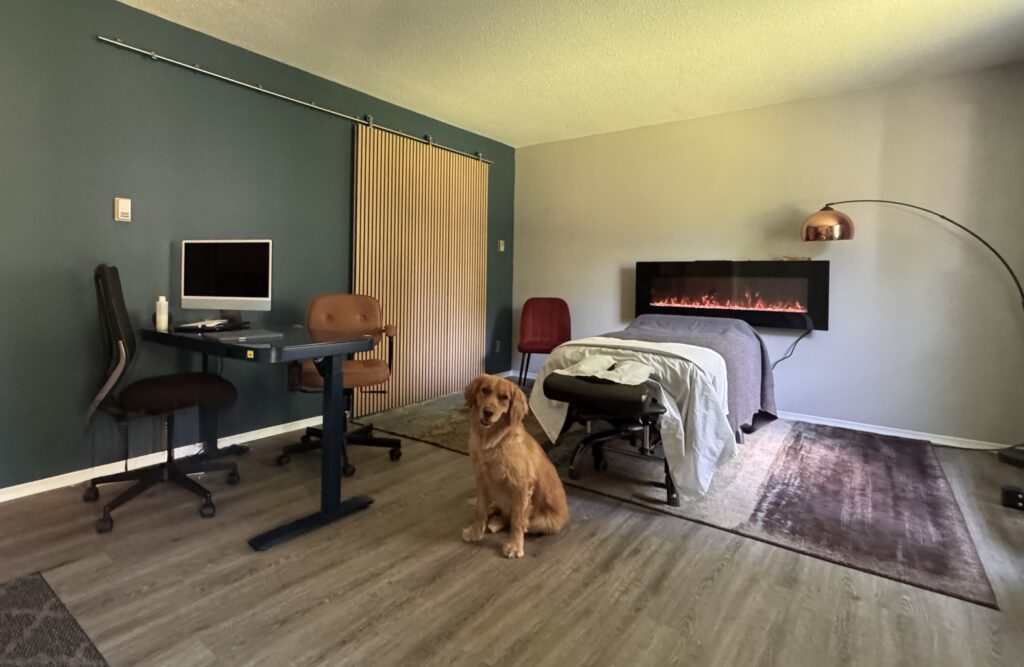
A gamer’s session with Bruno Panucci RMT starts with a short intake that works like a setup review: platform, hours, mouse or controller, which hand drives the inputs, and where the ache actually lives. Sixty minutes covers the whole pattern with honest triage, usually the mouse-side or controller forearm and thumb, the wrist flexors and extensors, the neck and the base of the skull, the upper traps, and the chest that anchors the rounded shoulders. The session costs $115 at his in-home practice in Brantford, a rate kept steady by low overhead, and he provides an official Registered Massage Therapy receipt with everything your insurer needs, which matters because many players are covered under a workplace or parental extended health plan without realizing massage is in it. Direct billing is available for most insurers. Two friendly, calm dogs share the treatment room; if you have allergies or would rather they sit this one out, ask and Bruno will keep them out for your session. Anyone under 18 needs a parent or guardian in the room for the entire session, which is worth knowing for younger competitive players.
Frequently asked questions
Can massage fix gamer wrist pain?
Massage may ease wrist and forearm pain that comes from tight, overworked muscle, and many players feel a real difference for days to weeks. It does not fix nerve problems. If your wrist symptoms include numbness, tingling, or weakness, see a physician first, then massage can support the muscular side.
How often should a serious gamer get a massage?
There is no set prescription, and Bruno does not sell packages. Players putting in heavy hours often find every four to six weeks holds the pattern down, tightening the gap around tournaments or periods of heavier play. Base the rhythm on how long relief actually lasts for you.
Do I have to stop gaming while getting massage treatment?
No. Massage works alongside your normal schedule. The research on esports players consistently recommends regular breaks and a better ergonomic setup as the prevention side, so the honest combination is hands-on treatment plus small changes to how you sit and how often you stand up.
Is massage for gaming pain covered by insurance?
Usually, yes, if you have an extended health plan. Treatment by a Registered Massage Therapist is reimbursable under most plans, including many parental plans that cover students. Bruno provides an official Registered Massage Therapy receipt after every session; check your plan for its annual limit.
Book a massage for gaming tension with Bruno in Brantford
Bruno Panucci RMT treats gaming-related wrist, forearm, neck, and back tension at his in-home practice in Brantford, serving Brant County including Paris, St. George, Mt. Pleasant, and Burford, with occasional mobile visits on request. Sessions are $115 for 60 minutes, with receipts for most extended health plans and direct billing available for most insurers.
Text Bruno at 519-753-5544 (he prefers texts), call the same number, or book online. If the calendar shows nothing that fits around your schedule, or you want a shorter session or a 90 minute one, text him. He can often rearrange to fit you in, sometimes the same day.
A note on scope: This page is general information, not medical advice. Massage may ease gaming-related muscle tension, but it does not diagnose or treat nerve conditions or injuries, and results vary. Numbness, tingling, weakness, night symptoms, or pain after an injury deserve a physician conversation first. Bruno Panucci is a Registered Massage Therapist (RMT), and works within current RMT scope of practice.
Related reading
- when wrist symptoms point to the carpal tunnel
- the sitting pattern, office edition
- treating the head-forward posture as a whole
Sources
- Schlesiger L, Oronowicz J, Lutter C, Tischer T, Seil R, Jasina A. Musculoskeletal disorders in eSports athletes: A systematic review. Journal of Experimental Orthopaedics, 2026. doi.org/10.1002/jeo2.70786
- Soffner M, Schmidt A, Tomschi F, Hilberg T. Do Esports Players Experience Pain? Pain Prevalence of Esports Players: a Systematic Review and Meta-analysis. Sports Medicine – Open, 2026. doi.org/10.1186/s40798-025-00971-1
- Alqabbani S, Alhussaini RF, Alsaedan SA, et al. A Cross-Sectional Survey on Musculoskeletal Pain Among Professional and Non-Professional Gamers in Saudi Arabia. Journal of Pain Research, 2026. doi.org/10.2147/jpr.s557124
- Anselmo-E-Silva CI, Santos-de-Araújo AD, Melger MJC, et al. Prevalence of musculoskeletal injuries and associated risk factors in Brazilian esports players: a cross-sectional study. Scientific Reports, 2026. doi.org/10.1038/s41598-026-41487-2
- College of Massage Therapists of Ontario, Standards of Practice.
- Government of Ontario. Massage Therapy Act, 1991, S.O. 1991, c. 27. ontario.ca/laws/statute/91m27