Bruno Panucci RMT
Hip Pain Massage in Brantford: Glutes, Flexors, Relief
Quick answer: Most hip pain that walks into a massage practice is muscular: sitting-shortened hip flexors, overworked or under-used glutes, and the deep rotators around the joint. Hip pain massage with Bruno Panucci RMT in Brantford treats exactly that, $115 for 60 minutes at his in-home practice, at the pressure you choose from soft through medium to deep. True joint disease is physician territory; this page is honest about the difference. General information, not medical advice.
Hip pain massage is soft-tissue treatment of the muscle system around the hip: the hip flexors at the front, the gluteal muscles behind, and the small deep rotators underneath them. Bruno Panucci RMT has worked on hips for 25 years, and at his Brantford in-home practice they arrive steadily, mostly attached to desk workers and drivers from across Brant County, Paris, St. George, Mt. Pleasant, and Burford. Most of what arrives is muscular, built by chairs rather than accidents, and that is squarely Registered Massage Therapy territory. The hip also rarely aches alone; it splits its workload with the low back, so this page pairs naturally with the connected low back work.
Bruno Panucci RMT, 25 years of practice: “The quiet villain in most of the hips I treat is a chair. Eight or nine hours of sitting shortens the front of the hip and puts the glutes to sleep, then the hip gets blamed for doing what it was trained to do all day. When someone tells me their hips are tight, I ask about their chair schedule before I ask about their hips. Most weeks, the chair answers first.”
In short: most hip pain seen in a massage practice comes from muscle rather than the joint. Hip flexors shortened by long sitting, glutes that have stopped pulling their weight, and irritable deep rotators respond to hands-on treatment. Pain from the joint itself, felt mostly in the groin, belongs with a physician first.
6 min read
Why does sitting make your hips tight and achy?
Sitting puts the hip into a flexed position and holds it there. Kept that way for eight or nine hours, the hip flexors adapt to the shortened length, while the glutes, stretched and idle at the back, gradually stop firing with any conviction. Stand up after a long block of sitting and you feel the result: a hip that is stiff at the front, vaguely achy, and slow for the first dozen steps. None of that means the joint is damaged. It is a training effect, the body adapting to the shape it is held in most. Massage may ease it; the chair schedule decides whether it stays eased. A tight the piriformis deep in the glute can refer pain down the leg, and it has a dedicated guide. The aches that follow a season of gardening have a dedicated guide. When the diagnosis is bursitis around the hip, the approach changes, as its own page explains.
Side, buttock, or groin: what does the location suggest?
Where hip pain presents is a rough guide to what is driving it, and only a rough one. Pain on the outside of the hip, tender to lie on, often involves irritated gluteal tendons and the guarding muscle around them. A deep ache in the buttock, worse after sitting, usually points at the glutes and deep rotators. Groin pain is the notable exception: a review in the Journal of Hip Preservation Surgery (Kalisvaart and Safran, 2015) notes that pain from inside the hip joint is generally felt in the groin, buttock, or thigh and usually cannot be reproduced by pressing on the area directly. A groin-centred hip that hurts to take weight belongs with your physician first. How the hockey stride and the hips wear each other down is covered on a dedicated page.
| Pattern | Massage’s honest role | Doctor first? |
|---|---|---|
| Outside of the hip, tender to lie on | Often irritated gluteal tendons with guarding muscle; massage may ease the guarding | If it is not settling, or wakes you at night |
| Deep buttock ache, worse after sitting | Glutes and deep rotators; classic massage territory | If numbness, tingling, or weakness runs down the leg |
| Front of the hip, tight after sitting | Sitting-shortened hip flexors; massage plus a change in chair habits | If it catches, clicks painfully, or gives way |
| Groin pain, worse with weight-bearing | More often the joint itself; massage is comfort around it, not a fix | Yes, physician first |
| After a fall or trauma, or night pain that will not settle | Wait until it has been assessed | Yes, physician first |
What does hip pain massage with Bruno involve?
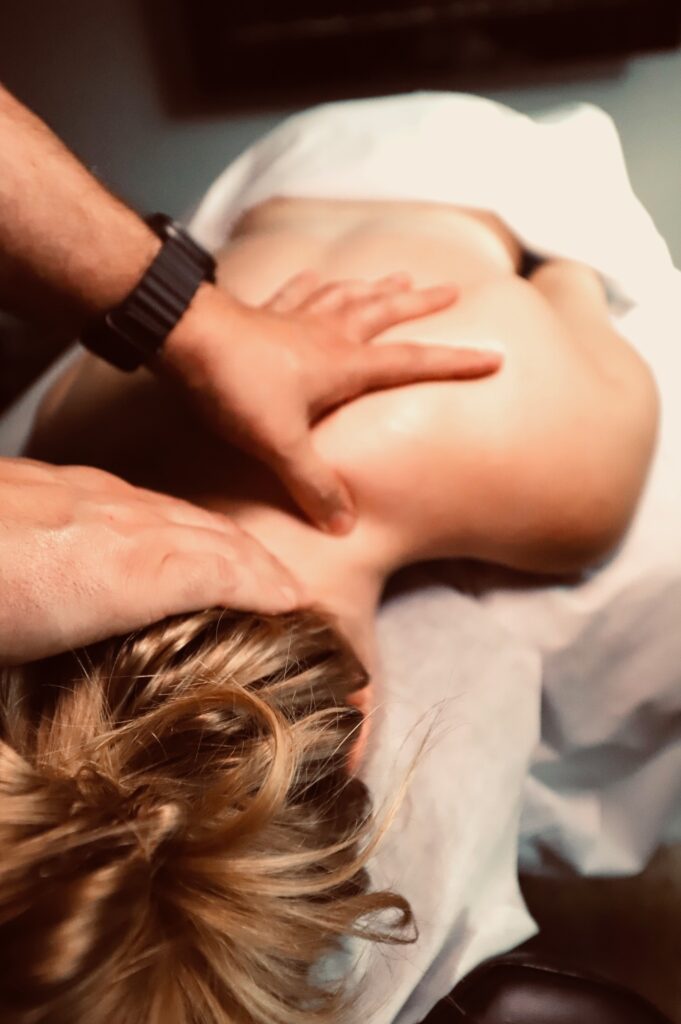
A hip session with Bruno Panucci RMT starts with pressure you control. You set the pressure, from soft through medium to deep, and you can adjust it, or stop, at any time; deep work is available on request, never the default. Because hip work involves the gluteal region, consent follows what the College of Massage Therapists of Ontario requires: the gluteal region is classed as a sensitive area, so Bruno asks for your written consent in advance, every time, before treating it. That is not awkwardness, it is professionalism. Draping keeps everything except the area being worked on covered, and the glute work can be done through the drape or your clothing if you prefer. Expect the session to move between the flexors, glutes, and deep rotators, with the low back usually joining the plan, in the private treatment room at his Brantford in-home practice.
How do the hip, low back, and leg connect?
The hip, low back, and leg work as one chain, and trouble migrates along it. Glutes that stop pulling their weight hand their share of every step to the low back, which is why long-sitting people collect hip and back complaints together. Tight hip flexors tip the pelvis forward and load the lumbar spine further. And the deep rotators sit directly beside the sciatic nerve, so an irritable buttock can send sensations down the leg that feel alarming out of proportion to their cause. Those travelling patterns get their own honest guide in when hip pain travels down the leg; in practice, Bruno often treats hip and low back in the same hour.
Can massage help hip arthritis or a hip replacement?
Massage does not treat hip osteoarthritis, and anyone who implies otherwise is overselling. Osteoarthritis is the most common form of arthritis and is understood as a disease of the whole joint (Felson, 2009, Arthritis Research and Therapy), which puts the joint itself outside what hands on muscle can change. What massage may do is ease the muscles that guard and overwork as an arthritic hip stiffens, and many people find that comfort worth having while their physician manages the joint. After a hip replacement, the timeline belongs to your surgeon: massage near the surgical area waits for their clearance, and Bruno works within that plan once the go-ahead is given.
When to see your physician before booking
Some hips need a physician before they need a Registered Massage Therapist. Book your doctor first if any of these fit:
- Groin pain that worsens when you put weight on the leg.
- Night pain that does not settle when you change position.
- Hip pain after a fall, accident, or other significant trauma.
- A hip that clicks painfully, locks, or gives way underneath you.
- Fever, unexplained weight loss, or a history of osteoporosis or cancer alongside new hip pain.
None of these rule massage out forever; diagnosis comes first, and massage may then support the muscles around whatever your physician finds.
Frequently asked questions
Can massage therapy fix hip arthritis?
No, and an honest therapist will say so plainly. Osteoarthritis is a disease of the joint itself, and massage does not change the joint. What massage may do is ease the muscles that guard and overwork around an arthritic hip, which can make day-to-day movement feel easier. Comfort work, honestly framed.
Why are my hips so tight after sitting all day?
A seated hip is a flexed hip. Held there for hours, the hip flexors adapt to the shortened position while the glutes spend the day stretched and idle, so standing up feels stiff and achy. It usually reads as tightness rather than injury, and it tends to respond to hands-on work paired with simply sitting less.
How does consent work for glute massage?
Under College of Massage Therapists of Ontario standards, the gluteal region is a sensitive area, so Bruno asks for your written consent in advance, every time, before treating it. Draping keeps everything but the area being worked on covered, and the work can be done through the drape or your clothing if you prefer. You can change your mind at any point in the session.
How many sessions does muscular hip pain take?
It varies, and Bruno Panucci RMT will tell you honestly rather than sell a package. Sitting-pattern hips often feel meaningfully better within one to three sessions, provided the chair schedule changes a little too. Long-standing patterns usually do better with a short series spaced over a few weeks.
Book hip pain massage with Bruno in Brantford
Bruno Panucci RMT treats hip, glute, and hip-flexor pain at his in-home practice in Brantford, serving Brant County including Paris, St. George, Mt. Pleasant, and Burford, with occasional mobile visits on request. Sessions are $115 for 60 minutes, with receipts for most extended health plans and direct billing available for most insurers.
Text Bruno at 519-753-5544 (he prefers texts), call the same number, or book online. If the calendar shows nothing that works, or you want a 90 minute or two hour session for hips and low back together, text him directly. He can often rearrange to fit you in, sometimes the same day.
A note on scope: This page is general information, not medical advice. Massage may ease muscular hip pain, but it does not diagnose hip conditions or treat joint disease, and results vary. For groin pain with weight-bearing, night pain, trauma, or a hip that gives way, see your physician first. Bruno Panucci is a Registered Massage Therapist and works within current RMT scope of practice.
Related reading
- the knee below a cranky hip
- firm, focused glute and flexor work
- planning a sensible series
- session pricing
Sources
- Kalisvaart MM, Safran MR. Microinstability of the hip, it does exist: etiology, diagnosis and treatment. Journal of Hip Preservation Surgery, 2015. doi.org/10.1093/jhps/hnv017
- Felson DT. Developments in the clinical understanding of osteoarthritis. Arthritis Research and Therapy, 2009; 11(1): 203. doi.org/10.1186/ar2531
- Government of Ontario. Massage Therapy Act, 1991, S.O. 1991, c. 27. ontario.ca/laws/statute/91m27
- College of Massage Therapists of Ontario, Standards of Practice.